
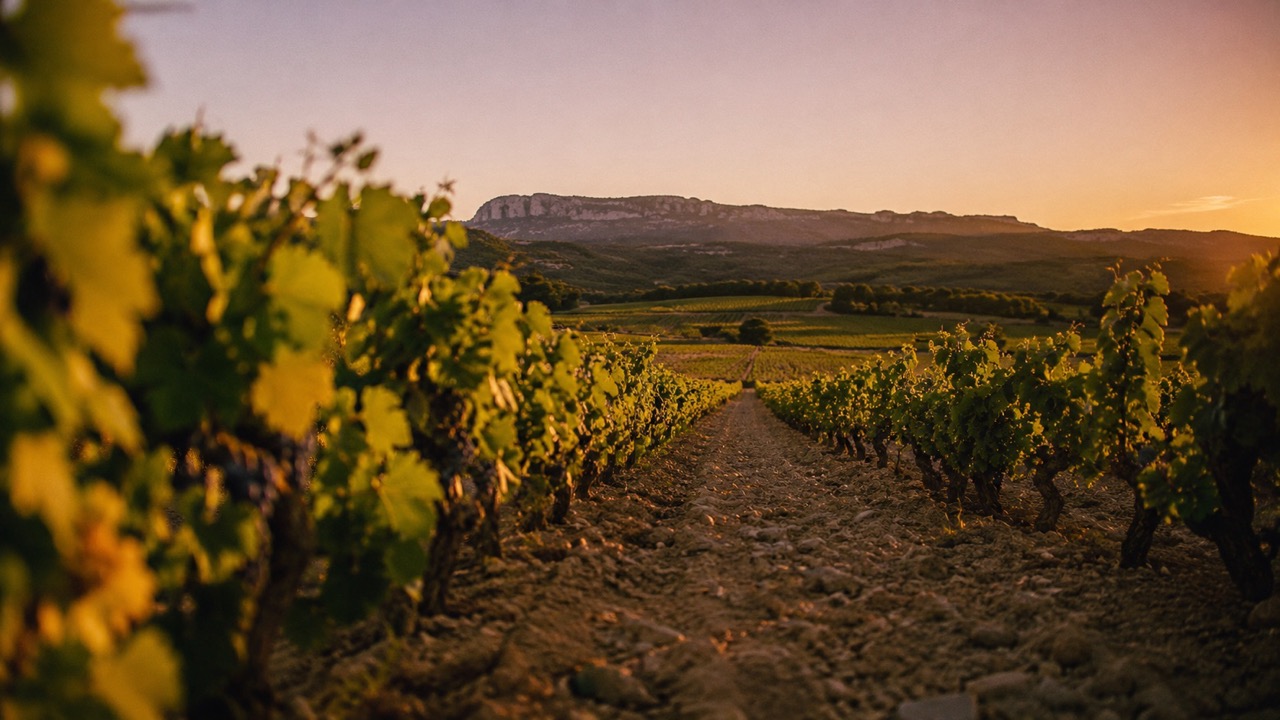
Spain’s vinous geography is absurdly generous — a peninsula of such climatic and geological diversity that it produces, within a single national border, wines of a stylistic range unmatched anywhere on earth. From the fog-shrouded Albariños of Galicia to the sun-baked Monastrells of Jumilla, from the chalk-pale Finos of Jerez to the schist-driven Garnachas of Priorat, this is a country whose wines reward not the casual drinker but the committed explorer — the connoisseur willing to follow a thread from one denomination to another, discovering at each stop something genuinely unlike what came before.
Ribera del Duero: The Aristocratic Expression
Vega Sicilia Único remains, after a century and a half, Spain’s most aristocratic wine — aged for a minimum of ten years before release, produced in quantities that ensure perpetual scarcity, and possessed of a gravitas that places it in conversation with the very greatest wines of Bordeaux and Burgundy. But Ribera del Duero’s genius extends far beyond its most famous estate. Pingus — Peter Sisseck’s micro-production from old-vine Tempranillo — demonstrated that the region could produce wines of cult intensity and modern ambition alongside its traditional aristocracy.
Dominio de Atauta, sourcing from pre-phylloxera vines at over 1,000 metres elevation, produces wines of a purity and mineral tension that challenge the region’s reputation for power alone. Aalto, Hacienda Monasterio, and Pesquera continue to demonstrate that Ribera del Duero’s continental extremes — baking summers, freezing winters, massive diurnal temperature variation — produce Tempranillo of a structure and longevity that few other regions can match.
Priorat: The Mineral Renaissance
Priorat’s story is the most dramatic in modern Spanish wine: an ancient region, abandoned to near-extinction, resurrected in the 1980s by a handful of visionaries who recognised that its licorella soils — fractured slate through which vines must drive roots metres deep to find moisture — could produce wines of extraordinary mineral intensity. Álvaro Palacios’s L’Ermita, from Garnacha vines planted on terraces so steep they must be worked by hand, achieves prices that rival Burgundy Grand Cru — and justifies them with wines of translucent power that taste, quite literally, of stone.
Below the cult level, Priorat offers remarkable value for wines of genuine personality. Clos Mogador, Clos Erasmus, Mas Doix — these are productions of serious ambition whose prices, while not modest, remain a fraction of equivalent quality from Burgundy or Barolo. The new generation — producers like Terroir al Límit, Scala Dei’s recent releases, and the growing number of estates working with old-vine Garnacha and Cariñena at elevation — suggests that Priorat’s renaissance is deepening rather than plateauing.
Sherry: The World’s Most Undervalued Great Wine
That the world’s most intellectually complex wines sell for a fraction of the price of far simpler beverages represents either a market failure or an extraordinary opportunity for the connoisseur — likely both. A Fino of fifteen years’ biological ageing, its flor yeast having imparted a complexity of saline, almond, and chamomile notes that no other winemaking process can replicate, sells for what a competent village Burgundy costs. An Amontillado, having transitioned from biological to oxidative ageing over decades, achieving a depth of flavour that encompasses both the freshness of Fino and the concentration of Oloroso, remains absurdly affordable by the standards of the world’s other great aged wines.
Palo Cortado — the category’s greatest mystery, a wine that begins as Fino but spontaneously abandons its flor, developing along an oxidative path with the structure of Amontillado and the richness of Oloroso — is perhaps the most fascinating wine style on earth. Producers like Equipo Navazos, Fernando de Castilla, and Bodegas Tradición release Palo Cortados of forty and fifty years’ average age at prices that would be unthinkable in any other region for wine of such antiquity and complexity.
Galicia: The Atlantic Edge
Spain’s northwest — cool, wet, Atlantic in every dimension — produces white wines that have nothing in common with the country’s Mediterranean identity. Rías Baixas Albariño is well known, though too often in its simplest expression. The serious producers — Zárate, Do Ferreiro, Forjas del Salnés — make wines of genuine complexity and age-worthiness from old vines on granite soils, wines that share more with fine Muscadet or Chablis than with anything produced south of the Duero.
But Galicia’s real excitement lies inland, in Ribeira Sacra’s vertiginous terraces above the Sil and Miño rivers, where Mencía planted on slate at extreme gradients produces reds of ethereal elegance — perfumed, fine-grained, lifted by acidity and mineral tension. Envínate’s work in the region, alongside estates like Guímaro and Dominio do Bibei, suggests that Ribeira Sacra may be Spain’s next region to achieve international critical recognition at the highest level.
The Connoisseur’s Privilege
What Spain offers the serious wine drinker is something increasingly rare in the modern market: genuine discovery at accessible prices. While Burgundy has become the province of speculation and Bordeaux the currency of investment portfolios, Spain’s greatest wines remain — with the exception of Vega Sicilia and Pingus — priced for drinking rather than trading. A bottle of twenty-year-old Palo Cortado, a mature Priorat from a serious estate, an old-vine Galician Mencía — these represent some of the finest wine experiences available anywhere, produced by people who have chosen to make wine in places where the market has not yet arrived to distort their ambitions.
This will not last indefinitely. The market discovers everything eventually. But for now, Spain remains the thinking drinker’s paradise — a country whose vinous depth rewards the explorer willing to venture beyond familiar names into denominations where the ratio of quality to price remains, by global standards, magnificently generous.