
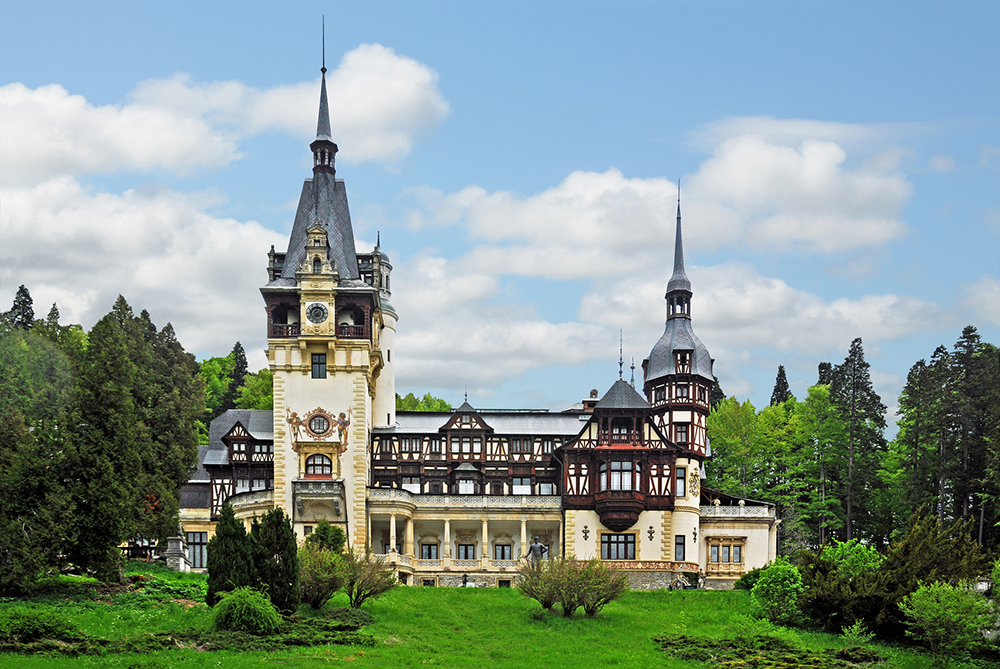
Romania arrives in the European imagination trailing a mythology not of its own making. The name conjures Dracula and Ceaușescu, communist concrete and Carpathian fog — an eastern edge, half-forgotten, filed away under “surprising” in the mental geography of the well-travelled. This mythology is not merely incomplete. It is, in almost every particular, a distortion of a country that is among the most culturally layered, scenically astonishing, and hospitably generous on the continent. Those who have spent serious time in Romania speak of it the way initiates speak of a secret: with the particular warmth of people who have been changed by what they found.
The Painted Monasteries of Bucovina
Begin in the northeast, in the region of Bucovina, where one of the most extraordinary concentrations of medieval art in Europe is arrayed across a landscape of rolling hills and forest. The painted monasteries — Voroneț, Sucevița, Moldovița, Humor — were built and decorated in the fifteenth and sixteenth centuries under the patronage of Moldavian princes, their exterior walls covered floor to eave in frescoes of such richness and preservation that they appear, in the right light, to have been completed yesterday. Voroneț, known as the “Sistine Chapel of the East,” is most famous for its southern wall: the Last Judgment rendered in a blue so vivid and so chemically mysterious — “Voroneț blue,” a pigment whose precise composition remains debated — that standing before it in morning light is a genuinely vertiginous experience.
These are not museum pieces. They are working monasteries, inhabited by communities of monks and nuns for whom the frescoes are devotional objects rather than tourist attractions. The coexistence of living faith and extraordinary art, set against the silence of the Bucovina countryside, produces an atmosphere unlike anywhere else in Europe.
Transylvania: Myth and Medieval Reality
Transylvania’s association with vampiric fiction has done it a curious disservice, drawing visitors who come looking for Gothic kitsch and finding instead one of the most genuinely beautiful and historically complex regions on the continent. The Saxon villages of the Transylvanian plateau — Viscri, Biertan, Sighișoara, Saschiz — are UNESCO-listed for good reason: they preserve a medieval built environment of astonishing completeness, their fortified churches and half-timbered farmhouses largely unchanged since the communities of German settlers who built them departed in the twentieth century.
Sighișoara is arguably the finest inhabited medieval citadel in Europe, its coloured clock tower and cobbled streets functioning not as a theme park but as a living town of some thirty thousand people, with cafés and schools and daily life proceeding beneath walls that have stood since the thirteenth century. Prince Charles — now King Charles III — has been a committed patron of Transylvania’s rural heritage for decades, investing in the restoration of several Saxon houses and making the region’s extraordinary character known to an international audience that might otherwise have missed it entirely.
Bucharest: Belle Époque and Contemporary Energy
Bucharest is the most misunderstood capital in Europe, dismissed too readily by visitors who judge it by the bombastic excesses of Ceaușescu’s Palace of the Parliament — the world’s second-largest administrative building, an exercise in megalomaniacal kitsch that is, admittedly, staggering in its way — and fail to penetrate the neighbourhoods that surround it. The districts of Floreasca, Dorobanți, and Herăstrău preserve a wealth of Belle Époque architecture — Art Nouveau villas, tree-lined boulevards, elegant cafés — that earned the city its nineteenth-century sobriquet “the Paris of the East,” a description that carries more truth than mockery.
Contemporary Bucharest is a city of genuine cultural vitality: a restaurant scene of serious ambition, a gallery and arts culture that has flourished since 1989 with the energy of long-suppressed creativity, a nightlife that routinely features in the same conversations as Berlin and Amsterdam. The Floreasca neighbourhood at dinner on a Friday evening — the restaurants full, the pavements animated, the conversation loud and multilingual — does not feel like a city on Europe’s periphery. It feels like a city in full flower.
The Danube Delta: Europe’s Great Wilderness
At Romania’s eastern extreme, where the Danube meets the Black Sea, lies one of the continent’s most extraordinary natural environments: the Danube Delta, a UNESCO World Heritage biosphere reserve of some five thousand square kilometres of channels, lakes, reed beds, and wetland forest. More than three hundred and forty species of bird have been recorded here, including white pelicans in colonies of several thousand, pygmy cormorants, and the glossy ibis. The delta is navigated by small wooden boats through channels so narrow the reeds brush both sides simultaneously, the water so still it holds a perfect inverted image of the sky above.
This is wilderness in the most honest sense of the word — not managed, not curated, not domesticated for the convenience of visitors. It requires patience and a tolerance for the particular pleasure of being in a place that is not arranged for you.
Wine, Table, and the Generosity of Welcome
Romania has been making wine since antiquity — its vineyards predate those of France — and its wine culture is now, after decades of post-communist recovery, producing bottles of genuine distinction. The Dealu Mare region produces structured Fetească Neagră and Cabernet Sauvignon; the Carpathian slopes yield aromatic whites of great delicacy. Romanian hospitality — the immediate warmth, the insistence on feeding guests beyond any reasonable expectation, the genuine pleasure taken in the company of strangers — is not a performance. It is a cultural reflex of considerable depth.
Romania does not reveal itself quickly. It rewards patience, curiosity, and the willingness to look past a received mythology that has always said more about the laziness of European assumptions than about the country itself. Those who look find something rare: a nation of genuine complexity, extraordinary beauty, and a warmth toward visitors that has not yet been worn smooth by the passage of too many of them. That, in itself, is a gift worth travelling for.