
Portugal has been practising the art of being itself for so long that it has, in a sense, perfected it. A nation at the far western edge of the European continent — the Atlantic at its back, a history of oceanic exploration stretching from the coast of Brazil to the spice routes of the East — Portugal carries within it a particular quality of wistful grandeur. The Portuguese call it saudade: that characteristically untranslatable word for a longing that is also a form of love, a nostalgia for something that may not have existed but was felt nonetheless. It permeates the country’s music, its architecture, its cuisine, and the quality of its silences.
Lisbon: The City of Seven Hills
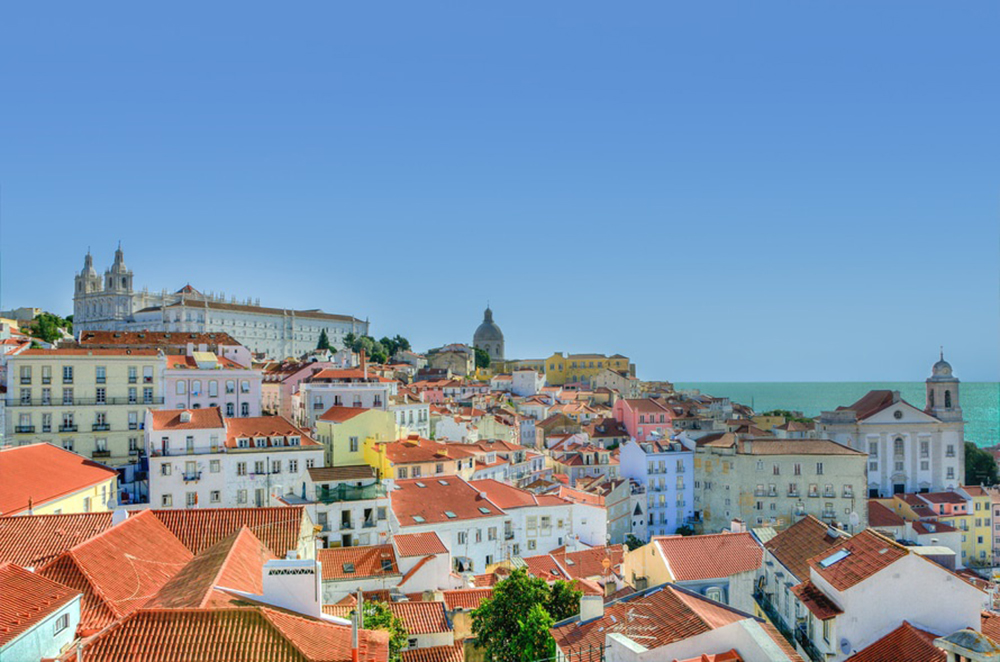
Lisbon underwent something close to a global discovery in the early years of this century and has not entirely recovered its composure since. The miradouros — the hilltop viewpoints from which the city’s extraordinary topography can be appreciated in its full ochre-and-white complexity — are now frequented by visitors from every continent who have come to verify what they were promised in the travel supplements. And yet Lisbon is large enough and layered enough to absorb this attention without losing its essential character.
The Alfama, the ancient Moorish quarter that survived the great earthquake of 1755, cascades down toward the Tagus in a labyrinth of cobbled lanes and whitewashed walls tiled in azulejo blues and greens. In the morning, before the day has fully assembled itself, the neighbourhood retains a quality of private life — laundry strung between windows, a cat of spectacular indifference seated on a doorstep, the sound of fado drifting from a radio somewhere above — that no amount of tourism has been able to entirely displace.
The Belém quarter, downstream, offers a different register: the Imperial grandeur of the Jerónimos Monastery, built with the profits of the spice trade in the exuberant Manueline style that is Portugal’s most distinctive architectural contribution to world culture, and — equally essential — the Pastéis de Belém bakery, which has been producing the same recipe of custard tarts since 1837 and which, on any given morning, fills the surrounding streets with a perfume of caramelised custard and cinnamon that constitutes a sensory argument for the absolute validity of Portugal’s contribution to civilisation.
Porto and the Douro
Porto, Portugal’s second city and arguably its most characterful, wears its grandiosity more lightly than Lisbon. The city’s famous wine cellars — lodges, properly — line the south bank of the Douro at Vila Nova de Gaia, their names painted in letters stories tall on the sloping rooftops, and the wines within them — tawnies of forty and fifty years’ age, vintage ports of legendary complexity — represent one of the world’s great and most enduring vinous traditions.
But Porto rewards the attentive visitor beyond its wine culture. The São Bento railway station, whose vast interior is entirely covered in blue-and-white azulejo tiles depicting scenes from Portuguese history, is one of the most beautiful public spaces in Europe. The Livraria Lello, a bookshop of extraordinary Neo-Gothic interior splendour, was briefly in some contention as the inspiration for J.K. Rowling’s descriptions of Flourish and Blotts, and while the scholarly evidence is contested, one visit confirms that the connection is at least aesthetically plausible.
The Alentejo: Portugal’s Hidden Interior
The vast, sun-bleached interior plateau of the Alentejo — cork oaks, golden wheat, whitewashed villages of exemplary quiet beauty — represents the Portugal that has not been discovered by the international imagination and is accordingly treasured by those who know it. The regional capital, Évora, is a UNESCO World Heritage Site of extraordinary completeness: Roman temple, medieval walls, a cathedral of Norman severity, and a chapel lined from floor to ceiling with human bones assembled by Franciscan monks with a philosophical disposition toward mortality. The Alentejo wine region, producing deep, aromatic reds from indigenous grapes, is increasingly celebrated; its restaurants, anchored in a cuisine of extraordinary simplicity and flavour — black pork, sheep’s cheese, honey from wild thyme — are among the most satisfying in the country.
The Algarve Beyond the Familiar
The Algarve’s famous limestone cliff formations and turquoise waters have made it one of the most recognisable coastal landscapes in Europe. What visitors who confine themselves to the international resort strip tend to miss is the coast to the east of Faro — the Sotavento — where the landscape softens into long barrier islands, shallow lagoons of the Ria Formosa, and fishing villages of striking, unhurried beauty. Here, Portugal’s maritime character — patient, salt-cured, deeply attentive to the sea — remains legible in a way that the resort towns further west have gradually obscured.
Portugal, ultimately, is a country that rewards the traveller who comes prepared to feel as well as to see: to feel the Atlantic wind off the cape at Sagres, where Henry the Navigator assembled his cartographers and his captains at the edge of the known world, and understand that this small nation once stood at the frontier of human possibility, and looked out at the ocean, and sailed.