
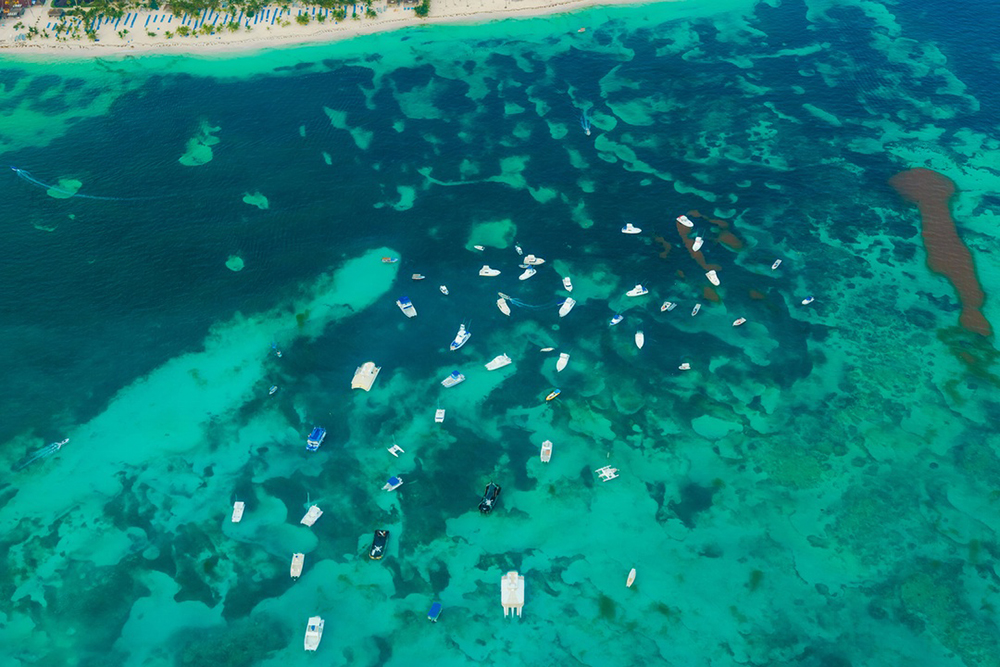
The Dominican Republic is a country that resists reduction. It occupies the eastern two-thirds of Hispaniola, the island where Columbus first stepped ashore in 1492 and declared the New World discovered — an announcement the Taíno people who had lived there for centuries might have found somewhat premature. Five centuries of consequential history have followed, layering this land with African, Spanish, and indigenous inheritances that manifest in its music, its cuisine, its extraordinary cultural vitality, and in the sheer physical drama of a landscape that contains, within a single nation, the highest peak in the Caribbean and the lowest point, beaches of uncanny beauty, and rainforest of genuine wildness.
The Landscape as Argument
To understand the Dominican Republic, one must first understand its topography, which is nothing less than extravagant. Pico Duarte rises to 3,098 metres above sea level, high enough that frost forms on its summit in winter, and the hiking trails that approach it pass through cloud forest ecosystems found nowhere else in the Caribbean. Lake Enriquillo, in the southwest, sits 44 metres below sea level — a hypersaline lake where American crocodiles bask on the banks and pink flamingos stand in the shallows in improbable abundance. The Samaná Peninsula in the northeast, where humpback whales arrive each January to calve in the warm, sheltered bay, is one of the finest whale-watching destinations in the world.
This is a country where the word “nature” encompasses an almost embarrassing range of phenomena, and where the traveller who confines their experience to a beach — however magnificent the beach — is missing the greater part of the story.
Casa de Campo: Where Luxury Takes Root
The name Casa de Campo, which translates simply as “country house,” understates with considerable elegance what is in fact one of the most accomplished resort developments in the Caribbean. Situated near the historic town of La Romana on the island’s southeastern coast, the 7,000-acre property contains two marinas, three Teeth of the Dog golf courses — one of which has long been ranked among the finest in the world — a shooting centre, a polo ground, and the extraordinary artist’s village of Altos de Chavón, a 16th-century Mediterranean-style village built by Dominican craftspeople in the 1970s and set on a bluff above the Chavón River. The village is not a theme park but a working community of artisans, galleries, and cultural institutions, anchored by an amphitheatre where Frank Sinatra sang at the opening ceremony and where the acoustics remain, some five decades later, remarkably fine.
The Samaná Experience
Those seeking a more elemental encounter with the Dominican Republic’s natural heritage will find Samaná to be the country’s best-kept confidence. The peninsula is lush in a way that the resort coast is not — genuinely tropical, its interior a tangle of palm forest and cocoa plantation, its coast indented with beaches that require effort to reach and therefore remain largely untouched. Los Haitises National Park, accessible only by boat, presents a landscape of limestone mogotes rising from the mangroves, their surfaces covered in petroglyphs left by the Taíno, their interiors home to cave systems where stalactites hang above the tidal water in formations of surprising delicacy.
From January to March, the whale season transforms Samaná Bay into something extraordinary. Humpbacks arrive in their hundreds, the males singing their long, complex songs in the warm shallow water, the females nursing their calves in the bay’s protection. Responsible whale-watching operators — and Samaná has been serious about this for decades — offer encounters of astonishing intimacy, small boats drifting at respectful distance while the animals perform their ancient rituals apparently indifferent to observation.
Merengue, Mamajuana, and the Table
The cultural life of the Dominican Republic deserves its own pilgrimage. Merengue — the country’s national music, a propulsive two-beat rhythm driven by accordion, tambora drum, and güira scraper — is not merely entertainment but social fabric, the music that animates celebrations, expresses grief, narrates history. In Santo Domingo’s colonial city, a UNESCO World Heritage Site and the oldest continuously inhabited European settlement in the Americas, the evening air is rarely free of it.
The capital’s culinary scene, long underestimated, has emerged with genuine confidence. Traditional sancocho — a rich stew of seven meats and root vegetables that is the country’s unofficial national dish — shares menus with contemporary interpretations of Dominican flavour that reflect a new generation of chefs who have cooked abroad and come home with wider ambitions. Mamajuana, the local spirit made from rum, wine, and honey infused with bark and herbs in a bottle that is refilled continuously for years, should be approached with respect and ideally with a local guide to its consumption.
The Other Shore
What the Dominican Republic offers the genuinely curious traveller is the rare experience of a Caribbean nation that has not been flattened by tourism into a single, generic version of itself. The country is too large, too various, too self-possessed for that. It has beaches of world-class beauty and rainforest of world-class wildness, a colonial capital of genuine historical weight, and a cultural energy that is entirely its own. Come for the resort; stay for the country. The Dominican Republic, encountered on its own terms, is one of the Caribbean’s most compelling arguments for going deeper.