
There are ingredients that can be shipped anywhere — and then there are ingredients that insist upon pilgrimage. The white truffle does not travel well in any meaningful sense: it arrives diminished, a memory of itself, its volatile aromatics dissipating with every hour away from the Piedmontese earth that produced it. To truly know these things — the world’s rarest and most geographically obstinate ingredients — one must go to them. The journey is not incidental to the experience. It is constitutive of it.
White Alba Truffle — Piedmont, October
The Tuber magnatum pico reveals itself only in autumn, only in the Langhe hills, only to trained dogs whose noses can detect it beneath thirty centimetres of earth. The truffle market in Alba — held every weekend from October through December — is theatre as much as commerce: weathered trifolai unwrapping their finds from damp cloths, buyers leaning close to inhale, the silent negotiation of price conducted by weight and aroma alone. To shave fresh white truffle over tajarin in a trattoria that evening, the perfume rising in waves from the warm egg pasta, is to understand why no preserved version, no truffle oil, no imported specimen can substitute for presence.
Saffron — Qaen, Iran, November
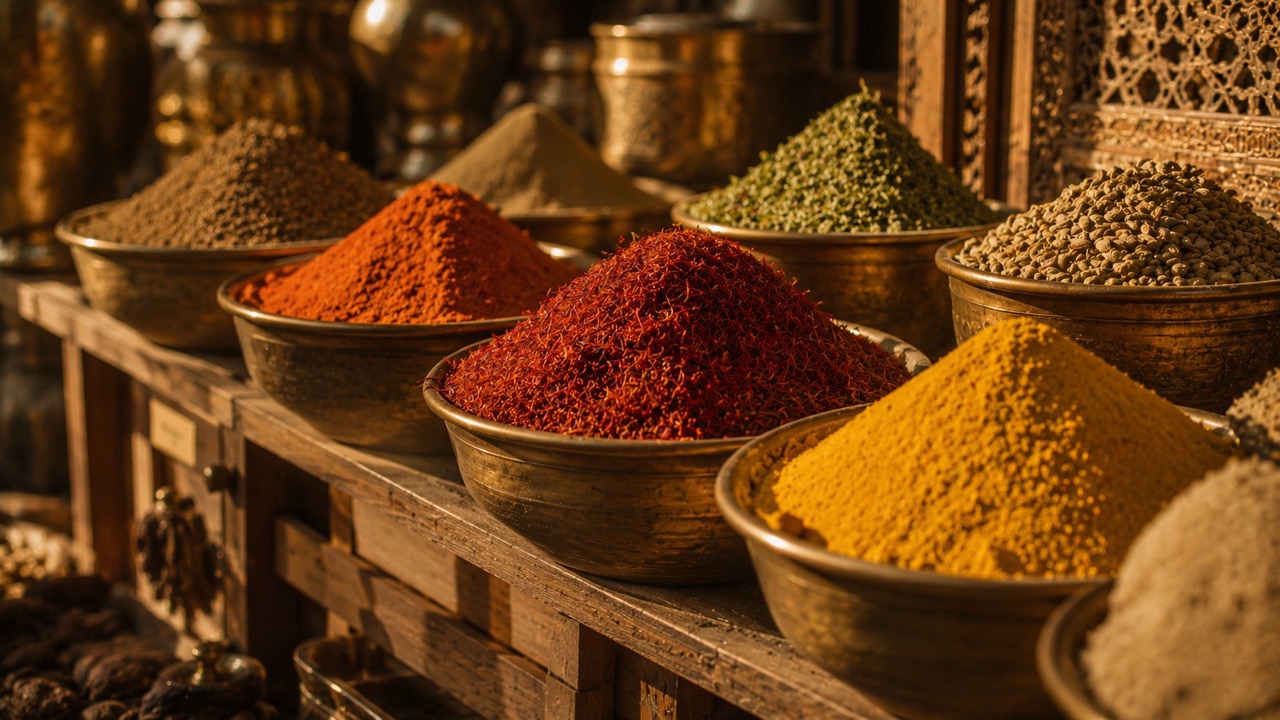
The world’s finest saffron comes not from Spain but from the high desert plateaux of South Khorasan province, where the crocus sativus blooms for precisely two weeks in November. The harvest is brutal: flowers picked before dawn, the three crimson stigmas separated by hand, dried over low heat in a process that transforms eighty thousand flowers into a single kilogram of spice. In Qaen, the saffron is graded by colour depth — measured in crocin content — and the finest grades achieve an intensity that Spanish or Kashmiri saffron cannot approach. The flavour is not merely stronger but different: more honeyed, more complex, with a metallic edge that speaks of mineral-rich soil.
Mānuka Honey — Waikato and Bay of Plenty, New Zealand
The Leptospermum scoparium flowers for just two to six weeks each summer, in valleys so remote that hives must sometimes be placed by helicopter. The honey produced during this narrow window contains methylglyoxal at concentrations found in no other food — the compound responsible for its extraordinary antimicrobial properties and its dark, resinous, almost medicinal flavour. The genuine article, verified by UMF grading, tastes nothing like the pale industrial product sold under the same name worldwide. It is dense, complex, faintly bitter — a substance that announces its origins with every spoonful.
Yuzu — Kōchi Prefecture, Japan, Winter
The yuzu of Kōchi ripens through November and December in groves clinging to the mountain slopes above the Shimanto River. Unlike the cultivated fruit exported in small quantities, Kōchi’s traditional yuzu grows semi-wild, unhybridised, producing a fragrance of staggering complexity — simultaneously floral and sharp, citric and herbaceous, with an aromatic depth that bottled juice cannot preserve. In Kōchi, yuzu appears in everything during winter: baths, ponzu, marmalades, the local sake. To smell a freshly cut Kōchi yuzu is to understand that what arrives in foreign markets is merely a sketch of the original.
Vanilla — Papantla, Mexico
Before Madagascar, before Tahiti, before the global vanilla industry existed, there was Papantla — the Totonac homeland in Veracruz where vanilla planifolia was first cultivated. The Mexican vanilla bean, hand-pollinated and sun-cured over months in the traditional method, produces a flavour profile distinct from its Malagasy descendants: smokier, more complex, with notes of dried fruit and tobacco that mass-produced vanilla cannot replicate. The Totonac curing process — alternating sun and shade over three to four months — develops flavour compounds that accelerated industrial methods simply cannot produce.
Kampot Pepper — Cambodia
The pepper gardens of Kampot province — devastated during the Khmer Rouge era, painstakingly revived since — produce a pepper whose flavour bears no resemblance to the generic black dust that fills most grinders. Grown on the slopes of the Elephant Mountains, in laterite soils unique to this coastal region, Kampot pepper delivers a heat that is complex rather than merely aggressive: floral, with notes of eucalyptus and ripe fruit, a long finish that unfolds rather than attacks. The red peppercorns — fully ripened on the vine — achieve a sweetness that verges on confectionery.
The Logic of Pilgrimage
What connects these ingredients is not rarity alone but inseparability from place. Each exists in its fullest expression only where it grows, only when it ripens, only in the hands of those who have spent generations understanding its particular demands. They cannot be meaningfully abstracted from their geography without losing the very qualities that make them extraordinary. To seek them out — to travel to Piedmont in October, to Kōchi in December, to Kampot in the dry season — is not indulgence but respect: an acknowledgement that the finest things in the world will not come to you. You must go to them.