
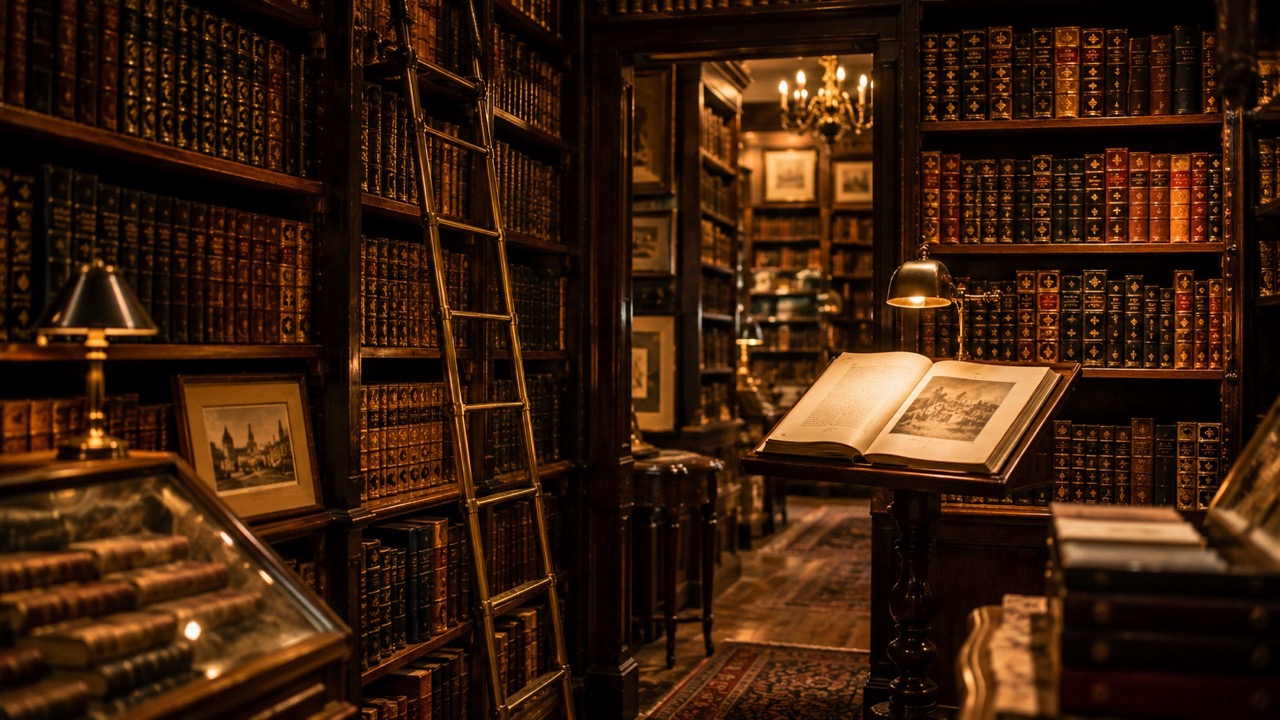
The bookshop is not dead. It has merely retreated from the high street into more defensible positions — arcaded passages, medieval cellars, rooms above canals — where the serious reader finds it with the same instinct that draws a pilgrim to a shrine. The great bookshops of the world form an invisible network, connected not by commerce but by conviction: that the physical book remains an irreplaceable technology, that browsing cannot be algorithmicised, and that certain knowledge lives only in places where printed matter has accumulated over decades in the care of people who understand what they hold.
Maggs Bros — London
In a Georgian townhouse in Bedford Square, Maggs Bros has been dealing in rare books and manuscripts since 1853. The atmosphere is that of a private library whose owner happens to be willing to sell: hushed, carpeted, the shelves arranged not by algorithm but by the accumulated intelligence of six generations of booksellers. Here one finds illuminated manuscripts, first editions of genuine rarity, letters in the hands of the famous dead. The prices are commensurate. The expertise is unmatched. One does not browse Maggs casually — one makes an appointment, states an interest, and submits to the guidance of specialists whose knowledge is measured in decades.
The Strand — New York
Eighteen miles of books — the Strand’s famous claim — stacked in a red-fronted building on the corner of Broadway and 12th Street. Unlike the antiquarian dealers, the Strand is democratic: review copies sit alongside rare editions, philosophy beside photography, the latest novels above the dollar carts on the sidewalk. The rare-book room on the upper floor holds genuinely significant material, but the Strand’s real gift is the unplanned discovery — the book you did not know you needed, found while looking for something else entirely, priced at a figure that makes acquisition painless.
Shakespeare and Company — Paris
The shop on the rue de la Bûcherie is not Sylvia Beach’s original — that was on the rue de l’Odéon and has been closed since 1941. But George Whitman’s recreation, opened in 1951 and now run by his daughter, has become its own institution: a living literary community housed in rooms above the Seine, facing Notre-Dame. The upstairs reading room — where aspiring writers have slept among the shelves since the shop’s founding — represents something rare: a bookshop that is also a residency, a library, a gathering point for literary life conducted without commercial motive.
The Bouquinistes of the Seine
The green wooden boxes along the Left Bank quays constitute the world’s oldest open-air bookshop — a continuous institution since the sixteenth century, protected by UNESCO heritage status. The quality is variable; much of what the bouquinistes display is tourist ephemera. But the serious browser, willing to work through the boxes systematically, still finds things: nineteenth-century engravings, forgotten editions of significant texts, maps and prints that have lain unsold for decades in their riverside cabinets. The institution persists not despite its inefficiency but because of it — a monument to the principle that the best finds require patience.
Jimbocho — Tokyo
An entire district dedicated to the book: Jimbocho in Kanda contains over 170 bookshops, each specialising with a precision that approaches the surgical. One shop sells only ukiyo-e prints. Another deals exclusively in mountaineering literature. A third holds nothing but cinema ephemera from the silent era. The effect is of a vast, distributed library organised by obsession rather than Dewey — and the serious collector can spend days moving between shops whose specialisms align with their own interests, each proprietor a scholar of their particular field.
Jimbocho’s survival — in a city that reinvents itself every decade — testifies to the persistence of book culture in Japan. The shops are not nostalgic; they are functional, serving a reading public whose appetite for physical books has not diminished as it has elsewhere. To visit Jimbocho is to experience a culture in which the bookshop remains central rather than marginal — a living institution rather than a heritage one.
Libreria Acqua Alta — Venice
In a small campo behind the Basilica of San Giovanni e Paolo, books are stacked in gondolas, bathtubs, and waterproof bins — practical measures against the acqua alta that periodically floods the ground floor. The effect is surreal: a bookshop as installation, the ordinary function of storage transformed by necessity into something visually extraordinary. But beneath the spectacle lies a serious stock — particularly of Venetian history, Italian art, and rare maps of the lagoon. The cats sleeping on the piles complete an atmosphere that no interior designer could create deliberately.
The Network Persists
These places form a constellation — connected by the shared conviction that printed matter, accumulated in physical space and curated by human intelligence, produces a kind of knowledge that no digital system can replicate. The algorithms predict what you already want. The great bookshop shows you what you did not know existed. It produces not satisfaction but surprise — the encounter with a book you had never heard of, in a field you had never considered, that changes the direction of your reading for years.
The bibliophile’s map is not commercial. It is devotional — a network of sites where the printed word is preserved, celebrated, and made available to those willing to seek it out. These shops will not come to you. They will not advertise. They will not optimise their inventory for discoverability. They will simply persist, as they have persisted for centuries, waiting for the reader who knows what to look for — or, better still, for the reader who does not yet know, and is ready to be shown.