
Cubism arrived like a detonation. Between 1907 and 1914, Picasso and Braque dismantled the conventions that had governed Western painting since the Renaissance — single viewpoint, coherent space, the illusion of depth — and replaced them with something that initially bewildered and ultimately liberated: the simultaneous representation of an object from multiple angles, the flattening of pictorial space into a field of intersecting planes, the elevation of the painted surface itself into the primary subject of the work. A century later, the reverberations of that detonation continue, and among the most interesting seismographic readings are being produced by a generation of contemporary artists who have returned to Cubism not as historical homage but as living methodology — a set of tools for seeing that the intervening decades of abstraction, minimalism, and conceptualism have not exhausted.
David Hockney: The Cubist Eye in the Digital Age
Hockney’s engagement with Cubism is perhaps the most sustained and productive in contemporary art. His “joiners” of the early 1980s — composite photographs assembled from dozens of individually captured images — were explicitly Cubist in their ambition: they sought to represent time and movement within a single visual field, to show not what the eye sees in a glance but what the body experiences as it moves through space. His subsequent explorations — the multi-canvas paintings of the Yorkshire Wolds, the iPad drawings that layer season upon season in a single landscape, the immersive video installations that present multiple viewpoints simultaneously on multiple screens — have all extended the Cubist project into media that Picasso could not have imagined but whose logic he would have recognised instantly.
Julie Mehretu: Cubism as Cartography
The Ethiopian-American painter Julie Mehretu works at a scale that is itself a statement: canvases of ten, fifteen, twenty feet across, layered with architectural drawings, maps, news imagery, and gestural marks that accumulate into compositions of extraordinary density and velocity. Her work is Cubist in the deepest sense: it represents multiple spaces, multiple times, and multiple systems of information simultaneously, collapsing the distances between a street plan in Addis Ababa and a news photograph from Aleppo into a single, unified visual field. The paintings move. They vibrate with a kinetic energy that suggests not a frozen moment but an ongoing process — the kind of simultaneous perception that Cubism proposed and that the information age has made the default condition of consciousness.
Tomás Saraceno: Cubism in Three Dimensions
If Cubism began as an attempt to represent three-dimensional objects on a two-dimensional surface from multiple viewpoints simultaneously, then Saraceno’s installations — habitable structures suspended in space, composed of transparent and reflective surfaces that multiply and fragment the viewer’s image — represent a logical extension of the project into actual three-dimensionality. His Cloud Cities, exhibited at the Hamburger Bahnhof in Berlin and at institutions worldwide, invite the visitor to inhabit a Cubist space: to see themselves reflected, fragmented, and recombined from angles that no single viewpoint can reconcile. The experience is disorienting in precisely the way that Braque’s first Cubist landscapes were disorienting — not because the space is incoherent but because it offers more coherences than the eye can process simultaneously.
Njideka Akunyili Crosby: The Cubism of Cultural Simultaneity
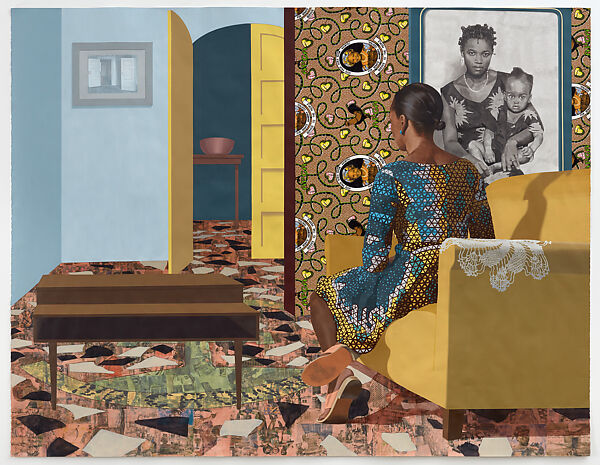
The Nigerian-American artist Njideka Akunyili Crosby produces work that is Cubist not in its formal vocabulary — her paintings are figurative, representational, often domestic in their subject matter — but in its fundamental proposition: that to represent contemporary experience honestly requires the simultaneous presence of multiple cultural realities within a single frame. Her large-scale paintings layer photographic transfers of Nigerian popular imagery — magazine covers, fabric patterns, family photographs — beneath and within painted domestic scenes set in American interiors, creating a visual field in which Lagos and Los Angeles, Igbo tradition and American contemporary life, exist not as opposites but as coextensive realities. The Cubist lesson — that truthful representation requires the acknowledgement of multiple simultaneous viewpoints — has rarely been applied with more emotional precision.
The Enduring Radicalism
What these artists share, beyond their debts to the Cubist tradition, is an understanding that the movement’s central insight has only become more relevant with time. We live in a condition of radical simultaneity — news from every continent available in the same scroll, cultural references from multiple traditions jostling within the same consciousness, physical and digital spaces overlapping in ways that would have fascinated Braque — and Cubism remains the most persuasive visual language for representing that condition honestly. The new Cubists are not revivalists. They are practitioners of a tradition that has never stopped being radical, working with tools — digital imaging, architectural software, photographic transfer, immersive installation — that extend the revolution’s reach while remaining faithful to its founding proposition: that to see truthfully, one must see from more than one place at once.