
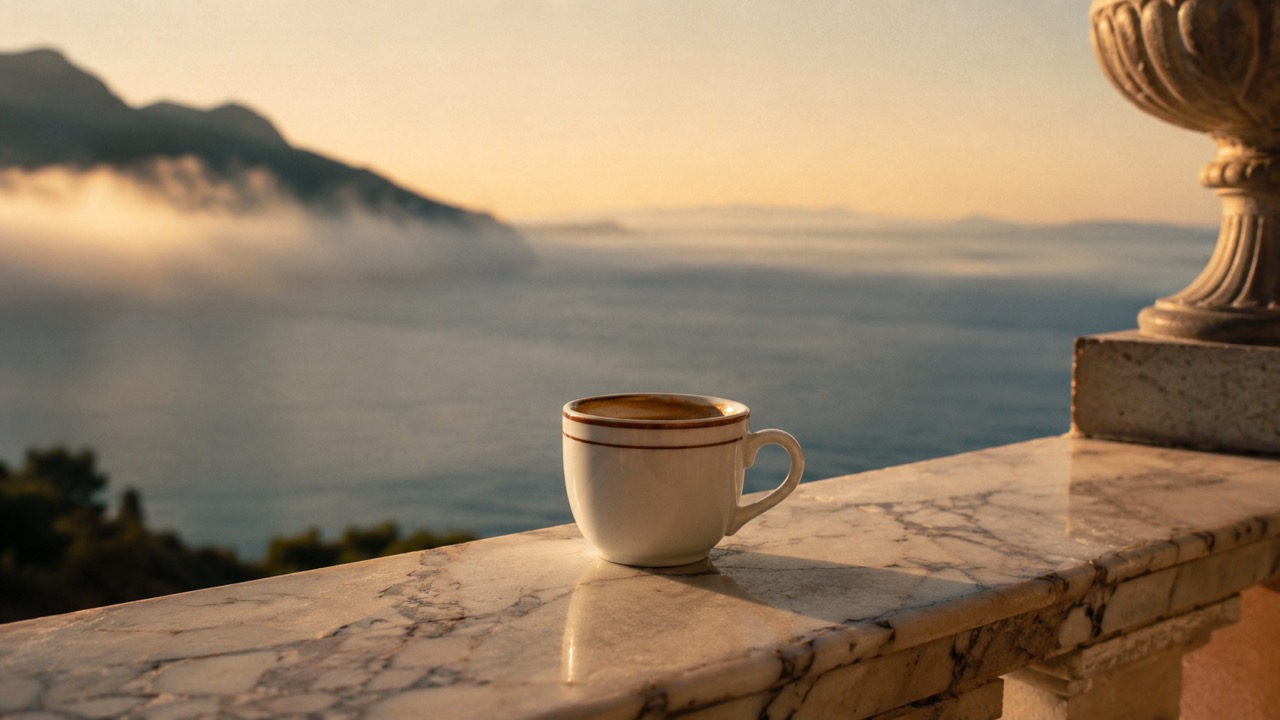
Long before coffee became a commodity traded on futures markets, before it was ground in steel burrs and extracted through pressurised machines, it was a sacred substance — prepared with ceremony, consumed with intention, its bitterness tempered by spice and sweetness in rituals that connected the drinker to something beyond mere wakefulness. The Mesoamerican traditions surrounding cacao and, later, coffee offer something the modern morning desperately lacks: the understanding that the first drink of the day is not fuel but practice.
The Ancestral Beverage
The Maya drank their cacao whipped into a bitter, spiced froth — xocolātl — mixed with chilli, vanilla, and achiote, poured from height to create the foam they prized above all. This was not hot chocolate in any modern sense. It was a ritual preparation consumed at ceremonies, offered to gods, exchanged at marriages. The vessel mattered. The preparation mattered. The attention brought to the act of drinking mattered. Nothing was casual. Nothing was rushed.
When coffee arrived in Mesoamerica — brought by the Spanish, cultivated by Indigenous farmers who recognised in the plant a kindred spirit to their cacao traditions — it was absorbed into existing ceremonial frameworks. The coffee bean became, in certain communities, the inheritor of cacao’s sacred role: a substance worthy of careful preparation, conscious consumption, and gratitude.
The Comal and the Stone
In traditional practice, the green beans are roasted on a comal — the flat clay or iron griddle that is the heart of the Mesoamerican kitchen. The roasting is done by sight and smell rather than temperature probe: the beans turned constantly with a wooden utensil, their colour deepening from green through gold to a rich, uneven brown. The unevenness is intentional — it produces a complexity of flavour that uniform commercial roasting eliminates. Some beans are slightly lighter, carrying brightness; others darker, contributing body. The blend happens in the roasting, not in the mixing.
The roasted beans are then ground — traditionally on a metate, the volcanic stone grinding platform used for millennia to process maize, cacao, and spices. The metate produces a grind that is coarse and irregular, yielding a brew that is textured rather than clean. Into the grinding, cinnamon — canela, the soft Ceylon variety rather than the hard cassia — is incorporated, along with piloncillo: unrefined whole cane sugar, dark and complex, tasting of molasses and earth.
The Morning as Ceremony
What emerges from this process is café de olla — coffee of the pot — brewed in a clay vessel that has absorbed decades of flavour into its porous walls. The clay itself contributes to the taste: a mineral quality, an earthiness that no steel or glass can replicate. The coffee is simmered rather than extracted, the grounds settling naturally, the liquid poured through nothing finer than patience.
The ceremony is in the slowness. In the attention paid to each stage — selecting beans, heating the comal, listening for the first crack, smelling the moment before the roast goes too far. In the physical labour of grinding. In the waiting while the brew simmers and settles. These are not inefficiencies to be engineered away. They are the practice itself. Each step requires presence. Each step returns the practitioner to the current moment.
Living Tradition
This is not historical recreation. In Oaxaca, in Chiapas, in the highlands of Guatemala, café de olla remains a daily practice — not a museum piece but a living tradition that adapts without abandoning its essential character. Contemporary practitioners might source single-origin beans from specific micro-lots. They might adjust their roast profile with more precision than their grandmothers employed. But the comal remains. The canela remains. The piloncillo remains. The clay pot remains. The slowness remains.
What the tradition offers the modern practitioner — wherever they live, whatever their heritage — is a framework for transforming the first act of the day from consumption into contemplation. Not meditation in any formal sense, but the quality of attention that any careful manual process naturally produces. The hands are occupied. The senses are engaged. The mind, freed from screens and urgency, settles into the rhythm of an ancient and uncomplicated task.
The Modern Morning
One need not adopt the full ceremonial apparatus to absorb its lesson. The lesson is this: that how we prepare what we consume matters as much as what we consume. That speed is not neutral — it carries a philosophy of its own, one that says the body is merely a machine requiring fuel. The Mayan coffee ritual proposes an alternative philosophy: that the body is a participant in consciousness, that the morning is a threshold, and that crossing it with care rather than haste establishes the quality of everything that follows.
A comal can be heated anywhere. Canela and piloncillo are available in any city with a Latin American grocery. A clay pot costs less than a single capsule-machine pod. The investment required is not financial but temporal — the willingness to give the morning its due, to stand before a simple fire and attend to something ancient, and to drink the result not as caffeine delivery but as the first conscious act of a conscious day.