
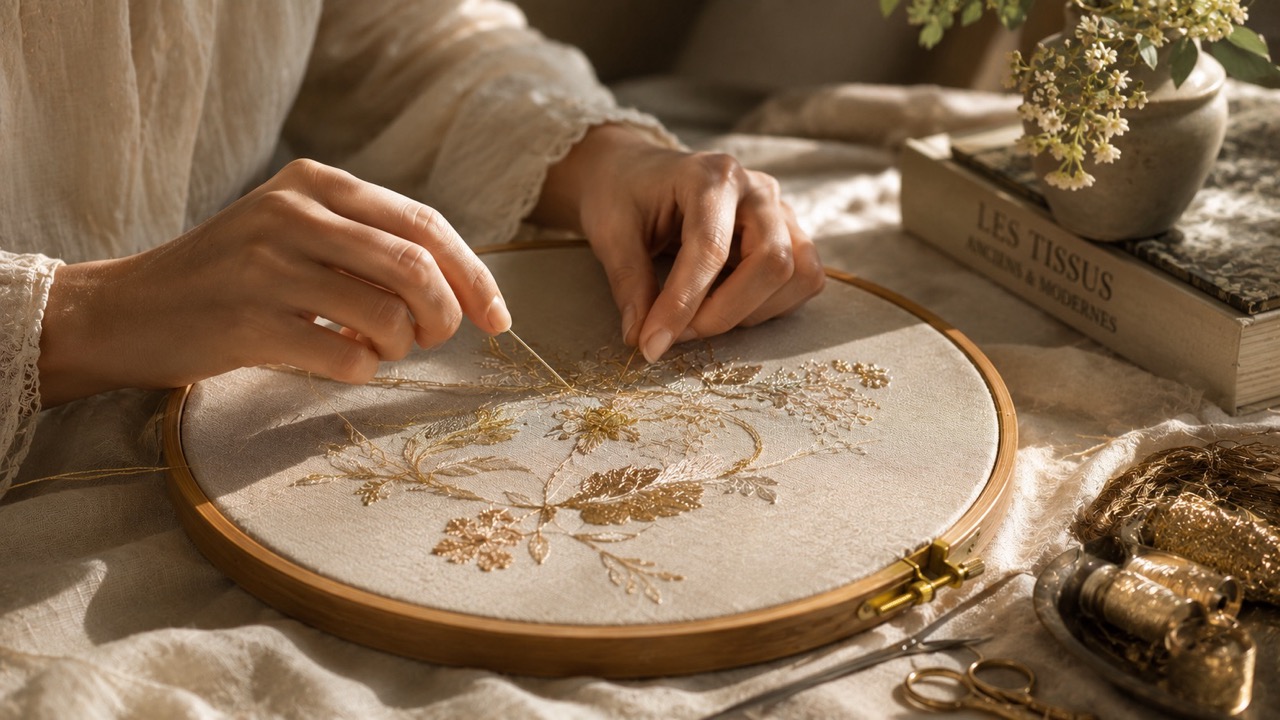
In a workshop on the Île de Burano, a twenty-minute vaporetto ride from the tourist crush of San Marco, a woman in her seventies works a needle through a web of thread so fine that the untrained eye might mistake it for spiderweb caught on a frame. She learned the stitch — punto in aria, literally “stitch in air,” the foundational technique of Venetian needlepoint lace — from her mother, who learned it from hers, a chain of transmission that stretches back to the sixteenth century, when Burano’s lacemakers supplied the courts of Europe and a single tablecloth could command a price equivalent to a Venetian palazzo. The thread she works with today is the same weight her predecessors used. The pattern — a seabird motif traditional to the island — has not changed in two hundred years. What has changed, dramatically and perhaps irreversibly, is the number of women who possess the skill. There are fewer than a dozen master lacemakers remaining on Burano, and the youngest is not young.
Brussels: The Point de Gaze and the Royal Tradition
Belgian lace — and specifically the point de gaze needlelace that reached its apotheosis in the workshops of Brussels during the nineteenth century — represents the art form at its most technically ambitious. Point de gaze is distinguished by its raised elements: flowers, leaves, and scrollwork built up in three dimensions from the flat ground, creating a bas-relief effect of remarkable delicacy. A single flounce of point de gaze for a court presentation gown could require eighteen months of work by a team of specialists — one for the ground mesh, another for the floral motifs, a third for the raised elements — and the finished piece had a weight, a drape, and a luminosity that no machine has ever replicated.
The Belgian royal family has maintained its connection to the lacemaking tradition with genuine commitment. The workshops supported by the Royal Foundation continue to train young lacemakers, and the Royal Museums of Art and History in Brussels hold a collection of historical lace that serves as both archive and inspiration. The tradition is not extinct, but it exists in a state of fragile vitality that makes every working lacemaker’s output an event of cultural significance.
Alençon: France’s Living Heritage
Point d’Alençon — the needlelace technique developed in the Norman town of Alençon in the seventeenth century under the patronage of Colbert, who saw in domestic lace production a weapon against the ruinous importation of Venetian lace — is the only lacemaking tradition in the world to hold UNESCO Intangible Cultural Heritage status. The technique requires mastery of ten distinct operations, each traditionally performed by a different specialist, and the most complex pieces require seven hours of work per square centimetre. The Atelier National du Point d’Alençon, housed in the Musée des Beaux-Arts et de la Dentelle, maintains a team of artisans who produce new work and conserve historical pieces, and the atelier’s output — measured in centimetres per year rather than metres — enters museum collections and, occasionally, the haute couture houses whose most ambitious commissions demand materials that exist at the outer limit of human handiwork.
Bruges and the Bobbin Tradition
Where needlepoint lace is constructed stitch by stitch with a single needle, bobbin lace is woven on a pillow using dozens or hundreds of thread-loaded bobbins, manipulated by the lacemaker’s fingers in patterns of crossing, twisting, and plaiting that produce a fabric of extraordinary complexity. The Flemish tradition of bobbin lace, centred on Bruges and its surrounding towns, developed in parallel with the needlepoint traditions of Venice and Brussels, and by the eighteenth century the two techniques had established a creative rivalry that pushed both to extraordinary levels of refinement.
The Kantcentrum in Bruges — the lace centre that serves as both museum and teaching workshop — maintains the bobbin tradition with an energy that defies the pessimism often attached to heritage crafts. Classes are consistently oversubscribed, and a new generation of lacemakers, drawn by an interest in slow craft and material culture that owes something to the broader maker movement, is producing work that honours the historical techniques while introducing contemporary designs that extend the tradition’s expressive range.
Lace and Couture: The Enduring Alliance
The relationship between handmade lace and haute couture has never been severed, despite the availability of machine-produced alternatives that approximate the visual effect at a fraction of the cost. The distinction is apparent to any hand that touches the fabric: handmade lace has a softness, a dimensional quality, and an irregularity of pattern — each repeat slightly, beautifully different from the last — that machine production cannot achieve. Chanel’s use of Calais lace, Valentino’s signature Venetian-inspired lacework, and Dior’s ongoing collaboration with the Maison Sophie Hallette, the French lace house that produced the lace for Catherine Middleton’s wedding gown, represent a commitment to handcraft that is economically irrational and aesthetically indispensable.
The thread that connects Burano to Brussels to Alençon to the atelier of a Parisian couture house is not merely historical. It is the thread of a conviction, shared by every lacemaker who has ever bent over a frame or a pillow: that beauty at this level of refinement — beauty that requires years to learn to produce and hours to create a centimetre of — is not a luxury that civilisation can afford to lose but a necessity that defines what civilisation, at its most ambitious, aspires to be.