
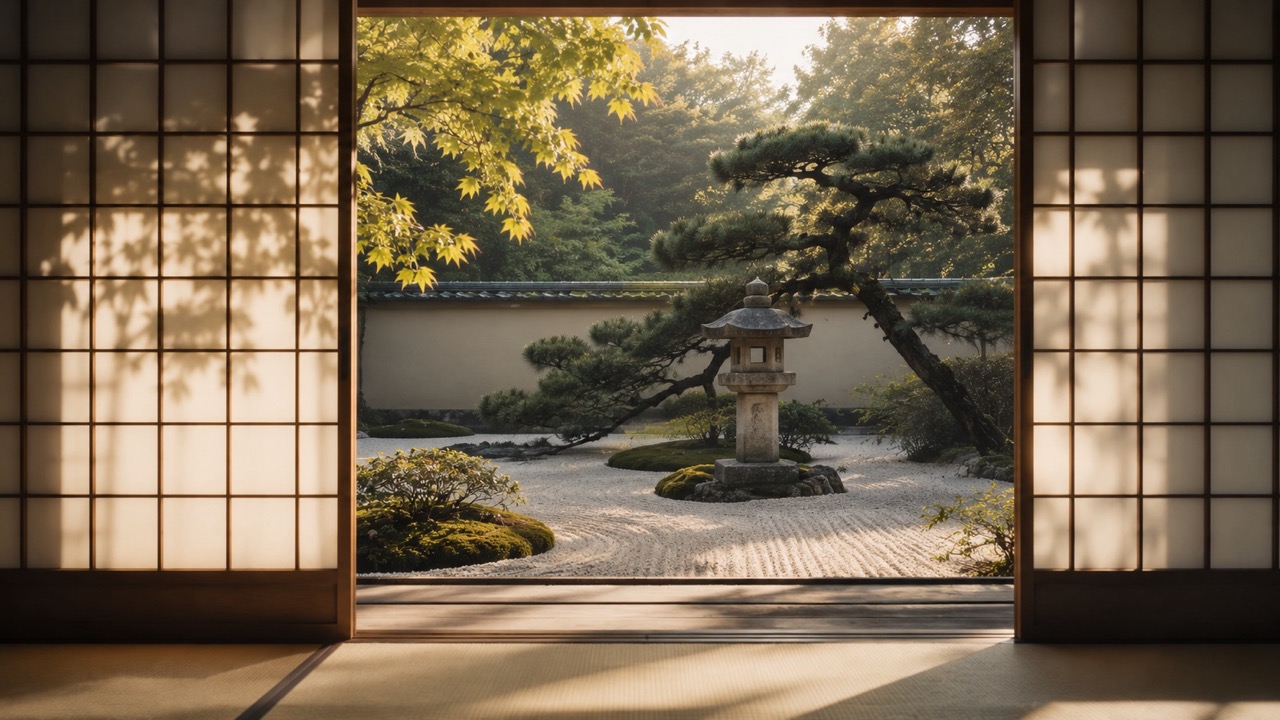
In the West, we furnish rooms. We fill them — with sofas, tables, shelves, objects, art — until the space between things becomes incidental, the leftover, the negative that defines the positive. In Japan, the tradition moves in the opposite direction. The space between things is not leftover; it is the thing itself. Ma (間) — variously translated as gap, pause, interval, or negative space — is not emptiness in the sense of absence but emptiness in the sense of potential. It is the silence between musical notes that gives the notes meaning. It is the white space on a page that allows the calligraphy to breathe. It is the unfurnished room that invites the fullness of attention.
The Charged Emptiness
Ma resists simple translation because it describes not a physical condition but a relational one. It is not merely space; it is space between. Not merely silence; but the pause that gives weight to what precedes and follows it. In architectural terms, ma is the quality that transforms an empty room from vacant to present — the difference between a room that has been stripped of its contents and a room that has been intentionally left open. The distinction is invisible to the eye but immediately felt by the body. A room designed with ma in mind feels spacious, charged, alert. A room that is merely empty feels abandoned.
The traditional Japanese house is organised around this principle. Rooms defined by sliding shoji screens can be opened to one another or closed, their function shifting with need and season. A space that serves as living room by day becomes bedroom by night — not through the addition of furniture but through the laying down of a futon on tatami. The room does not accumulate; it transforms. Its emptiness is not poverty but versatility — the openness that allows multiple modes of living within a single, uncluttered volume.
The Tokonoma: A Theatre for One Object
The tokonoma — the recessed alcove found in traditional Japanese reception rooms — is ma’s most refined architectural expression. A shallow niche, typically framed by a pillar of natural wood and floored with polished wood or tatami, the tokonoma displays a single scroll painting or calligraphy, accompanied perhaps by a single flower arrangement and one carefully chosen object. That is all. The rest of the alcove is empty — but it is an emptiness that amplifies the presence of what it contains, the way a frame of silence amplifies a single spoken word.
The Western equivalent would be a mantlepiece crowded with photographs, candlesticks, invitations, and accumulated objects. The tokonoma refuses accumulation. It insists on selection — on the discipline of choosing one thing and giving it the space to be fully itself. The scroll changes with the season; the flower arrangement responds to what is blooming; the accompanying object is chosen for its resonance with both. The tokonoma is not decoration but ceremony — a ritualised assertion that attention is finite and precious, and that the proper response to a beautiful object is not to surround it with other beautiful objects but to surround it with space.
Empty Rooms, Full Attention
The neuroscience of attention confirms what Japanese aesthetics have long intuited: that a cluttered environment fragments perception. The brain, confronted with multiple stimuli competing for attention, allocates resources poorly — seeing everything and therefore truly seeing nothing. A spare environment, by contrast, allows attention to settle, to deepen, to engage fully with what is present rather than skimming across surfaces. The empty room does not demand less of its inhabitant; it demands more. It asks you to be present to subtlety — to notice the quality of light on a bare wall, the grain of wooden floorboards, the shadow of a single branch outside a window.
This is ma’s gift to Western interiors, if we are willing to receive it: the understanding that space is not a problem to be solved by filling it but a resource to be preserved. That a room with fewer objects in it is not a room with less in it but a room with more — more light, more air, more attention available for what remains. The challenge for the Western designer is not to imitate the Japanese house (the materials, climate, and cultural context are too different for direct translation) but to absorb its underlying principle: that emptiness is not absence but presence of a different kind.
Ma in Western Practice
Certain Western designers have intuited this principle without necessarily naming it. John Pawson’s minimalism — the long limestone surfaces, the monastic absence of ornament, the rooms in which a single object achieves the status of altar piece — operates in ma’s territory, even if Pawson’s intellectual lineage runs through Cistercian monasteries rather than Kyoto temples. Axel Vervoordt, the Belgian antiquarian whose interiors achieve a quality of meditative stillness, speaks explicitly of wabi-sabi and the Japanese influence on his work — the patina of age, the beauty of imperfection, the space that allows old objects to breathe.
The practical application need not be austere. Ma does not demand minimalism; it demands intentionality. A room can contain many objects and still possess ma if the space between those objects is considered — if each has room to be perceived individually, if the arrangement acknowledges that the eye needs rest as much as stimulation, if the overall composition includes pauses. A bookshelf that is not filled to capacity. A wall that holds one painting rather than four. A table surface on which empty space is as deliberately placed as the objects that occupy it.
What the Japanese concept offers Western living is not a style but a discipline — the discipline of restraint, of selection, of trusting that what is not there can be as eloquent as what is. In a culture that equates abundance with richness and accumulation with success, ma proposes a radical alternative: that the richest rooms are those with the most space in them, and that the deepest luxury is not the possession of things but the possession of the emptiness in which things can be truly seen.