
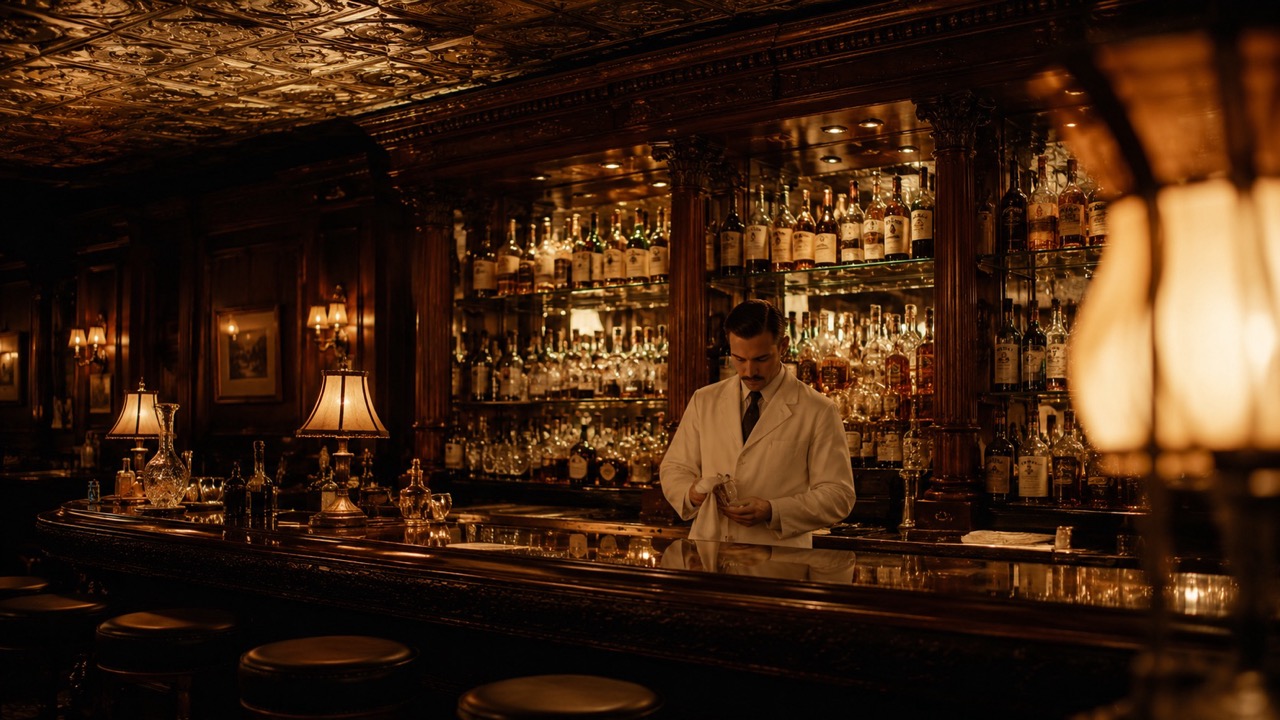
A grand hotel is never merely a place to sleep. It is a proposition about civilisation — an argument, rendered in stone and silk and silver, about how human beings ought to be received, how cities ought to present themselves to the world, and how the passage of time might be honoured rather than merely survived. The great hotels of Europe are not relics. They are living monuments to the idea that hospitality is an art form — and that architecture is its most eloquent medium.
The Ritz Paris: The Invention of Modern Luxury
When César Ritz opened his hotel on the Place Vendôme in 1898, he invented a category that had not previously existed: the hotel as total aesthetic environment. Every detail — the lighting calibrated to flatter a woman’s complexion, the brass beds replaced with wooden ones for warmth, the private bathrooms that were then revolutionary — expressed a single controlling intelligence. The building itself, an eighteenth-century hôtel particulier, provided the architectural grammar: the symmetry of the façade, the progression from public grandeur to private intimacy, the garden that creates an impossible tranquillity in the heart of the first arrondissement. After its four-year restoration completed in 2016, the Ritz emerged as both museum and working hotel — every surface restored to Ritz’s original vision while the infrastructure beneath achieved twenty-first-century standards. The Coco Chanel suite, where she lived for thirty-four years, remains perhaps the most famous hotel room on earth — not for its size or its fittings but for what it represents: the idea that a hotel could be more than a temporary address, that it could be a life’s chosen home.
Claridge’s London: The Art Deco Democratic Palace
Claridge’s sits at the intersection of Mayfair and the world — a hotel that has functioned, since the 1850s, as an unofficial extension of Buckingham Palace and simultaneously as the London home of every displaced European monarch, visiting head of state, and itinerant grandee. The current building dates primarily from 1929 — Oswald Milne’s Art Deco masterpiece, with its black-and-white marble foyer, its mirrored ballroom, and that extraordinary staircase that manages to be both monumental and intimate. The architecture argues that public grandeur and personal warmth need not be opposed: the proportions of the public spaces inspire a certain posture, a certain behaviour, while the rooms themselves — recently redesigned by various hands including Linley and Champalimaud — offer a domesticity that the lobby’s formality makes all the more welcome. To arrive at Claridge’s is to understand what London means by civilisation: rigour expressed as warmth, tradition animated by wit.
The Gritti Palace, Venice: A Doge’s Residence on the Canal
The Gritti — a fifteenth-century palazzo on the Grand Canal, converted to a hotel in 1895 — proposes something more radical than luxury. It proposes that one might actually inhabit Venice rather than merely visit it. The building’s position — directly opposite the church of Santa Maria della Salute, at the point where the Grand Canal opens toward the basin of San Marco — places the guest within one of Western civilisation’s supreme urban compositions. The architecture is Venetian Gothic overlaid with centuries of modification: the piano nobile’s great windows, the terrazza where Hemingway wrote and Monet painted, the water entrance where arrivals step directly from boat to marble. The recent restoration under the Marriott Luxury Collection preserved the palazzo’s essential character — the hand-painted wallpapers, the Murano chandeliers, the terrazzo floors worn smooth by five centuries of passage — while introducing modern systems with an invisibility that honours the building’s age.
Hotel Adlon Kempinski, Berlin: Reconstruction as Act of Memory
The original Adlon — opened in 1907 on Unter den Linden, destroyed in 1945, its ruin finally demolished by the East German government — was Berlin’s answer to the Ritz: a hotel conceived at imperial scale for a city convinced of its destiny as a world capital. The current building, opened in 1997 on the same site beside the Brandenburg Gate, is not a restoration but a reimagining — a new structure that references the original’s proportions and decorative vocabulary without pretending to authenticity. This honesty gives the Adlon a particular quality: it is simultaneously brand-new and deeply historical, a building that acknowledges the rupture of the twentieth century while insisting that Berlin’s tradition of grand hospitality survives it. The view from the upper floors — the Pariser Platz, the Tiergarten, the ghost geography of the Wall — makes the Adlon not merely a hotel but a meditation on what cities lose and what they choose to rebuild.
Beau-Rivage Palace, Lausanne: The Swiss Ideal
The Beau-Rivage Palace occupies ten acres of parkland on the shore of Lake Geneva — a position of such tranquil authority that the building seems less constructed than grown from the landscape. The architecture is Belle Époque at its most confident: symmetrical facades of pale stone, mansard roofs in grey slate, and a porte-cochère designed for the arrival of carriages that expressed, in their time, the same casual wealth that private jets do today. The hotel’s significance lies partly in its history — the Treaty of Lausanne was negotiated here in 1923, Coco Chanel was a long-term guest, heads of state have convened in its salons since 1861 — but more profoundly in its embodiment of a specifically Swiss ideal: perfection without ostentation, service without servility, grandeur that remains, somehow, modest. The lake, the mountains, the gardens — the architecture frames these elements rather than competing with them, proposing that the highest form of luxury is the creation of a setting in which the natural world is received as a guest of honour.
These hotels endure not because they are expensive — many competitors exceed them on that measure — but because they are serious. Each represents a sustained investment in the proposition that how we house strangers reveals what we value most. To sleep in their rooms is to participate in an ongoing conversation about grandeur, intimacy, and the civilising power of beautiful spaces. It is, in the most literal sense, to be received — not merely accommodated.