
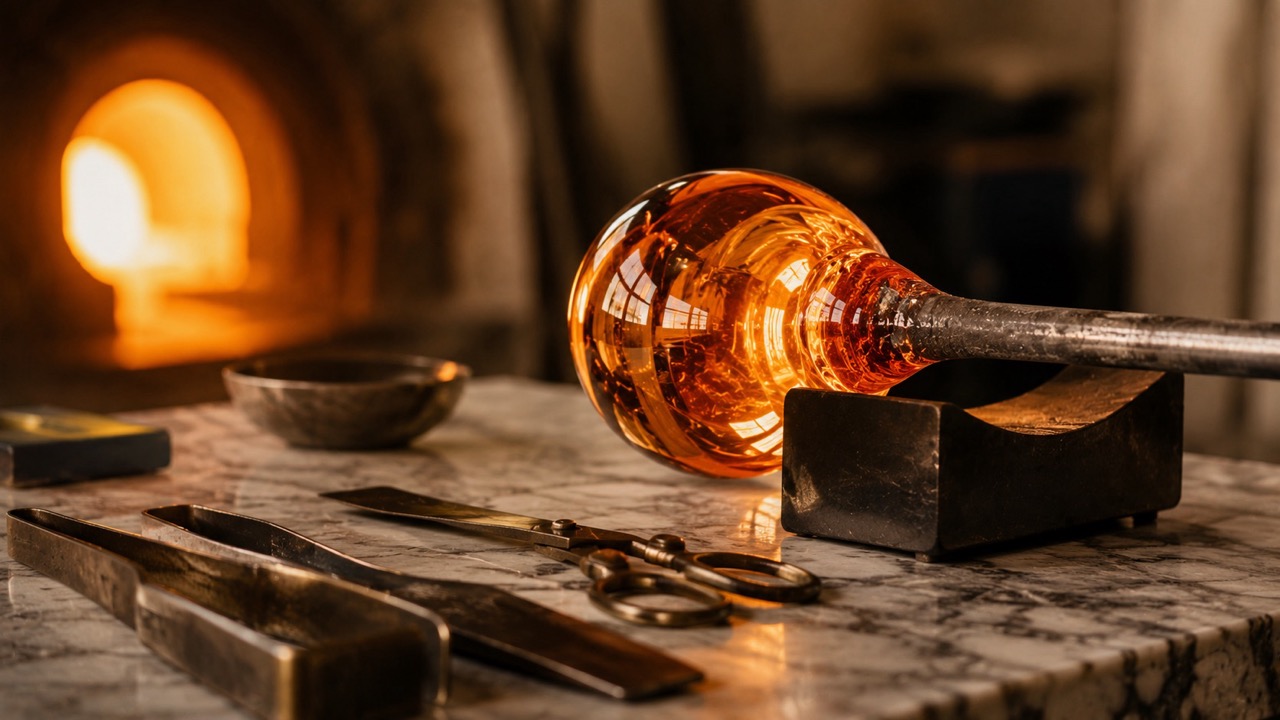
The furnace at Vetreria Artistica Archimede Seguso burns at eleven hundred degrees Celsius, and has done so, with only wartime interruptions, since 1397. The heat is visible — a shimmering distortion in the air that makes the workshop appear to breathe. At its centre, a maestro vetraio gathers molten glass on the end of a blowpipe, turning it with a rhythm so practised it appears effortless. His hands are scarred with decades of burns. His apprentice, who has been watching and assisting for fourteen years, is not yet trusted to work alone. On Murano, mastery is not earned in years but in generations.
An Island of Fire and Secrecy
In 1291, the Venetian Republic ordered all glassmaking furnaces moved from Venice to the island of Murano, ostensibly to protect the city from fire. The true reason was control. Murano’s glassmakers possessed knowledge of incalculable commercial value — the formulas for cristallo, lattimo, aventurine, millefiori — and the Republic intended to keep that knowledge contained. The artisans were granted noble privileges: their daughters could marry into Venetian aristocracy, and they were exempt from prosecution by the Venetian state. But they were forbidden, under penalty of death, from leaving the island or sharing their techniques with outsiders. A maestro who fled could expect assassins. His family, left behind, would bear the consequences of his betrayal.
This brutal arrangement produced, paradoxically, the conditions for extraordinary artistic development. Concentrated on a single island, competing dynasties of glassmakers pushed one another toward innovations that no individual workshop would have achieved alone. The Barovier family, whose presence on Murano dates to 1295, developed cristallo — glass of such clarity it rivalled rock crystal. The Seguso line, equally ancient, refined the techniques of filigrana and reticello that remain among the most technically demanding feats in glasswork. Knowledge passed from father to son with the intensity of sworn secrecy, each generation adding its refinements to a body of inherited wisdom.
The Maestro’s Forty-Year Apprenticeship
A maestro vetraio does not declare himself; he is recognised. The path begins in adolescence — carrying tools, maintaining the furnace, watching. Years pass before a young man is permitted to touch the blowpipe. More years before he is allowed to shape glass unsupervised. The physical demands are extraordinary: the furnace temperature, the weight of molten glass on the pipe, the need for absolute precision in movements that must be completed before the material cools. But the intellectual demands are greater still. A maestro must understand glass as a living material — its moods at different temperatures, its willingness or resistance at different viscosities, the way it responds to breath and gravity and the particular humidity of a given day.
Lino Tagliapietra, perhaps the most celebrated living maestro, began his apprenticeship at eleven. He was not permitted to blow glass independently until his mid-twenties. He did not consider himself a maestro until his forties. “Glass teaches patience,” he has said, “because it will not be hurried. It moves at its own speed. You learn to move at its speed, or you produce nothing.” This is the temporal economy of Murano — a system in which expertise is measured not in certificates or qualifications but in decades of embodied practice.
Venini’s Legacy and the Art of Innovation
Paolo Venini, a Milanese lawyer who fell under Murano’s spell in the 1920s, understood something that the island’s traditionalists initially resisted: that the future of Murano glass lay not in reproducing historical forms but in collaboration with contemporary designers and architects. He invited Carlo Scarpa, Gio Ponti, and later Tapio Wirkkala to work with his maestri, creating pieces that married ancient technique with modern vision. The Venini fornace became a laboratory where tradition and invention existed in productive tension — where a maestro’s centuries-old knowledge of glass behaviour met a designer’s contemporary sensibility.
This model — tradition as foundation for innovation rather than constraint upon it — remains Murano’s most viable path forward. Today, houses like Salviati and Barovier & Toso collaborate with designers including Zaha Hadid Architects and Ron Arad, producing work that could not exist without both the ancient knowledge and the contemporary eye. The glass is still blown by hand, still shaped by maestri whose lineage on the island stretches back centuries. But the forms are new, the colours unexpected, the scale sometimes monumental.
Between Art, Tourism, and Survival
Murano today faces pressures that the Republic’s death threats never anticipated. Chinese imports flood the market with machine-made imitations sold at a fraction of the cost. Young Italians, offered the choice between a fourteen-year apprenticeship and a university degree, increasingly choose the latter. The number of active furnaces has declined from hundreds to dozens. Tourism sustains the island economically but threatens it culturally — when the primary customer wants a souvenir rather than a masterwork, the incentive to maintain the highest standards erodes.
Yet the furnaces that remain are producing work of extraordinary ambition. Adriano Berengo’s Glasstress exhibitions, held during the Venice Biennale, commission major contemporary artists to create works in Murano glass, asserting the medium’s place in the conversation of serious art. Young maestri like Davide Fuin are finding audiences who understand and value the distinction between handmade and manufactured, between a piece that carries seven centuries of knowledge and one that merely resembles it.
The island endures as it has always endured — by fire, by stubbornness, by the simple irreducible fact that what happens when a maestro’s breath meets molten silica at eleven hundred degrees cannot be replicated by any machine yet devised. Murano’s glass is not a product; it is a performance, unrepeatable, existing fully only in the moment of its making. That is its vulnerability, and its salvation.