
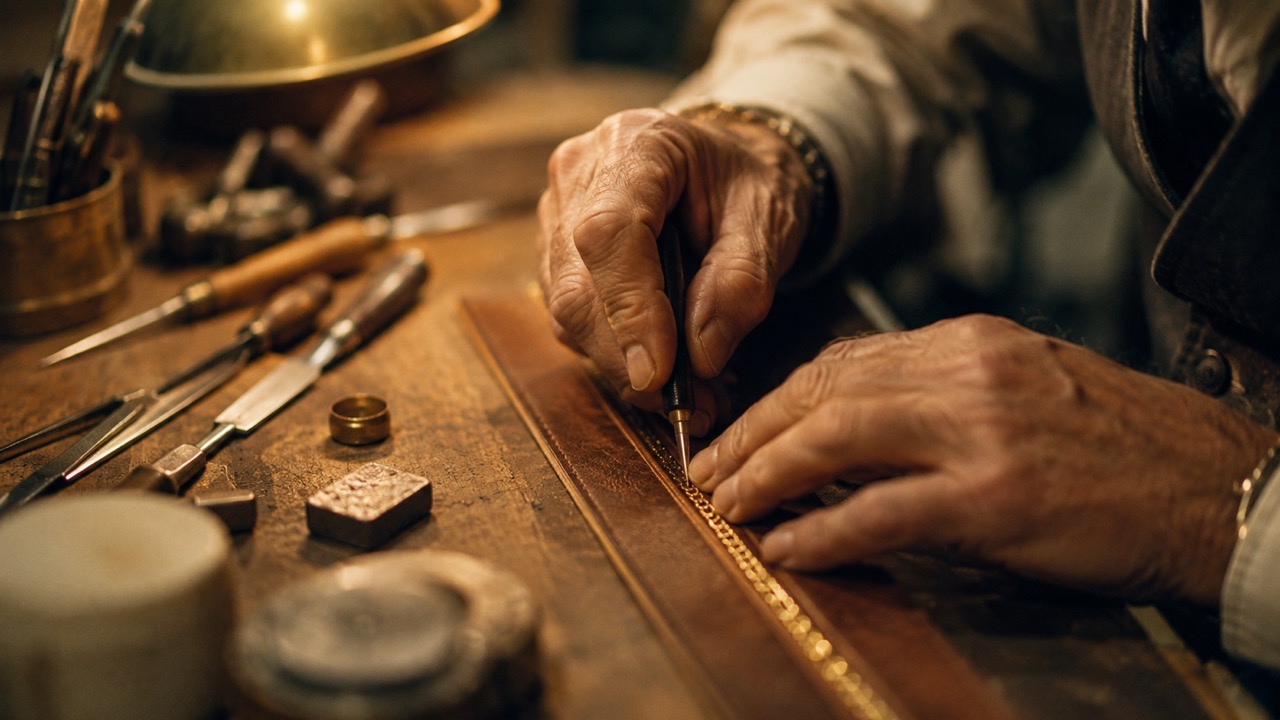
Somewhere in Goodwood, in a studio whose quiet belies the weight of its purpose, Mark Court dips a brush made from squirrel hair into a pot of paint and draws a single, continuous line along the flank of a motor car worth more than most houses. The line is not perfectly straight — cannot be, by its nature. It carries within its slight, almost imperceptible variance the unmistakable signature of a human hand. And this is precisely the point.
The Coachline Tradition
The coachline is older than the motor car itself. It descends from the decorative striping applied to horse-drawn carriages in the eighteenth century — a subtle accent that distinguished one coachbuilder’s work from another. When Rolls-Royce inherited this tradition, they inherited not merely an aesthetic convention but a philosophy: that the finest things bear the mark of their maker. A machine can produce a line of mathematical perfection. Only a human hand can produce a line that lives.
Court has been the sole coachline painter at Rolls-Royce for decades. There is no understudy, no succession plan publicly acknowledged. He paints every line on every car that leaves the Goodwood factory — a volume that demands both extraordinary consistency and, paradoxically, the acceptance that no two lines will be identical. Each stroke begins with a steady breath, a relaxed shoulder, and a confidence born of ten thousand repetitions. The brush touches the lacquer and moves without hesitation. There is no correction. There is no second attempt. The line is drawn once, in a single motion, and it is done.
The Economics of Imperfection
This is, by any rational economic measure, absurd. A robotic arm could paint a coachline in seconds, with tolerances measured in microns, reproduced identically across every vehicle. The cost saving would be significant. The consistency would be absolute. And yet Rolls-Royce persists in employing a single human being to perform this task — slowly, expensively, imperfectly.
The persistence is not sentimental. It is strategic. What Rolls-Royce understands, with a clarity that escapes most luxury brands, is that perfection is available to anyone with sufficient capital and machinery. A CNC mill can cut to tolerances that no human hand could match. A laser can engrave with precision that makes the finest craftsman look crude. Perfection, in our age, is merely expensive. It is not rare.
What is rare — what is genuinely irreplaceable — is the trace of a human hand. The slight wobble that proves a living person stood here, concentrated here, breathed here. This is what the coachline represents: not a decoration but a proof of presence. It is the automotive equivalent of a painter’s brushstroke, a calligrapher’s pressure variation, a potter’s thumbprint in wet clay.
The Squirrel-Hair Brush
The brush itself deserves attention. Squirrel hair — specifically, hair from the tail — produces a brush of extraordinary softness and flexibility. It holds paint evenly, releases it consistently, and follows the micro-topography of the lacquered surface without resistance. A synthetic brush would be stiffer, more predictable, less responsive to the subtle variations in pressure that give the coachline its character. The choice of material is not affectation. It is precision of a different kind — precision calibrated not to mechanical tolerance but to human expression.
Court’s brushes are made to his specification by a single supplier. The hair is selected, bundled, and shaped to produce a particular width and flow rate. Each brush has a working life measured in cars rather than hours. When a brush is spent, it is replaced — but the new brush must be broken in, its particular character learned, its behaviour under varying conditions of temperature and humidity understood through use.
Where Value Actually Lives
The coachline costs Rolls-Royce, in purely economic terms, far more than its visual impact might suggest. It requires the salary of a highly skilled specialist, the maintenance of a tradition, the acceptance of human variability in a manufacturing environment otherwise devoted to eliminating it. But this cost purchases something that no amount of engineering can produce: authenticity.
In a world saturated with machine-made perfection — where every surface is flawless, every tolerance met, every specification achieved — the hand-painted coachline stands as a statement about where luxury’s real value resides. Not in the absence of flaws but in the presence of humanity. Not in the cold precision of the automated but in the warm imprecision of the alive.
When a Rolls-Royce owner runs a finger along their coachline — feeling nothing, seeing only the slightest evidence of a hand’s passage — they are touching something that no amount of money can replicate by machine: the proof that another human being cared enough to stand here, breathe steadily, and draw a single perfect-imperfect line. In that line lives everything that distinguishes luxury from mere expense.