
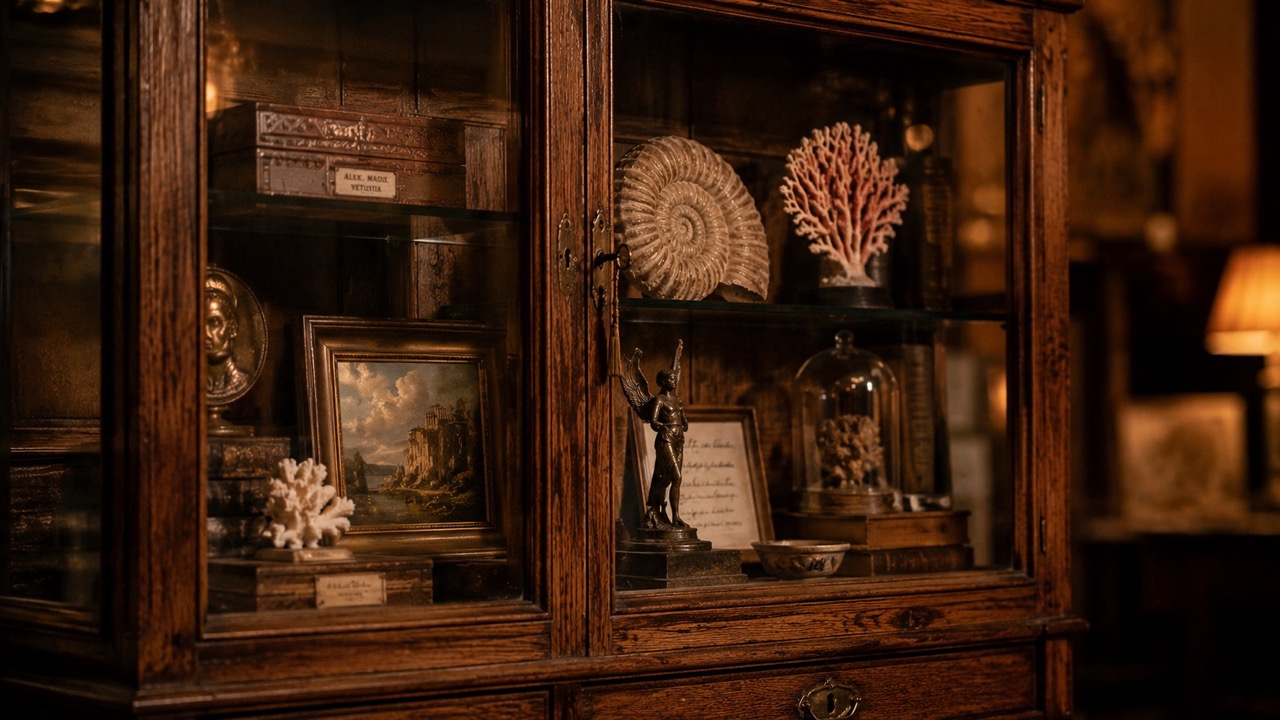
The flea market rewards a different kind of looking from the gallery or the auction house. In the gallery, the frame does the work — the white wall, the lighting, the label that names the artist and the price, all conspire to tell you that what you are seeing is worthy of attention. At the flea market, the object must announce its own quality from within a chaos of competing claims: stacked crockery, tangled jewellery, furniture dusty with the particular patina of indifference that distinguishes the junk stall from the antique shop. The curator’s eye — trained, patient, and willing to look past surface to structure — is the only instrument that separates the extraordinary from the ordinary in this environment. And the pleasure of the find, when it occurs, is unlike anything the more controlled settings of the art world can offer.
What to Look For: The Principles of Recognition
The first principle is materiality. In an era of mass production, the handmade object declares itself through qualities that the machine cannot replicate: the slight irregularity of a hand-thrown ceramic, the tool marks on a piece of hand-forged iron, the visible grain of a wood that was sawn and planed by a human rather than a computer-controlled cutter. These marks are not defects but signatures, and the eye that learns to read them — to distinguish the wobble of a potter’s hand from the wobble of a cheap mould, the patina of age from the chemical simulation of age — possesses the fundamental skill of flea-market connoisseurship.
The second principle is proportion. An object whose proportions are right — whose height relates to its width with the kind of inevitability that suggests the maker understood geometry at an intuitive level — will hold attention even when its surface is damaged, its finish degraded, or its function obsolete. A Provençal olive jar whose shape has been refined by generations of potters into a form of perfect utility is a beautiful object regardless of condition. A Victorian cast-iron garden urn whose classical proportions reflect two millennia of Western ornamental tradition is a beautiful object even when it is rusted and soil-stained. Proportion survives neglect.
The Geography of the Find
Every flea market has its particular character, shaped by the culture, the economy, and the domestic traditions of its region. The markets of northern France — Lille’s Grande Braderie, the brocantes that appear in every village throughout the summer — yield French provincial furniture, industrial lighting, and the linen that French households accumulated for centuries as part of the trousseau tradition. The markets of the English Home Counties produce Georgian silver, Victorian ceramics, and the particular eccentricities of the English domestic interior. The rastro of Madrid and the mercatini of Tuscany yield different treasures still, each reflecting the material culture of its region with a specificity that no international antiques fair can replicate.
The Ethics of Restoration
The question of how much to restore a flea-market find — and the related question of whether restoration adds or subtracts value — is one that the serious collector must answer for themselves, but the general principle favours restraint. The patina of age, the wear marks of use, the minor damage that records an object’s history — these are not imperfections to be corrected but evidence to be respected. A chair whose rush seat is worn through tells you that people sat in it, regularly, for a long time — and that information, transmitted through the object’s physical condition, is part of what makes it interesting. The principle is not that restoration is wrong but that it should be conservative: stabilise what is fragile, clean what is obscured, but do not erase the evidence of the life the object has led.
The curator’s flea market is, in the end, an exercise in attention — in the willingness to look longer, look closer, and trust the eye’s response to quality even when the context does not encourage it. The extraordinary thing in an ordinary place is not hiding. It is simply waiting for the person whose looking is good enough to see it.