
The alarm is a violence. The snooze button is a negotiation with that violence — a temporary ceasefire that resolves nothing and delays everything. The modern morning, in most of the industrialised world, begins as an emergency: the sudden extraction from sleep, the immediate reach for a screen, the scrolling through overnight accumulations of obligation before the feet have touched the floor. We begin in reaction rather than intention, in consumption rather than creation, and the day that follows bears the character of its opening — fragmented, hurried, never quite our own.
The Italian Colazione: Standing, Brief, Perfect
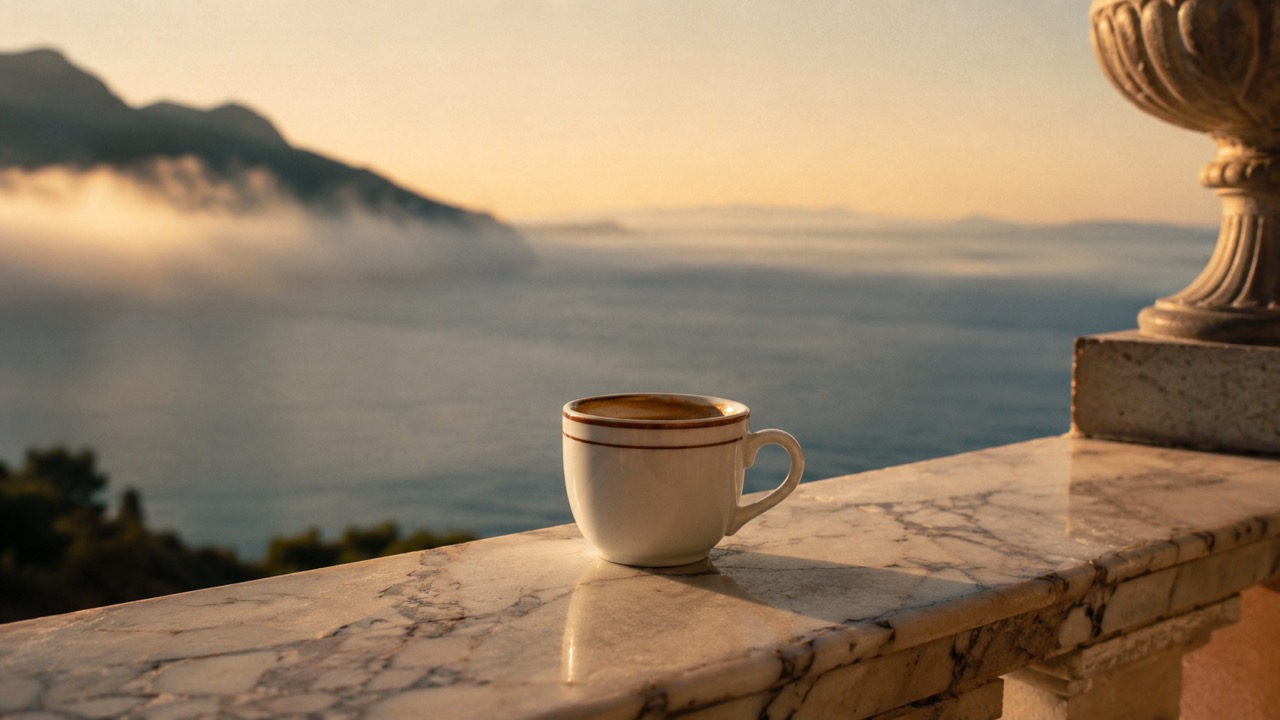
In Italy, the morning ritual is compressed to its essence and performed in public. The colazione — breakfast — takes place at the bar, standing, and lasts no more than five minutes. But those five minutes are dense with intention. The espresso must be precisely made: the crema thick and tawny, the temperature such that it can be drunk in three sips without burning. The cornetto — if one takes a cornetto — must be fresh from that morning’s baking, its layers still distinct, its interior still giving off warmth. The barista is known; the exchange is brief but genuine. The newspaper — a physical newspaper, folded to the page of interest — provides three minutes of connection to the world beyond the self.
And then it is over. The Italian does not linger at breakfast; the lingering is reserved for lunch, for dinner, for the passeggiata. The morning is a transition — brief, beautiful, complete. Its purpose is not nourishment (the caloric content of an espresso and a cornetto is negligible) but orientation: a moment of sensory pleasure and social connection that establishes the day’s tempo. Fast, yes. But not hurried. There is a difference, and the Italian morning is its demonstration.
The Japanese Morning: Ritual as Foundation
The traditional Japanese morning operates on an entirely different temporal logic. Where the Italian colazione compresses ritual into a single perfect gesture, the Japanese morning expands it into a sequence of small, deliberate acts, each one a practice of attention. The day begins with the opening of curtains or shoji — the admission of light as a conscious act rather than an automatic one. Tea is prepared with a formality that varies from household to household but retains, even in its simplest form, something of the ceremony: the warming of the cup, the attention to water temperature, the moment of stillness before the first sip.
Stretching or light movement follows — not exercise in the Western sense, not performance, but the body’s conversation with itself after sleep. A brief engagement with the garden, even if the garden is a single bonsai on a windowsill. Radio taisō — the national morning calisthenics programme broadcast since 1928 — provides a communal rhythm, millions of Japanese moving in unison at 6:30 AM to the same piano accompaniment. The morning meal, when it is traditional, is a small universe of balance: grilled fish, pickled vegetables, miso soup, rice. Each element placed with consideration. Each flavour a distinct note in a harmonic composition.
The French Petit Déjeuner: Domestic Theatre
The French breakfast is a performance for an audience of intimates. The table is set — not elaborately, but correctly: the bowl for café au lait (never a mug), the bread board, the butter (always unsalted, always at room temperature), the confiture in its proper jar. The baguette was purchased that morning — to use yesterday’s bread for this morning’s breakfast would be a failure not of economy but of respect. It is torn, not sliced — the hand-torn bread absorbing butter differently, more generously, than a knife-cut surface.
What makes the French morning distinct is its domesticity. Unlike the Italian bar ritual, the petit déjeuner is performed at home, at a table, often in a dressing gown. It is the day’s first act of civilisation — the assertion that even in the private space of the early morning, before public life demands its costumes and performances, one will sit properly, eat properly, drink from appropriate vessels. The radio may play. Conversation may occur. But the essential quality is one of composed calm — the cultivation of an interior stillness that the day ahead will test but not, ideally, destroy.
The Scandinavian Morgenmad: Democratic Abundance
The Nordic breakfast table is a landscape — a spread of rye bread, seed-studded knäckebröd, cold cuts, cheeses, smoked fish, boiled eggs, muesli, yoghurt with berries, and coffee so strong and so plentiful that it approaches the sacramental. The Scandinavian morning is generous where the Italian is spare, communal where the French is intimate, pragmatic where the Japanese is ceremonial. It fuels bodies that will spend the day in cold climates; it provides the sustained energy that darkness and distance demand.
But beneath its pragmatism lies a philosophy. The Danish morgenmad, the Swedish frukost, the Norwegian frokost — all share a quality of democratic abundance. Everything is available; nothing is prescribed. Each person at the table constructs their own meal from the common offering, selecting according to need and mood. The table is both communal and individual — shared provisions, personal choices. It is hygge before the word was exported: the warmth of gathered family, the abundance of a table well-laid, the unforced togetherness of people eating in proximity without obligation.
The Morning as Philosophy
What these traditions share — despite their radical differences in duration, formality, and content — is intentionality. Each treats the morning not as a transition to be rushed through but as a practice to be honoured. Each asserts, in its own cultural register, that how you begin the day determines how you live it. The Italian’s standing espresso is no less intentional than the Japanese tea ceremony in miniature; the French baguette torn at the kitchen table is no less civilised than the Scandinavian table laid with democratic abundance. What matters is not the specific form but the underlying commitment: that the first hours are not given to reaction but to presence, not to the urgent but to the essential.
To adopt any of these traditions wholesale would be an act of cultural tourism. But to absorb their shared principle — that the morning is sacred, that it belongs to you, that it should begin in intention rather than emergency — is to make a choice about what kind of life one intends to live. The slow morning is not an indulgence; it is an investment. The returns compound daily, quietly, in the quality of attention one brings to everything that follows.