
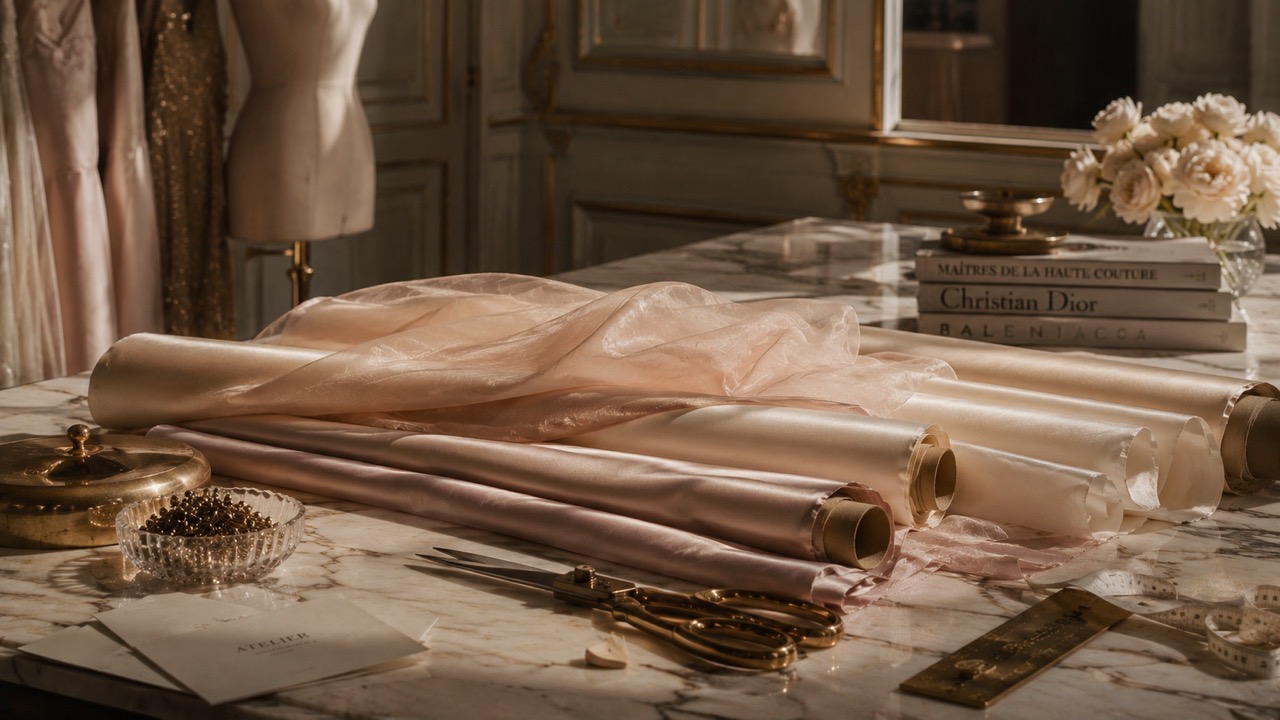
A fashion house, at its most essential, is not a business. It is an argument about beauty — a sustained, decades-long statement about how the world might be seen, worn, and inhabited. The great houses understand this instinctively. Chanel did not merely produce garments; she produced a vision of what a woman could be, how she might move through the world unencumbered, formidable, and entirely herself. Hermès does not merely make leather goods; it makes objects that embody a particular idea of excellence — the conviction that the finest thing one can do is make something so well that it requires no further justification. These are, at root, acts of identity: not marketing, but philosophy made material.
The Founding Vision and Its Discipline
Every enduring house begins with a founding sensibility so clear and so personally felt that it functions less like a business strategy than a worldview. Cristóbal Balenciaga’s architecture of volume and sculptural form was not a positioning decision — it was a deeply held conviction about the relationship between fabric, body, and space. When he cut a coat away from the shoulders, creating that hovering, suspended silhouette, he was not differentiating himself in a market. He was solving what he understood as a formal problem, as an architect might resolve the load-bearing question of a spanning arch.
What transforms this founding vision into a brand — in the deepest, most lasting sense — is the discipline with which it is maintained. Brands erode not through catastrophe but through the accumulation of small exceptions: a collaboration that doesn’t quite fit, a diffusion line that dilutes the proposition, a celebrity association that shifts the cultural register in ways that are difficult to reverse. The houses that have survived and flourished across generations are those that have held their founding argument intact, even — especially — under commercial pressure.
Material as Statement
One of the most instructive lessons the great fashion houses offer is the significance of material commitment. Hermès’s relationship with leather is not incidental; it is constitutive of the brand’s entire claim upon the world. The decision to work only with specific grades of Barenia calf or Togo leather, to reject shortcuts in tanning and finishing, to maintain ateliers where individual artisans complete an entire bag from cutting to stitching, is not merely a quality control decision. It is an argument about value — about what makes an object worth owning, caring for, passing on.
Brunello Cucinelli’s commitment to cashmere from Mongolian highlands, worked and dyed in his Umbrian village of Solomeo according to practices he has spent decades refining, tells a similarly coherent story. The material is the message. When you understand where a sweater’s wool came from, how it was handled, by whose hands and with what knowledge, you understand something essential about the brand’s sense of self — and, by extension, something about your own.
The Role of Place
Geography is not merely backdrop for the great houses; it is content. Chanel is Parisian in a way that cannot be separated from its identity — the ease, the wit, the refusal of excessive effort are qualities that belong to a specific cultural atmosphere. Prada’s Milanese severity, its intellectual rigor and comfort with the provocative, reflects the city’s particular brand of northern Italian modernism. Dries Van Noten’s Antwerp sensibility — bookish, layered, drawn equally to ethnography and abstraction — is inseparable from the city’s tradition of conceptual fashion education.
For any brand seeking to build lasting identity, the implication is significant. Authenticity of place — a genuine relationship with a specific cultural and geographic context — cannot be manufactured or adopted as a styling choice. It must be inhabited. The brands that attempt to borrow the cultural codes of other places without earning them produce a kind of costume rather than an identity: recognisable at the surface level but hollow at the centre.
The Long View
What fashion’s greatest houses teach, above all, is that identity requires time to stabilise and depth to sustain. The brands we regard today as monuments — Lanvin, Loewe, Givenchy, Bottega Veneta — were each built through decades of consistent practice, occasional creative evolution, and unwavering commitment to their founding argument. When Bottega Veneta’s intrecciato weave became so widely imitated that the house briefly stepped back from it, only to have Daniel Lee restore and recontextualise it as a gesture of confident ownership, it was demonstrating something essential: identity is not what others can copy, but what only you can embody with genuine conviction.
For those of us who wear and love fashion, this architecture of identity offers a lens through which to understand our own choices. The garments we return to across years, the houses we trust instinctively, the pieces we would not sell — these are not merely preferences. They are, in their small way, arguments about who we are and what we believe the world, dressed at its best, might look like.
Fashion, when it achieves this depth, ceases to be an industry and becomes something closer to culture in the oldest sense: the shared story a civilisation tells about itself, expressed not in words but in cloth, cut, and the particular dignity of things made with extraordinary care.