
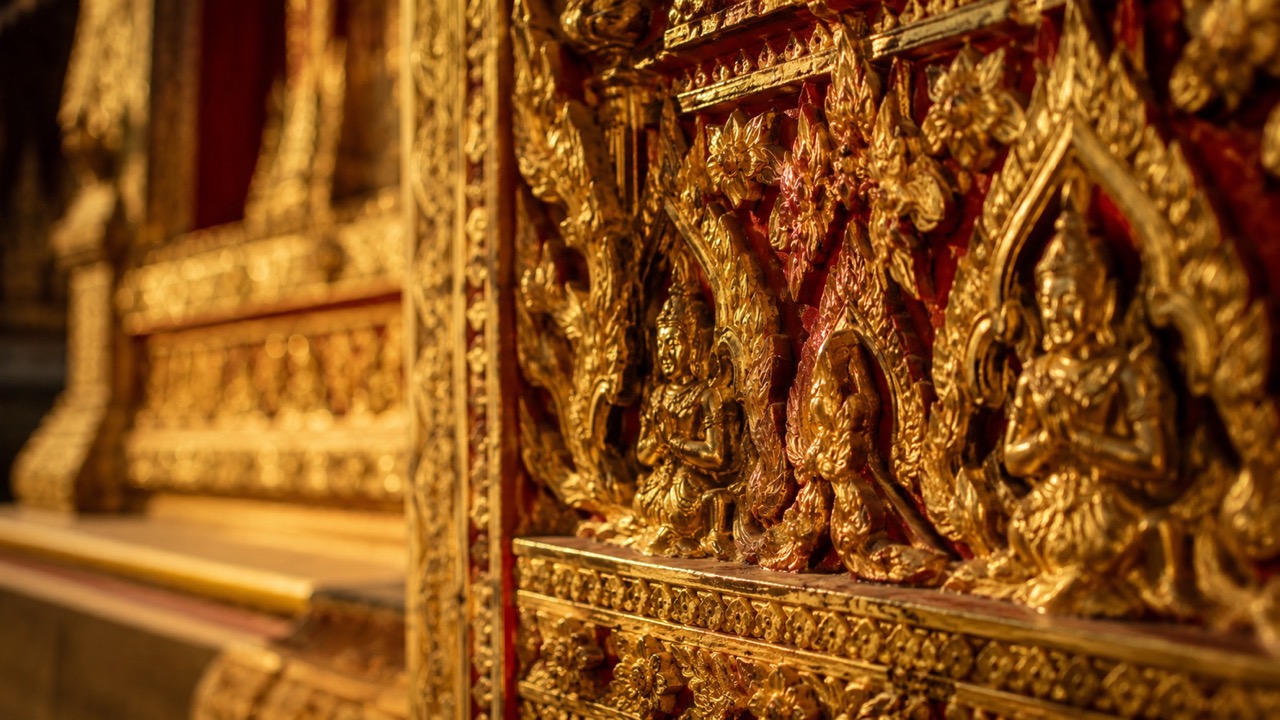
Thailand resists reduction. Every attempt to summarise it — the beaches, the temples, the food — collapses under the weight of its own inadequacy. The country is a civilisation in the fullest sense: ancient, stratified, intensely beautiful, and possessed of a hospitality culture so deeply rooted that it functions less as custom than as natural law. For the discerning traveller who has moved beyond the familiar itinerary, Thailand offers three quite distinct journeys, each capable of sustaining weeks of genuine discovery. What follows is not a schedule but an orientation — a way of entering each world with the attention it deserves.
The Cultural North: Chiang Mai and the Mountains Beyond
The north begins differently from the moment you land: cooler air, a skyline of temple spires rather than resort towers, the scent of teak and jasmine rather than salt and sun cream. Chiang Mai is the obvious entry point, and it rewards the visitor who gives it time rather than distance. The old city within its moat contains more than three hundred temples, but to approach them chronologically and architecturally — to understand Wat Phra Singh not as a photo opportunity but as the repository of the Phra Buddha Sihing image and the embodiment of northern Lanna style — is to discover a city of genuine spiritual and artistic depth.
Beyond Chiang Mai, the mountains of the Golden Triangle region hold what may be the most complex cultural landscape in mainland Southeast Asia. The hill tribe villages — Akha, Karen, Hmong, Lahu — are not, at their best, tourism spectacles; they are living communities with distinct languages, textiles, spiritual practices, and relationships to the land that reward patient, respectful engagement. Seek out community-based tourism operators who direct proceeds back to village infrastructure rather than intermediary agencies. The cooking schools worth attending in the north are not the hotel demonstration kitchens but the intimate sessions held in private homes and organic farm residences, where a Thai grandmother teaches the logic of balance — sour, sweet, salty, hot — with the authority of someone for whom this knowledge has never been theoretical. And the elephant sanctuaries: only those that prohibit riding and employ mahouts on ethical contracts deserve a visit. The genuine sanctuaries, where rescued animals graze freely and interact with visitors on their own terms, offer something far more affecting than any performance ever could.
The Culinary and Design South: Phuket, the Andaman, and the Architecture of Escape
Phuket’s Old Town — the Sino-Portuguese quarter of Talang Road and Thalang, with its painted shophouses in faded ochres and aquamarines — is one of the most architecturally coherent historic districts in Southeast Asia, and it remains, despite growing recognition, pleasingly unhurried. The food here carries the layered history of the island: Peranakan-inflected curries, Chinese-Thai stir-fries, the gloriously complex Hokkien noodles called mee sua, and the crab preparations of the Andaman coast that are simply among the finest seafood dishes produced anywhere on earth. The Andaman Sea itself — that extraordinary body of water bounded by limestone karsts that rise from the water like a fever dream — provides a seafood of incomparable quality: sweet, firm prawns; grouper of a delicacy that mere grilling seems almost to oversimplify; squid prepared with a lightness that reveals the skill of the southern Thai cook.
The boutique resort landscape of the southern islands and peninsula has matured considerably in the past decade, and several properties now carry genuine design credentials — architecture that engages seriously with the vernacular rather than mimicking it superficially, interiors that commission local craft and contemporary Thai art in equal measure. The best of these properties feel like positions of considered observation rather than destinations of distraction: rooms that open directly to water, menus that treat the local ingredient as primary, staff who possess the kind of unperformed warmth that cannot be trained but only cultivated over time.
Bangkok Immersive: A Capital That Contains Multitudes
Bangkok defeats the visitor who arrives with a fixed itinerary and rewards lavishly the one who allows the city to re-sequence the plan. The Grand Palace — vast, gilded, extraordinary in its scale — and the adjacent Wat Phra Kaew, home to the Emerald Buddha, demand more time than most travellers allow; the iconography is dense, the history layered, the craftsmanship worth examining at close range. Wat Pho, slightly south along the river, houses the magnificent Reclining Buddha and the oldest massage school in Thailand, and its courtyards carry a quality of meditative calm that the Grand Palace, for all its splendour, cannot quite achieve.
But Bangkok is simultaneously one of the most dynamic contemporary art cities in Asia, a fact obscured by the temples and the traffic. The Museum of Contemporary Art — housed in a building of considerable ambition on the northern edge of the city — holds one of the largest private collections of modern and contemporary Thai art, assembled with a seriousness that puts many institutional collections to shame. The Bangkok Art and Culture Centre, at the intersection of Pathumwan, occupies a striking modernist building and programmes with genuine curatorial ambition across visual art, performance, and design. The gallery neighbourhood around Charoen Krung is producing a new generation of spaces that track both local and international practice with intelligence.
The Michelin-starred street food operations — Jay Fai’s crab omelette, the boat noodles of Phra Nakhon, the pad thai made on a single ancient wok by a cook who has executed the same movement forty thousand times — are not overrated; they are, in fact, among the great culinary achievements of the twenty-first century, and the fact that they exist at pavement level with plastic stools and fluorescent lighting is not a paradox but a truth about where excellence actually lives. The rooftop bars, for their part, earn their cliché: the view of Bangkok from altitude — that improbable sprawl of modernism and antiquity, of spire and skyscraper, of river and expressway — is one of the genuinely astonishing urban panoramas on earth, best encountered at the hour when the light turns amber and the city below begins to breathe differently.
Three journeys, one country — and still, on any honest accounting, only the beginning. Thailand’s gift to the traveller who comes with genuine curiosity is the discovery that there is always more: more temple, more flavour, more landscape, more conversation, more beauty. It is a country that repays return without ever quite releasing the need for it.