
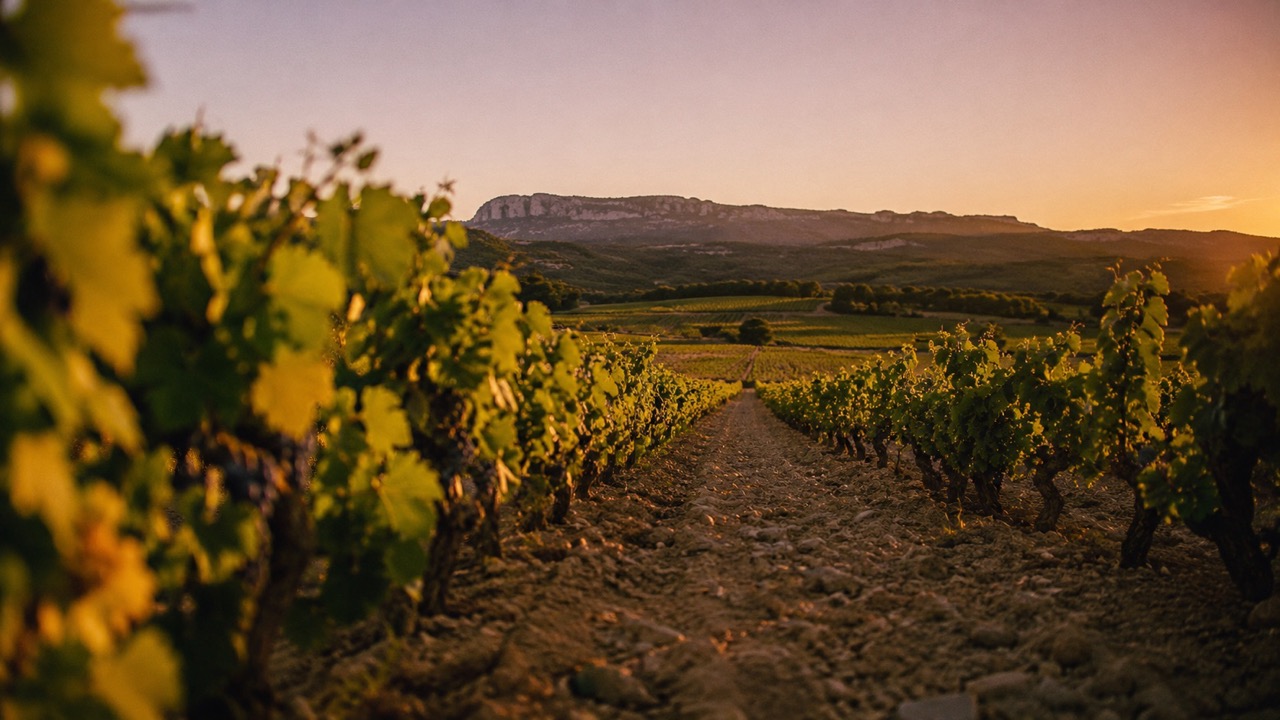
Wine has always been an argument about place. Long before the word terroir entered the vocabulary of the sommelier, farmers in Burgundy and the Douro were tasting the difference between one hillside and another — noting how the same grape, grown fifty metres higher or on a different aspect of slope, produced something entirely distinct. What the sustainable wine movement has added to this ancient conversation is a moral dimension: not merely where a wine comes from, but how that place was tended, and whether it might go on producing a century from now.
Biodynamic Burgundy: The Philosophy Beneath the Vines
To walk the lanes of the Côte de Nuits in early autumn, when the Pinot Noir hangs in deep garnet clusters and the soil gives off a complex, almost bread-like warmth, is to understand immediately why the region’s most thoughtful vignerons have turned toward biodynamic practice. Domaine Leroy, Anne Gros, and a constellation of smaller estates now farm according to lunar calendars, compound their own preparations from plant and mineral, and treat their soil not as substrate but as living community. The results speak with uncommon directness: wines of transparency and precision, wines that seem to describe their origins without editorial.
A trail through these estates — available through several specialist wine-tour operators — winds from Gevrey-Chambertin south through Chambolle-Musigny to Vosne-Romanée, pausing at cellars where the owner will speak as readily about earthworm populations as about barrel selection. These are vignerons for whom sustainability is not a marketing position but a conviction rooted in observation. They will tell you that their best vintages have come since abandoning conventional agriculture, and the glasses they pour make the argument better than any philosophy could.
The Living Vineyards of Priorat
In the rugged Catalan interior, where terraced slopes of fractured black slate — llicorella, the locals call it — rise from the gorge of the Siurana river, a different kind of sustainable wine story is unfolding. Priorat’s great revival of the 1990s brought international attention to a region that had been nearly abandoned; what followed, more quietly, was a movement among a new generation of winemakers to restore the old, pre-phylloxera wisdom of low yields, dry farming, and the patient cohabitation of vine with stone.
Estates such as Mas Doix and Terroir al Límit tend ancient Grenache and Carignan vines — some over a century old — with a gentleness bordering on reverence. The vines are dry-farmed entirely; their deep roots find water in ways that younger vines cannot. Walking these vineyards at harvest, with the scent of wild thyme and the particular mineral cold of morning air, is an experience that needs no wine to complete it — though the wines, when poured, confirm everything the landscape has already told you.
New Zealand’s Marlborough: Green Conviction at the Edge of the World
At the northern tip of the South Island, where the Wairau Valley opens toward the sea and the light has a particular southern clarity, Marlborough’s Sauvignon Blanc vineyards are undergoing a quiet revolution. The region’s reputation was built on a style — pungent, vivid, electrically fresh — that the world’s wine drinkers came to know and depend upon. Its sustainability credentials are being built more slowly, but with growing seriousness.
Forrest Wines, Seresin Estate, and Huia Vineyards are among those leading an organic and biodynamic transition that is reshaping the valley’s agricultural character. Seresin in particular, founded by film cinematographer Michael Seresin with a commitment to biodynamic farming from the outset, has created an estate of extraordinary biodiversity: wetlands, native bush corridors, beehives, and olive groves coexist with the vines in a system designed to sustain itself indefinitely. The wines — Chardonnay and Pinot Noir alongside the signature Sauvignon — are among the most complexly expressive in the country.
Etna: The Volcano’s Gift
Perhaps no wine region on earth makes the case for terroir and sustainability with more elemental force than the flanks of Mount Etna, where ancient Nerello Mascalese vines cling to volcanic soils of striking fertility and equally striking mineralogy. The mountain’s activity means these soils are perpetually renewed; its altitude — many vineyards sit above 700 metres — provides natural diurnal temperature swings that concentrate character without sacrificing freshness.
Producers such as Cornelissen, Benanti, and Terre Nere farm with minimal intervention, some avoiding sulphur additions entirely. The resulting wines are wines of austere beauty: pale in colour, long in the glass, carrying the particular tang of volcanic mineral that no other terroir quite replicates. To follow the wine trail up Etna’s northern slope — through Randazzo and Solicchiata, past gnarled pre-phylloxera vines and the ruins of eruption-swallowed farmhouses — is to drink history as much as wine.
The Wine Trail as Education
What all of these trails offer, beyond the pleasure of exceptional wine in exceptional settings, is a particular kind of education — in attention, in patience, in the relationship between human cultivation and natural system. The most memorable bottles one opens, long after returning home, carry with them not just flavour but context: the slope they came from, the family that tended them, the philosophy of care that shaped every decision from pruning to bottling. That is what terroir, at its most profound, actually means: the whole world of a place, pressed into the glass.
To travel with that understanding is to travel differently. And to drink with it is to drink better — not only for the quality of what is in the bottle, but for everything it represents about how we might inhabit the world with more grace and more responsibility.