
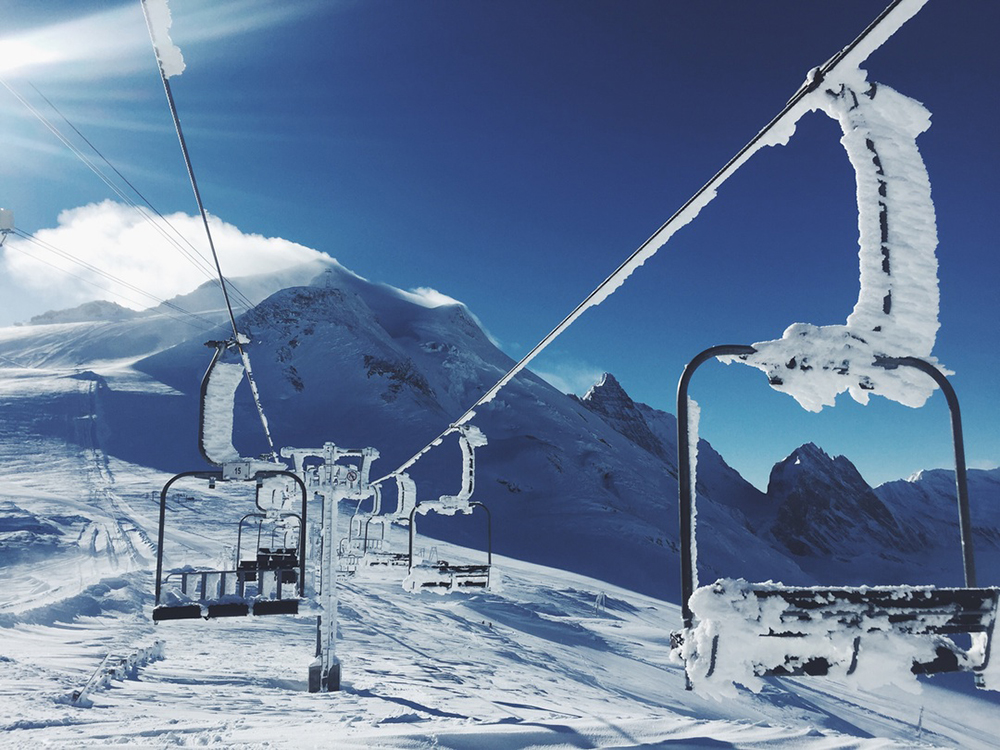
There is a moment, known to every serious skier, that exists just before the descent begins. The lift has deposited you at the summit, the valley spreads below in its winter amplitude, the snow is untracked or very nearly so, and the cold air carries that particular alpine clarity that seems to make every colour more precise, every sound more distinct. In this moment — poles planted, weight slightly forward, the mountain waiting — one understands why people have been making pilgrimages to the Alps for generations, why poets and painters and the simply wealthy have always found in this landscape something that cannot be replicated elsewhere. Switzerland, which contains the Alps in their most articulate and demanding form, has been refining the art of the ski run for more than a century. The results, on certain slopes, border on the transcendent.
Zermatt and the Matterhorn’s Shadow
No discussion of Swiss skiing can begin anywhere other than Zermatt, for the simple reason that no other ski destination in the world possesses an equivalent backdrop. The Matterhorn — 4,478 metres of pyramidal granite that has appeared on more chocolate wrappers, more luggage stickers, more postcards than any other mountain on earth — is, in person, more affecting than any reproduction prepares you for. It dominates the valley with a physical authority that the eye keeps returning to involuntarily, throughout the day, across every run.
The skiing itself is worthy of the scenery. Zermatt’s linked ski area extends across the Swiss-Italian border into Cervinia, offering 360 kilometres of marked runs across terrain that ranges from the broad, confidence-building motorways of the Sunnegga area to the sustained, technically demanding descents of the Stockhorn and the Haute Route connections that draw the expert backcountry skier. The Matterhorn Glacier Paradise, accessible by cable car to 3,883 metres, offers year-round glacier skiing of remarkable quality. The town below — car-free, village-scaled, its chalets and hotels maintaining an architectural standard that preserves the feeling of arrival in a place that takes itself seriously — provides an après-ski experience built around the finest fondue, the deepest wine cellars, and the kind of luxury hotels — the Omnia, the Chalet Zermatt Peak, the Mont Cervin Palace — that understand their setting and have dressed accordingly.
Verbier: The Expert’s Election
Verbier is where the skiing elite come when they wish to be tested. Situated in the Val de Bagnes above the Rhône Valley, the resort is part of the 4 Vallées ski area, encompassing 412 kilometres of marked runs and a quantity of off-piste terrain that has made it the headquarters of freeride skiing in Europe. The Vallon d’Arby, the Col des Mines, the legendary Mont Fort descent from 3,330 metres — these are runs that appear in the climbing diaries and ski memoirs of serious alpinists alongside names like Chamonix and Verbier itself.
The resort’s social reputation — Verbier is where certain well-known families have owned chalets for generations — has not diminished its skiing credentials. If anything, the two qualities reinforce each other: Verbier attracts people who take both their skiing and their comfort seriously, which has produced a resort of unusual dual excellence. The Chalet d’Adrien, owned by the Bonvin family and set just above the village with views across the Combins massif, remains one of the finest small hotels in the Alps — intimate, beautifully furnished with antiques and local craft, with a kitchen that takes the Valais wine and cheese tradition as its starting point and builds something genuinely excellent from it.
St. Moritz: The Original
St. Moritz invented the winter holiday. This is not marketing hyperbole but historical fact: it was here, in the Engadin valley in 1864, that hotelier Johannes Badrutt made a wager with a group of English summer guests that the winter sun was warm enough to justify their return in January. He won the bet, and in doing so launched an industry. The resort that grew from that wager — with its frozen lake, its Cresta Run, its Corviglia and Corvatsch ski areas — remains the most consistently glamorous address in the alpine world. Badrutt’s Palace Hotel, opened in 1896, retains a grandeur that is neither nostalgic nor ironic but simply the natural result of doing something very well for a very long time.
Gstaad: Discretion Above All
If St. Moritz is the Alps at their most publicly magnificent, Gstaad is the Alps at their most privately satisfying. The resort is small and deliberately understated, its chalets built in the Bernese Oberland style of dark wood and whitewashed plaster, its main street — the Promenade — arranged with the casualness of a village that happens to contain several of the finest hotels and restaurants in Switzerland. The Palace Gstaad, perched above the village on its own hill, has been welcoming the quietly wealthy for over a century with a consistency that speaks of institutional confidence. The skiing across the Glacier 3000 and the broader Gstaad Mountain Rides area is varied and satisfying, though in Gstaad the skiing has always been somewhat beside the point. The point is being here, among people who have always been here, in a landscape that rewards the quality of one’s attention.
The Alpine State of Mind
Swiss skiing, at its finest, is about more than gradient and snow conditions, though both matter enormously. It is about the particular state of mind that the Alps impose — a sharpening of the senses, a pleasurable reduction of life’s complexity to the immediate facts of mountain, snow, and the body in motion. The après-ski glass of Glühwein, the raclette consumed at a mountain restaurant with the valley spread below, the deep sleep that follows a day at altitude — these are not incidentals but constitutive parts of the experience. Switzerland has been perfecting all of it, with characteristic thoroughness, for more than a century. The results, in the right conditions, on the right mountain, at the right hour of a winter afternoon, are as close to perfection as travel is likely to offer.