
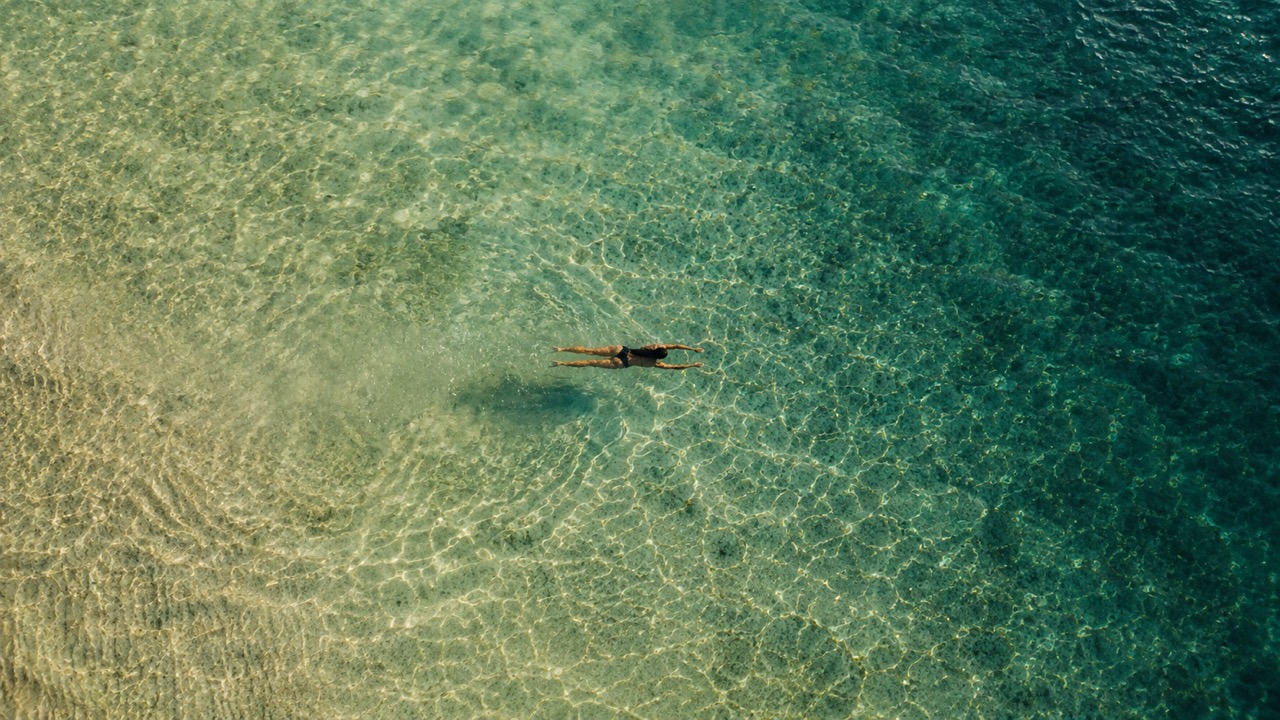
There is a silence beneath the surface of the sea that is unlike any silence available to the land-bound mind. It is not an absence of sound — the ocean is full of its own music, the creak of coral, the distant percussion of waves breaking far above, the uncanny clicking language of creatures that never surface. It is, rather, a silence of the self. Submerged, weighted gently against buoyancy, breathing in the slow, deliberate rhythm that diving demands, a human being arrives at a state of presence that most meditation traditions spend lifetimes trying to achieve. The ocean teaches it in minutes.
Why the Underwater World Heals
The science of marine immersion and its effects on human wellbeing is still young, but its findings are consistent: time spent underwater, even time spent simply observing an aquatic environment, measurably reduces cortisol levels, lowers blood pressure, and induces the kind of meditative brainwave activity associated with deep rest. The blue space effect, as researchers have termed it, is amplified beneath the surface. There is, in the concentrated attention that diving requires — the constant monitoring of depth, breath, buoyancy — a form of enforced mindfulness that no app can replicate.
But beyond the physiology, there is something harder to quantify that every diver knows: the underwater world is profoundly humbling. To enter a coral reef or drop into the blue void above an oceanic trench is to encounter life in forms so alien, so ancient, so elaborately strange, that one’s ordinary preoccupations simply dissolve. You are no longer a person with a schedule. You are a temporary visitor to a world that preceded you by hundreds of millions of years and will persist long after you are gone. The effect, counterintuitively, is liberating.
The Coral Triangle: Abundance Beyond Measure
Indonesia’s Raja Ampat Archipelago sits at the heart of the Coral Triangle, the oceanic region that marine biologists recognise as the planet’s most biodiverse marine environment. The numbers are almost incomprehensible: more species of reef fish exist here than anywhere else on earth, coral varieties that have been lost elsewhere persist here in extraordinary proliferation, and the water itself has a clarity and vivid blue-green quality that makes the surface world seem provisional by comparison.
To dive at a site such as Misool — where barracuda schools turn in synchronised columns and pygmy seahorses cling to their gorgonian fans with an almost comic diligence — is to understand why early naturalists, returning from the East Indies, struggled to convince their colleagues back home that what they had witnessed was real. The beauty here is not merely spectacular; it is conceptually challenging.
The Blue Hole: Vertical Philosophy
The Blue Hole of Dahab, in Egypt’s Sinai Peninsula, is one of the world’s most iconic dive sites and, for advanced divers, one of its most contemplative. Dropping from the surface through clear water to the arch at sixty metres, passing through a shaft of aquamarine light that narrows as one descends, is an experience that invites a particular kind of introspection. The site has a legendary reputation among free-divers who have found in its vertical depths a kind of peace available nowhere else on earth.
For the recreational diver equipped with nitrox and a qualified guide, the shallower reaches of the Blue Hole offer their own rewards: cathedral-like walls draped in soft coral, glassfish shimmering in dense silver clouds, the occasional Napoleon wrasse moving through the blue with the unhurried authority of a creature that has nothing to fear.
Palau: The Jellied Miracle
Palau, the Micronesian island nation whose marine protected areas represent some of the most successful ocean conservation efforts on the planet, offers an experience unique in all of diving: Jellyfish Lake. Separated from the ocean millions of years ago, this landlocked marine lake evolved a population of golden jellyfish that, having no predators, lost their ability to sting. To snorkel through thousands of pulsing, amber-coloured medusae, drifting among them as if in some luminous dream, is an experience that defies ordinary categories of sensation. It is, quite simply, one of the most extraordinary things a human body can do.
The Practice of Going Deep
To engage with diving at the level these sites demand requires preparation that is itself part of the wellness journey. The training — learning to equalise with grace, to control buoyancy with the subtlety of a breath rather than a kick, to read current and weather and the subtle language of the reef — cultivates a quality of patient attention that suffuses ordinary life long after the wetsuit is hung to dry.
The finest dive experiences pair this physical practice with deliberate slowness: no agenda, no ticking of species boxes, no compulsive photography. Simply the descent, the blue world unfolding around you, the steady percussion of your own breath, and the silent instruction of an ocean that has been going about its extraordinary business long before language existed to describe it.
In a world that increasingly confuses connectivity with meaning, the wordless serenity of the deep may be the most radical form of rest available to us. One simply goes down, and waits, and watches — and comes back changed.