
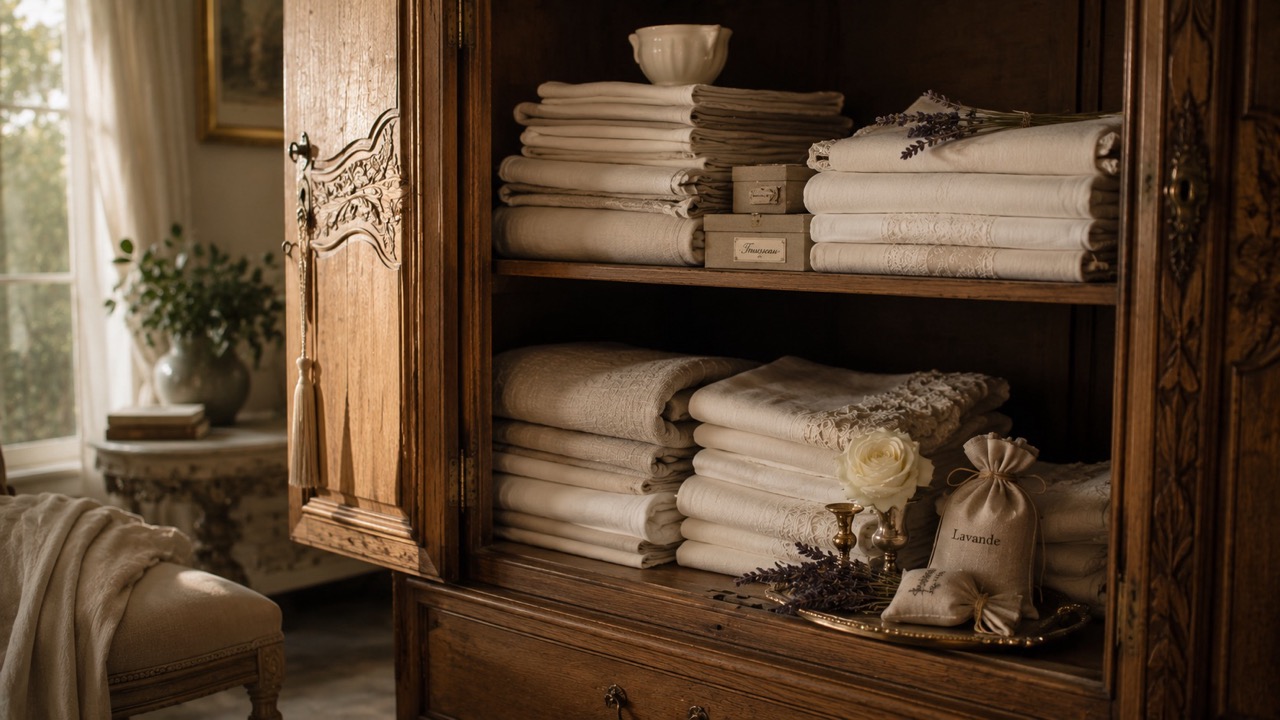
Memory lives in objects. A gilded mirror that reflects morning light at a particular angle, a set of linen-covered armchairs whose provenance traces to a Viennese estate sale, a side table bearing the patina of a century of use — these are not merely furnishings but emissaries from other times, carrying with them an atmospheric density that no newly manufactured piece, however beautifully conceived, can replicate. The art of nostalgic interiors is not the art of pastiche or of wholesale period recreation; it is something more nuanced and more demanding: the deliberate weaving of historical resonance into spaces that remain fully alive to contemporary life.
The Philosophy of Patina
The first principle of the nostalgic interior is an honest relationship with age. Patina — the darkening of wood, the softening of gilt, the gentle fading of silk, the fine crazing of lacquer — is not damage but biography. It is evidence of a life lived alongside objects, of the slow accumulation of light and air and human proximity that no artificially distressed finish can genuinely simulate. The decorator who understands patina does not seek to restore aged pieces to a false newness but to integrate them into spaces where their age becomes a positive quality, a counterweight to the sharp edges and unvaried surfaces of contemporary architecture.
This requires a certain confidence — the willingness to place a slightly worn Bessarabian rug beneath a sleek contemporary dining table and trust that the combination will resolve not as contradiction but as conversation. The great interior designers of the twentieth century — Madeleine Castaing, Renzo Mongiardino, Sister Parish — understood this instinctively, placing pieces of wildly disparate periods in proximity and relying on the cultivated eye, and on the shared quality of deep human attention that fine things from any era carry, to make the room cohere.
Sourcing with Intelligence
The pleasure of building a nostalgic interior begins long before any piece is placed in a room — it begins in the search. The great European antique fairs — the Biennale des Antiquaires in Paris, the Decorative Antiques and Textiles Fair in Battersea, the Tefaf in Maastricht — provide access to material of the highest quality alongside dealers whose knowledge is formidable and whose enthusiasm, for clients who arrive with genuine curiosity, is generous. But the more intimate discoveries — the Biedermeier desk found in a small dealer’s back room in Vienna, the pair of Swedish gustavian chairs bought at a provincial auction for a fraction of their London equivalent — carry a particular satisfaction that the fair circuit, for all its magnificence, rarely provides.
Online platforms have democratised access considerably, though they require developed visual literacy: the ability to assess scale, condition, and quality from photographs is a skill that develops only through sustained looking at physical objects in person. The fundamental rule for serious collectors is to buy what is genuinely excellent rather than merely convenient, and to be patient: the right piece, at the right moment, consistently justifies the wait.
Integration Without Surrender
The critical challenge of the nostalgic interior is achieving integration without surrendering the contemporary quality that makes a room liveable rather than museological. The distinction between a home that references the past with sophistication and one that is simply trapped in it lies almost entirely in the treatment of light and textile. Contemporary lighting — whether thoughtfully chosen period-appropriate fixtures or quietly modern architectural illumination — animates antique surfaces in ways that the original owners of those pieces would find entirely recognisable; human beings have always understood that fine things look their best by candlelight, and the warm, directed light sources that skilled lighting designers specify achieve a modern approximation of exactly that quality.
Textiles anchor the nostalgic room while allowing it to breathe. A nineteenth-century inlaid commode placed against walls covered in a contemporary interpretation of a traditional documentary pattern — perhaps a Cole and Son recreation of a Regency stripe, or a de Gournay hand-painted wallcovering drawing on chinoiserie tradition — achieves a layering of historical reference that reads as richly cultivated rather than rigidly period. The upholstery of antique seating in current cloth — a Georgian wing chair covered in a contemporary linen weave, a Victorian button-back in a plain cashmere — performs the same function: honouring the chair’s history while making it clearly and comfortably part of the present.
The Personal Dimension
The most successful nostalgic interiors are invariably personal rather than categorical. They do not represent a single period or style but a sensibility — the accumulated evidence of a particular person’s encounters with beauty across time. Inherited pieces carry the additional weight of familial memory and should be honoured as such: the grandmother’s writing desk placed in a position of prominence, the family portraits hung not in isolation but in conversation with other works collected independently. These personal layers are what transform a beautifully decorated room into a home — a space that tells a story belonging to someone specific, rather than the aspirational fiction of a showroom.
To weave vintage elegance into a modern space is ultimately to refuse the tyranny of the contemporary moment: to insist that the past has things to teach, that beauty does not expire, that the objects made with care and skill in other centuries deserve the continued company of human beings who know how to receive them. This is not nostalgia in its sentimental sense but in its most elevated meaning — the desire to remain connected to the full depth of human experience, across time.