
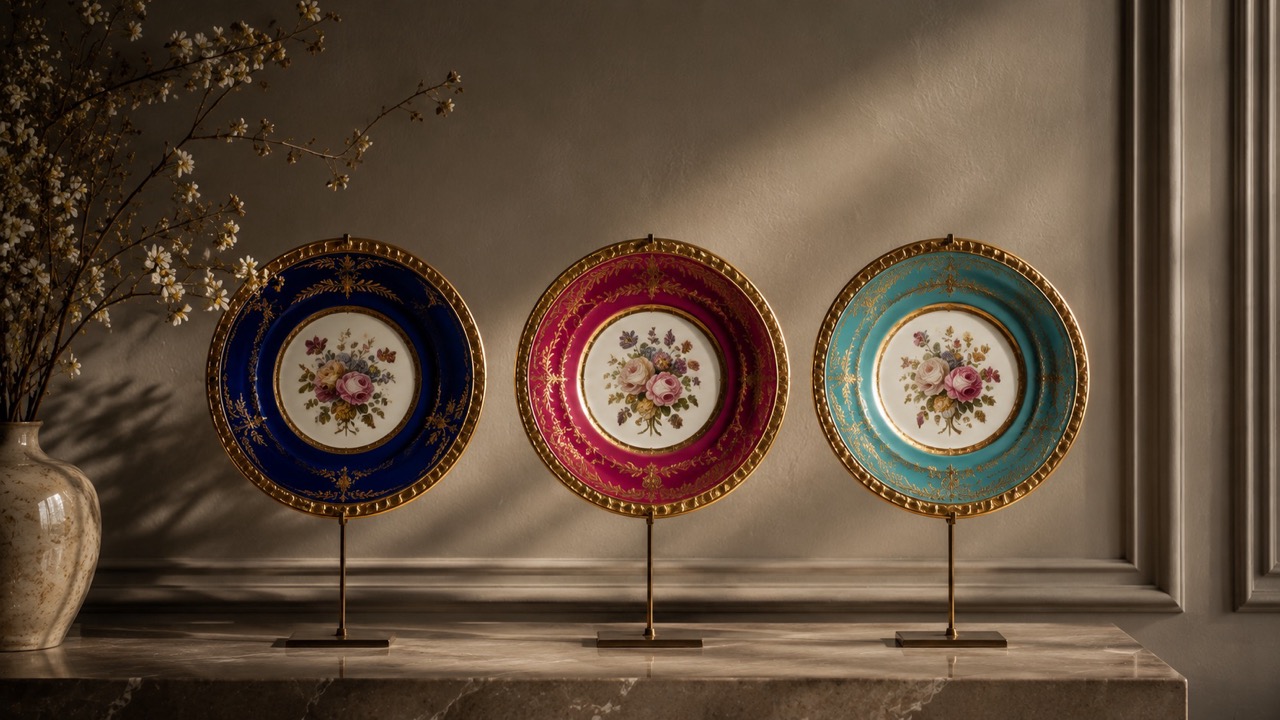
Porcelain is the only material in the decorative arts whose European history begins with an obsession. For three centuries, from the first Portuguese imports of Chinese blue-and-white in the sixteenth century, European courts coveted, collected, and attempted to reverse-engineer a material whose secret — the combination of kaolin, petuntse, and firing temperatures above 1,300 degrees Celsius — eluded every alchemist, potter, and royal commission that pursued it. Augustus the Strong of Saxony, whose porcelain mania was legendary even by the standards of absolutist collecting, reportedly traded an entire regiment of dragoons for forty-eight Chinese vases. The obsession was not merely aesthetic. Porcelain represented a civilisational challenge: proof that China possessed a technology the West could not replicate. When Johann Friedrich Böttger finally cracked the formula in Meissen in 1710, he did not merely found a manufactory. He shifted the balance of cultural self-confidence between continents.
Meissen: The First and the Finest
The Royal Porcelain Manufactory at Meissen, established under Augustus’s patronage and kept under conditions of near-imprisonment to prevent the secret’s escape, produced the first true hard-paste porcelain in Europe. The early Meissen pieces — the red stoneware of Böttger’s initial experiments, the white wares that followed, and the spectacular painted services that emerged under the artistic directorship of Johann Gregorius Höroldt — established a standard of quality that became the benchmark against which every subsequent European porcelain manufactory measured itself. The crossed swords mark, applied to Meissen porcelain since 1720, is among the oldest trademarks in continuous use, and the pieces that bear it from the factory’s first decades command prices at auction that reflect both their rarity and their historical significance.
Sèvres: Porcelain as Statecraft
The French response to Meissen was, characteristically, a matter of royal ambition and aesthetic originality rather than mere imitation. The manufactory established at Vincennes in 1740 and moved to Sèvres in 1756 under the direct patronage of Louis XV (who personally sold the annual production at Versailles, making it diplomatically inadvisable to leave the sale without a purchase) developed a soft-paste porcelain of distinctive character — warmer in tone than Meissen’s hard paste, with a glaze that accepted colour with a depth and a luminosity that the German product could not match. The bleu de roi, the rose Pompadour, and the turquoise grounds developed at Sèvres remain among the most celebrated colours in the history of the decorative arts, and the gilding — applied by specialist doreurs whose skill has been transmitted through unbroken apprenticeship for nearly three centuries — possesses a richness that modern reproduction consistently fails to match.
Limoges: The Democratic Porcelain
The discovery of kaolin deposits near Limoges in 1768 transformed a regional pottery centre into the porcelain capital of France — a position it retains. Where Meissen and Sèvres produced for courts and collectors, Limoges developed a production model that made fine porcelain accessible to the bourgeois table: the dinnerware service, the tea service, the individual piece chosen for daily use rather than display. The great Limoges houses — Haviland, Bernardaud, Raynaud — continue to produce table porcelain of the highest quality, and the best contemporary pieces, decorated by hand in ateliers that employ techniques unchanged since the nineteenth century, represent a quality of domestic object that mass production has not been able to replicate or replace.
The Contemporary Porcelain Revival
The past two decades have seen a remarkable revival of interest in porcelain as a medium for contemporary artistic expression. Artists including Edmund de Waal — whose installations of hundreds of small porcelain vessels, arranged in vitrines with a minimalist rigour that owes as much to Mondrian as to the Song Dynasty, have entered the permanent collections of the V&A and the Kunsthistorisches Museum — have demonstrated that porcelain is not a historical material but a living one, as capable of expressing contemporary ideas as any medium available. The collaboration between the great European manufactories and contemporary designers — Meissen’s partnership with artists including Chris Antemann, Sèvres’s programme of limited-edition artist commissions — has produced work that honours the tradition’s technical excellence while extending its expressive range into territory that Augustus the Strong could not have imagined.
Three centuries after Böttger’s discovery, the material that began as an obsession remains one — refined by time, enriched by the accumulated knowledge of hundreds of master craftspeople, and still capable of producing objects whose beauty is inseparable from the difficulty of their making. The crossed swords, the interlaced Ls, the Limoges mark: these are not mere trademarks but guarantees of a continuity that connects the cup in your hand to the kilns of three centuries ago.