
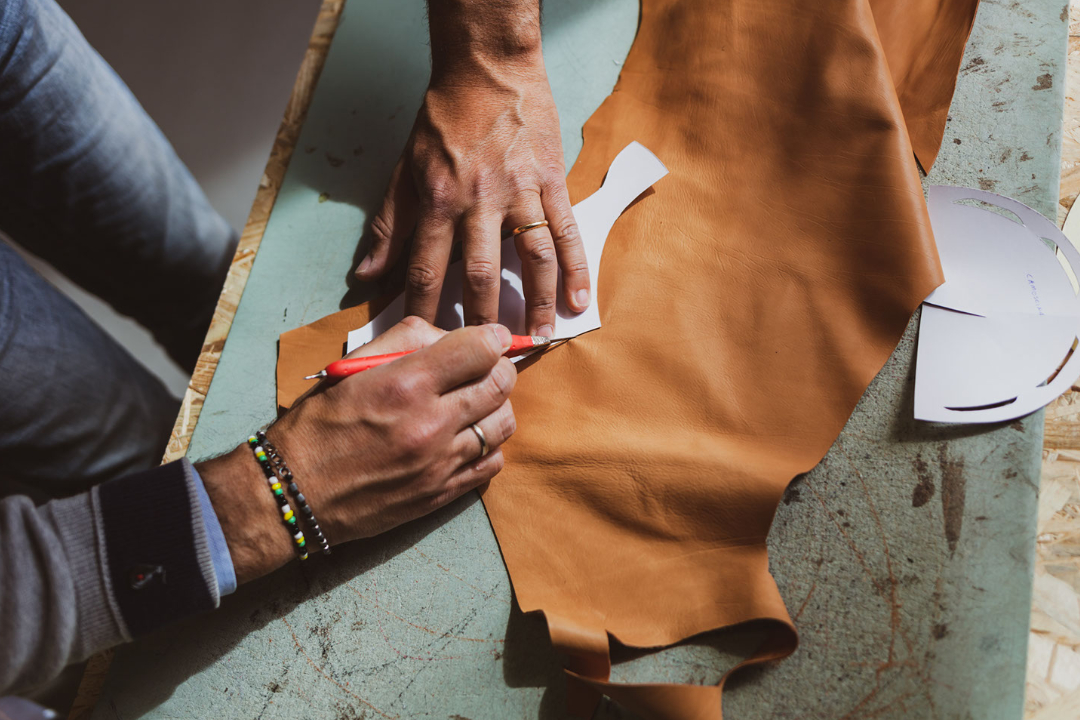
In a laboratory outside Paris, a team of material scientists employed by one of the world’s oldest luxury houses examines a sheet of something that looks, feels, and behaves like the finest calf leather. It is not. It grew from mycelium — the root structure of mushrooms — in a bioreactor over the course of weeks rather than the years required to raise, slaughter, and tan an animal. The house will not name the product until it is ready. But ready, they insist, it nearly is.
Hermès and the Mushroom
When Hermès unveiled its Victoria bag in Sylvania — its proprietary mushroom-based material developed with MycoWorks — the gesture was deliberately understated. No press conference, no sustainability manifesto, no suggestion that the house was abandoning leather. Instead, a single bag, presented alongside its traditional leather siblings, inviting comparison on purely material terms. The message was clear: this is not a compromise. This is an expansion of the palette.
The development had taken years and reportedly tens of millions of euros. Hermès’s approach was characteristically patient — the house that famously measures its ambitions in generations rather than quarters was never going to rush a material to market before it met the standard that six generations of craftsmen had established for leather. Sylvania had to earn its place in the atelier on merit, not on moral argument.
Stella McCartney: The Intellectual Pioneer
Stella McCartney has operated without leather or fur since her house’s founding in 2001 — a position that was once considered commercially suicidal for a luxury brand and is now recognised as visionary. Her partnership with Bolt Threads produced garments in Mylo, another mycelium-based material, while her ongoing collaborations with biotech firms have explored lab-grown silk, algae-based yarns, and grape-skin leather alternatives.
What McCartney understood earlier than most is that material innovation is not peripheral to luxury — it is its essence. The great houses were built on material mastery: Hermès’s understanding of leather, Chanel’s transformation of jersey from underwear fabric to haute couture, Fortuny’s secret pleating techniques. Innovation in materials is not a departure from luxury tradition. It is luxury tradition.
Kering’s Billion-Euro Wager
Kering — parent of Gucci, Saint Laurent, Balenciaga, and Bottega Veneta — has invested systematically in material science through its Materials Innovation Lab, which now contains more than 3,800 certified sustainable fabrics and alternatives. The group’s partnership with Bolt Threads, its investment in Worn Again Technologies for textile-to-textile recycling, and its development of a proprietary environmental profit-and-loss accounting system represent a scale of commitment that only a conglomerate of Kering’s size could sustain.
François-Henri Pinault’s thesis is straightforward: the house that solves materials first wins the century. If petroleum-based synthetics become untenable and animal agriculture faces increasing constraint, the luxury group that has already developed alternatives of equivalent beauty and performance holds an unassailable competitive position. This is not philanthropy. It is strategy of the most cold-eyed kind.
LVMH: The Quiet Infrastructure
LVMH’s approach has been characteristically different from Kering’s — less public, more infrastructural. Its LIFE 360 programme sets targets across the group, while individual maisons pursue their own material research. Loewe has explored cactus-based leathers. Dior has worked with Parley for the Oceans on recycled marine plastic. Loro Piana — always the most material-obsessed of luxury houses — continues its decades-long investment in the rarest natural fibres: vicuña, baby cashmere, lotus flower silk.
The LVMH model assumes that material innovation will come from within each house’s existing craft tradition rather than from a centralised laboratory. A Loewe leather artisan experimenting with new substrates brings decades of haptic knowledge to the evaluation. They know how a material should feel under the needle, how it should age, how it should respond to the hand of the eventual owner. This craft intelligence cannot be replicated by a materials scientist alone.
Beyond “Sustainable”
The language of sustainability has become so debased by greenwashing that the serious houses have largely abandoned it. What they pursue instead is something more ambitious and more honest: materials that are not merely less harmful than their predecessors but actively superior in some dimension — lighter, more durable, more responsive to craft techniques, capable of colours or textures that animal leather cannot achieve.
This is the crucial distinction. The next generation of luxury materials will not succeed because consumers feel guilty about leather. They will succeed because a mushroom-derived material can be grown to precise thickness specifications impossible in animal hide, because lab-grown silk can be engineered for strength characteristics that silkworms cannot produce, because bio-fabricated materials can be designed from the molecular level up to meet exact performance criteria.
The great houses are not building alternatives. They are building what comes next — materials as extraordinary as anything nature provides, grown rather than taken, designed rather than inherited. The atelier of the future will select its materials from a palette undreamed of by previous generations of craftsmen, and it will do so not because the world demands it, but because the possibilities are genuinely more beautiful than what came before.