
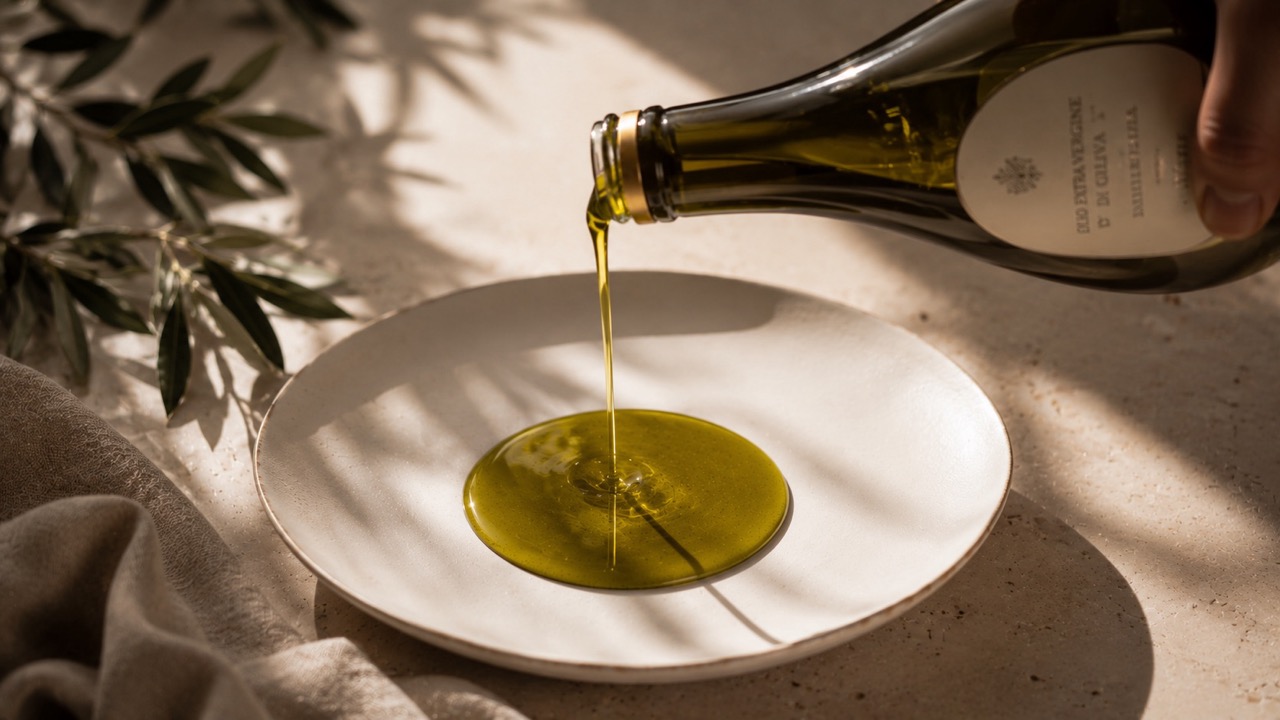
The wine world’s vocabulary of terroir, vintage, varietal character, and estate production has never been systematically applied to olive oil, and this is among the more consequential oversights in gastronomy. A single-estate extra virgin olive oil from a named grove, pressed from a specific cultivar within hours of harvest, in a specific year, is as terroir-expressive, as vintage-variable, and as capable of complexity as any wine — and considerably less likely to disappoint at the table, since olive oil at its best is one of the most universally delicious things the human palate encounters. The connoisseur who approaches olive oil with the same seriousness they bring to wine discovers a world of comparable depth and considerably less pretension.
Tuscany: The Frantoio and the Philosophy of Amaro
Tuscan olive oil, at its finest, possesses a characteristic that initially surprises and subsequently converts: a pronounced bitterness on the mid-palate, followed by a pepperiness in the throat that the Italians call pizzica and that indicates, with the reliability of a chemical assay, high polyphenol content and, therefore, both quality and health benefit. The great Tuscan estates — Laudemio, Capezzana, Frescobaldi’s Laudemio — produce oils from the Frantoio, Moraiolo, and Leccino cultivars that are pressed within hours of harvest in November, when the fruit is still partially green and the resulting oil is at its most intense. A newly pressed Tuscan oil, tasted on bruschetta rubbed with garlic, is one of the great simple pleasures of the gastronomic year — an experience of such directness and vitality that it recalibrates the palate’s expectations of what a condiment can be.
Andalusia: The World’s Largest Olive Garden
The province of Jaén in Andalusia produces more olive oil than the entire country of Greece, and the landscape — sixty million olive trees stretching to every horizon, their silver-green canopy covering the rolling hills with a uniformity that makes the terrain resemble a vast, shimmering sea — is among the most striking agricultural vistas in Europe. The quality revolution in Spanish olive oil over the past two decades has transformed what was once a bulk commodity into a category of genuine connoisseurship. Estates like Castillo de Canena, whose Arbequina and Picual oils have won every significant international competition, demonstrate that Spanish olive oil at the top level rivals the best Italian production in complexity and frequently surpasses it in value.
Greece: The Koroneiki and the Taste of Antiquity
Greek olive oil is, in one sense, the original: the olive was domesticated in the eastern Mediterranean, and the oil pressed from it was the foundation of an economy, a cuisine, and a civilisation. The Koroneiki cultivar, which dominates Greek production, produces an oil of distinctive character — fruity, with green-apple and herb notes, a moderate bitterness, and a persistence of flavour that lingers on the palate long after the tasting. The estates of the Peloponnese, Crete, and the Ionian islands produce oils of a quality that the international market is only beginning to recognise, and the informed buyer who seeks out named estates — Olio Ferrini in Laconia, Terra Creta in the Kolymvari region of western Crete — discovers oils of exceptional quality at prices that Italian equivalents would not approach.
The Tasting: How to Approach Oil as You Approach Wine
The professional olive oil tasting protocol — blue glass (to eliminate the colour bias that yellow glass introduces), covered and warmed in the palm, the aroma assessed before the taste, the oil drawn across the palate with an inward breath that distributes it across the taste receptors — is a discipline as formalised and as revealing as wine tasting. The vocabulary maps onto familiar territory: fruitiness (green or ripe), bitterness (an indicator of polyphenol content), pungency (the pepperiness that signals freshness), and the defects — rancidity, fustiness, mustiness — that indicate poor storage or processing. The educated palate, trained through comparative tasting, can distinguish cultivars, regions, and harvest dates with a specificity that would not disgrace a wine professional.
The final parallel with wine is the most important: like wine, olive oil is alive. It changes from the moment of pressing, and its optimal window of consumption — within eighteen months of harvest for most extra virgin oils — is dramatically shorter than most consumers realise. The bottle of supermarket olive oil that has sat in a kitchen cabinet for two years is not olive oil in any meaningful sense; it is a fat that has lost everything that made it worth pressing. The connoisseur buys the current harvest, stores it in darkness, uses it generously, and replaces it before the next season’s oil appears. This rhythm — annual, seasonal, connected to the agricultural calendar — is itself a pleasure, and one that olive oil, like wine, offers to anyone willing to pay attention.