
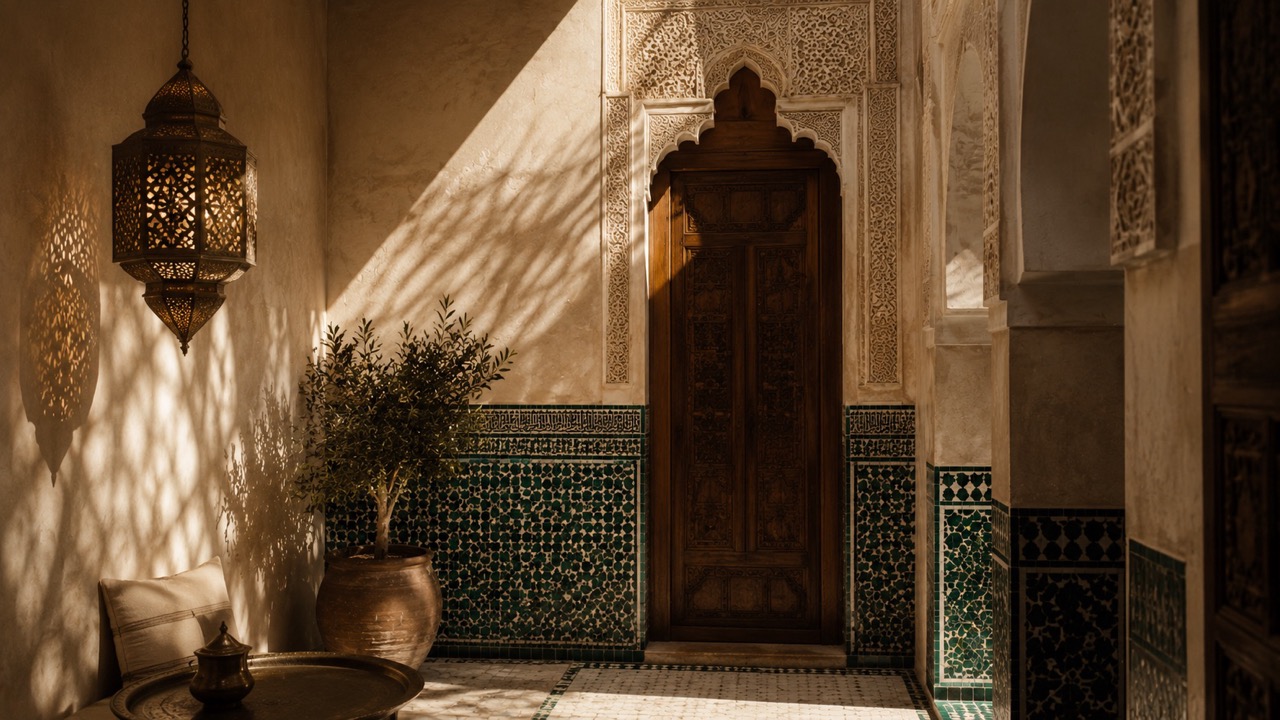
From the narrow derb — the medina alleyway where donkeys press past and the air thickens with cumin and cedar smoke — you push open an unremarkable wooden door and step into silence. A courtyard of zellij tilework rises around a central fountain whose murmur is the only sound. Orange trees frame the sky. The temperature drops five degrees. This is the genius of the riad: a dwelling that turns its back entirely on the city’s chaos and creates, within walls of rammed earth and plaster, a private paradise. In Marrakech, Fez, and Essaouira, these courtyard houses have been transformed into some of the world’s most intimate and architecturally extraordinary places to stay — and the best of them offer an experience of luxury fundamentally different from anything the international hotel industry can produce.
The Architecture of Interiority
The riad — from the Arabic riyad, meaning garden — is defined by its inversion of Western architectural logic. Where European houses present their finest facades to the street and reserve their utilitarian spaces for the interior, the riad shows nothing to the outside world: blank walls, a single door, no windows at ground level. All beauty is directed inward, toward the central courtyard that functions as the building’s heart, lungs, and soul. This is architecture as philosophy: the conviction that private life is sacred, that beauty exists for its inhabitants rather than for display, that the most luxurious space is the one invisible to the world. The courtyard’s proportions — typically square, with a fountain at centre and orange or lemon trees providing shade — are governed by principles of Islamic geometry: ratios that produce a sensation of harmony so complete that the eye rests rather than searches. Above, the terrasse offers the counterpoint: open sky, the muezzin’s call, the Atlas Mountains on the southern horizon.
Royal Mansour: The Riad as Total Vision
The Royal Mansour in Marrakech — commissioned by King Mohammed VI and designed to represent the absolute pinnacle of Moroccan craft — takes the riad concept to its logical extreme. Each of its fifty-three accommodations is a freestanding riad: three storeys of private living space around an individual courtyard, connected by underground passages through which staff move invisibly. The craftsmanship is staggering — fourteen hundred artisans worked for three years on the carved plaster (gebs), painted cedarwood ceilings (zouak), and mosaic tilework — but what distinguishes the Royal Mansour from mere opulence is the completeness of its vision. Every surface, every transition, every proportion adheres to the principles of traditional Moroccan architecture while incorporating contemporary comfort with total invisibility. It is not a hotel that references riad architecture. It is a medina in miniature — a private city of courtyards, gardens, and rooftop terraces that functions as both museum and living space.
La Mamounia: Garden as Protagonist
La Mamounia occupies a different position in Marrakech’s hospitality landscape — not a riad in the strict sense but a palace hotel whose twelve acres of gardens, originally gifted to a prince in the eighteenth century, embody the same principle of enclosed paradise. The building — Art Deco by Jacques Majorelle’s generation, recently restored by Patrick Jouin and Sanjit Manku — frames its gardens rather than competing with them. The olive and citrus groves, the rose beds, the paths beneath ancient palms that Churchill painted and Hitchcock admired — these are not amenities but the property’s reason for existence. La Mamounia proposes that luxury is horticultural: that a garden of sufficient age and beauty is the highest form of architecture, and that the building’s role is merely to provide the vantage point from which to contemplate it.
The Private Riads: Four Suites and an Owner
Beyond the grand properties lies a category of accommodation unique to the medina: the privately owned riad of four to six suites, restored by a single individual — often a European architect, designer, or aesthete — and run with the intensity of a personal project rather than a commercial operation. Riad Jaaneman, behind its door in the Mouassine quarter, offers five rooms of extraordinary refinement — a Belgian owner’s obsessive attention to Moroccan craft expressed through contemporary spatial intelligence. El Fenn, Vanessa Branson’s three-riad compound near the Bab el Ksour, functions as part gallery, part guest house, part collector’s residence. Dar Ahlam in Skoura — technically outside the medina, in a kasbah amid date palms — extends the principle to its furthest point: five suites, no fixed menu, no schedule, every meal and activity bespoke to each guest. These properties share a quality impossible at larger scale: the feeling that one is not a guest in a hotel but a guest in someone’s home — that the aesthetic intelligence visible in every surface, every textile, every carefully placed object is personal rather than corporate.
Fez and Essaouira: Beyond Marrakech
Marrakech dominates the riad conversation, but Fez offers the tradition in its purest and most ancient form. The medina of Fez el-Bali — the largest car-free urban area on earth — contains riads of a scale and ornamental richness that surpass even Marrakech’s finest. Riad Fès, Palais Amani, and the extraordinary Riad Laaroussa (a seventeenth-century palace with a garden courtyard of mature orange trees) offer an experience closer to time travel than to tourism. Essaouira provides the coastal variation: smaller riads with Atlantic light pouring through upper-floor windows, the sound of waves replacing the muezzin, the air salt-tinged rather than spice-heavy. Heure Bleue Palais, with its rooftop pool overlooking the ramparts and the ocean, demonstrates that the riad principle — interiority, courtyard, paradise contained — adapts to any Moroccan setting while retaining its essential character.
To stay in a riad is to understand, viscerally, a principle that Western architecture largely abandoned centuries ago: that the most powerful luxury is not visibility but concealment, not display but enclosure, not the grandeur of the facade but the perfection of the interior world. Behind every unremarkable door in the medina lies the possibility of paradise — and it is this possibility, renewed each time a door opens onto a courtyard of tilework and orange blossom and silence, that makes Morocco’s riads among the most civilised places to sleep on earth.