
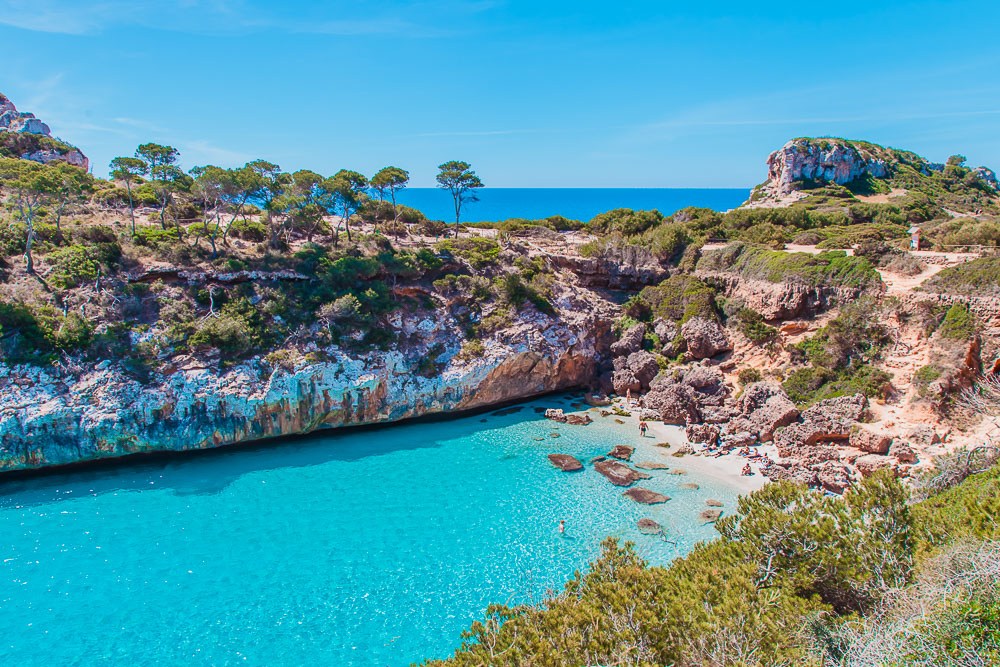
Mallorca is one of the Mediterranean’s most written-about destinations and one of its most consistently misrepresented. The island that appears in the imagination of the first-time visitor — a landscape of party resorts and crowded beaches, package holidays and synthetic sangria — is real enough along its southeastern coast and the strip west of Palma. But it is a thin veil over something altogether different: an island of extraordinary geological and cultural complexity, with an interior that feels, in August’s deepest heat, as remote and as ancient as anything in the Iberian Peninsula. The traveller who moves beyond the postcard finds a Mallorca that rewards every quality of attention they bring to it.
Palma: A Capital of Unsuspected Depth
Begin, as one always must, in Palma — but begin early, before the cruise ships have disgorged their thousands and the cathedral square has filled. The Cathedral of Santa Maria, known as La Seu, is among the most ambitious Gothic structures in the world: begun in 1229, its nave achieves a height of forty-four metres and its great rose window — fourteen metres in diameter — is arguably the finest example of Gothic tracery in existence. What is less commonly known is that Antoni Gaudí spent fourteen years in the early twentieth century restoring the cathedral’s interior, adding the wrought-iron baldachin over the altar and repositioning the choir in ways that remain controversial and fascinating in equal measure. This layering of Gothic ambition and modernist intervention, in a building facing a harbour where Phoenicians once traded, is Mallorca’s architectural biography in miniature.
The old city’s neighbourhood of Es Baluard, clustered within the Renaissance walls, has become one of the Mediterranean’s most quietly compelling cultural precincts. The contemporary art museum of the same name occupies a former bastion with a dramatic rooftop terrace; around it, a constellation of independent galleries, concept stores, and restaurants in restored medieval buildings constitute a neighbourhood that rewards wandering without agenda.
The Tramuntana: Stone, Olive, and Light
The Serra de Tramuntana, the mountain range that runs along Mallorca’s northwestern coast, was declared a UNESCO World Heritage Cultural Landscape in 2011 — an unusual designation that recognises not just the landscape itself but the millennia of human modification that shaped it. The Arabs who governed the island from the tenth to the thirteenth centuries engineered an extraordinary system of terraced agriculture and water management across these steep limestone slopes, and the terraces they built — kilometres of dry-stone walls, each stone placed by hand — still define the character of the landscape today. Olive trees of inconceivable age, their trunks hollowed and twisted into sculptural forms by centuries of wind and drought, occupy terraces that have been worked continuously since the Moorish period.
The villages of Deià, Valldemossa, and Fornalutx each offer a different aspect of this mountain culture. Deià, where Robert Graves spent most of his adult life and where a bohemian international community has gathered ever since, perches above a pebbled cove with views of improbable drama. Valldemossa, where Chopin and George Sand famously wintered in 1838 in a former Carthusian monastery, carries a slightly melancholy beauty in the grey months. Fornalutx, consistently ranked among Spain’s most beautiful villages, is a masterclass in the aesthetic possibilities of local stone, its steep lanes and flowering balconies suggesting a version of Mediterranean life untouched by the twentieth century.
The Interior: A Different Island Entirely
The Mallorcan interior — the Pla, the flat plain at the island’s centre — is where the island’s agricultural identity persists most purely. Here, among almond groves that bloom white in February and carob trees whose pods have fed generations of livestock, the great country estates known as possessions still occupy the landscape as they have since the medieval period. Some have been converted into hotels of extraordinary character: Son Brull, near Pollença, occupies an eighteenth-century monastery whose austerely beautiful architecture has been restored with a sensitivity that does not conflate contemporary comfort with the erasure of history.
The island’s interior table is one of its greatest pleasures. Sobrassada, the soft, spiced cured sausage made from the black-footed Mallorcan pig, is spread on bread still warm from wood-fired ovens. Tumbet, a layered vegetable dish of aubergine, potato, and pepper in tomato sauce, is the island’s answer to ratatouille — simpler, more direct, and deeply satisfying. The wine grown in the Binissalem denomination, from the indigenous Manto Negro grape, has improved dramatically over the past two decades and now produces reds of genuine distinction.
The True Character of the Island
What one comes to understand, spending time in Mallorca beyond the immediate resort experience, is that the island’s true character is one of remarkable tenacity. It has absorbed Phoenicians and Romans, Arabs and Catalans, artists and billionaires, and has remained, beneath all of these encounters, fundamentally itself: a limestone island of great natural beauty, worked for millennia by people who understood that beauty and utility need not be in opposition. The dry-stone walls of the Tramuntana, the great Gothic nave of La Seu, the gnarled olive trees of the interior — all of them say the same thing in different registers: that the finest things endure through the quality of their making and the depth of the attention brought to them.
That is the Mallorca worth knowing — and it asks only that you arrive with time enough to look past the first impression to the real thing beneath.