
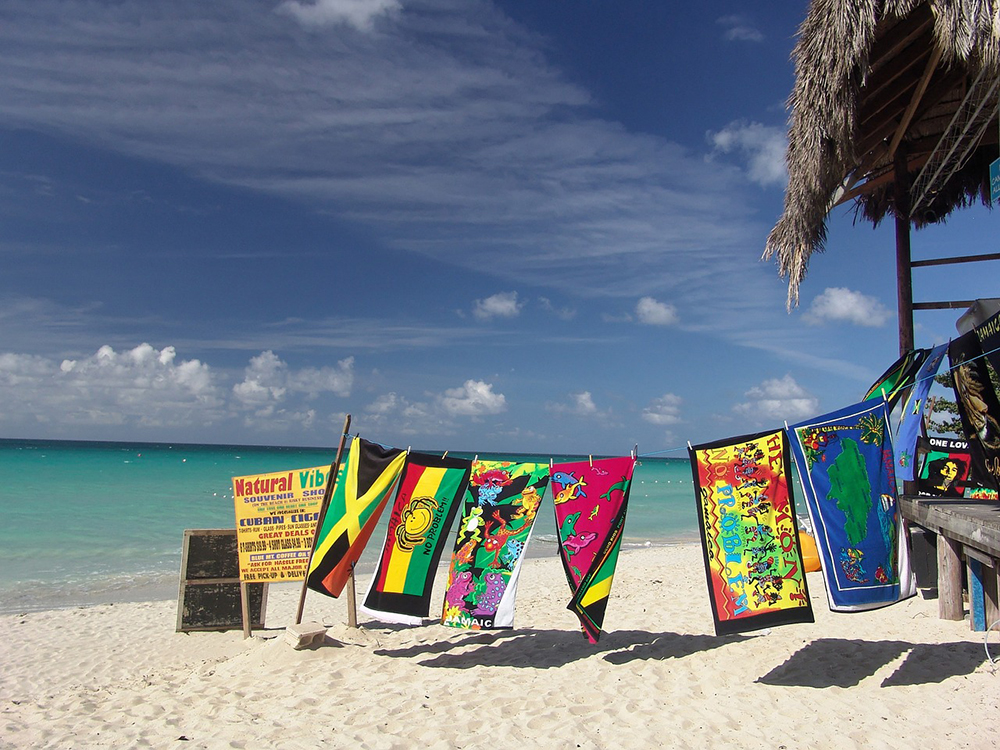
There is another Jamaica — one that exists far from the swim-up bars and regimented excursion buses, where creativity pulses through Kingston’s streets with the same insistence as a riddim track at dawn. This is the Jamaica of painters and poets, of third-generation jerk masters and coffee farmers whose families have worked Blue Mountain slopes since emancipation. It is a place of extraordinary cultural depth, and it rewards those who arrive not as tourists but as students.
Kingston’s Defiant Canvas
The National Gallery of Jamaica, housed in a modernist block on Ocean Boulevard, holds what is arguably the Caribbean’s finest permanent collection — Edna Manley’s sculptural work alone justifies the visit, her Negro Aroused capturing a century of postcolonial aspiration in bronze. But Kingston’s art scene has long since spilled beyond institutional walls. The muralists of Fleet Street and the Downtown corridor have transformed Kingston’s concrete into an open-air gallery, their work shifting between Rastafarian iconography, pointed political commentary, and pure chromatic exuberance. Studios in the Liguanea and Barbican districts welcome visitors who know to ask; these are not galleries in the commercial sense but working spaces where sculpture, painting, and installation exist in constant dialogue with the island’s fraught, fertile history.
The Mountain and the Bean
Blue Mountain coffee is one of the world’s most regulated single-origin beans, its growing region defined by altitude and microclimate with a specificity that would satisfy a Burgundian vigneron. The estates — Clifton Mount, Mavis Bank, the Craighton Estate with its plantation-era great house — offer not mere tastings but immersion in terroir. The mist-wrapped slopes above two thousand feet produce a bean of uncommon sweetness, almost entirely free of bitterness, and the processing methods here — hand-pulped, sun-dried on barbecues, rested in parchment — belong to a tradition that predates the commodity market’s homogenising impulse. One visits not for the cup alone but for the landscape: precipitous green ridges dissolving into cloud, the air thin and floral, the silence broken only by the streamertail hummingbird’s territorial complaint.
Jerk as Serious Cuisine
To reduce jerk to a seasoning is to misunderstand it entirely. The tradition is technique, ritual, and terroir compressed into smoke. The original Maroon method — pimento wood, scotch bonnet, allspice, slow heat in a covered pit — produces something that no backyard barbecue can replicate. At Boston Bay in Portland, where the tradition is strongest, the jerk pits operate with the quiet confidence of establishments that need no signage. The pimento smoke carries for hundreds of metres, a fragrant announcement. What arrives — chicken or pork, sometimes fish — is layered, complex, the heat subordinate to depth. This is peasant food elevated by centuries of refinement, as worthy of serious culinary attention as any charcuterie tradition in the Auvergne.
Beyond the Reggae Postcard
Jamaica’s musical heritage is too often flattened into a Bob Marley compilation. The island’s sonic history runs deeper and stranger: from mento’s calypso-adjacent storytelling through ska’s kinetic optimism, rocksteady’s aching romanticism, and dub’s radical deconstruction of the recording studio itself into an instrument. Studio One on Brentford Road remains hallowed ground — Coxsone Dodd’s labels produced hundreds of foundational recordings in a space no larger than a suburban garage. Tuff Gong, the Marley family’s studio and pressing plant on Hope Road, operates as both working facility and informal museum. But the living tradition matters more than the monuments — the dancehall sessions in Waterhouse, the sound system culture that influenced everything from UK garage to Berlin techno, the dub poets who carry the tradition of Louise Bennett into digital-age Kingston. One hears the island’s entire postcolonial narrative in its music: resistance, joy, exile, return.
Fleming’s Golden Eye
Ian Fleming wrote every Bond novel at GoldenEye, his estate on the north coast near Oracabessa. The property — now an Island Outpost hotel — retains its mid-century spareness: louvred windows open to the Caribbean, the writing desk positioned to catch the trade winds, the reef he snorkelled each morning still teeming with the same parrotfish and elkhorn coral. Fleming was drawn to Jamaica’s particular combination of beauty and danger, its reef-sharp light and shadow — qualities that infused the Bond novels with a sensuality absent from the grey London of their composition. Noël Coward followed, building Firefly on the hill above, where his piano still sits facing the view that made him weep. Errol Flynn had preceded them both, drawn to Port Antonio’s dramatic coastline and rainforested mountains. This stretch of coast attracted a creative class that recognised in Jamaica something Europe could no longer offer — an intensity of colour and sensation that made art feel urgent, that insisted the senses were not incidental to the creative life but its very foundation.
The Jamaica that exists beyond the resort wall is not hidden, merely overlooked by those who mistake proximity for access. It asks something of its visitors: curiosity, patience, a willingness to be moved by complexity rather than comfort. What it offers in return — art born of resistance, cuisine refined by centuries, music that remade the world — is immeasurably richer than any all-inclusive package could contain.