
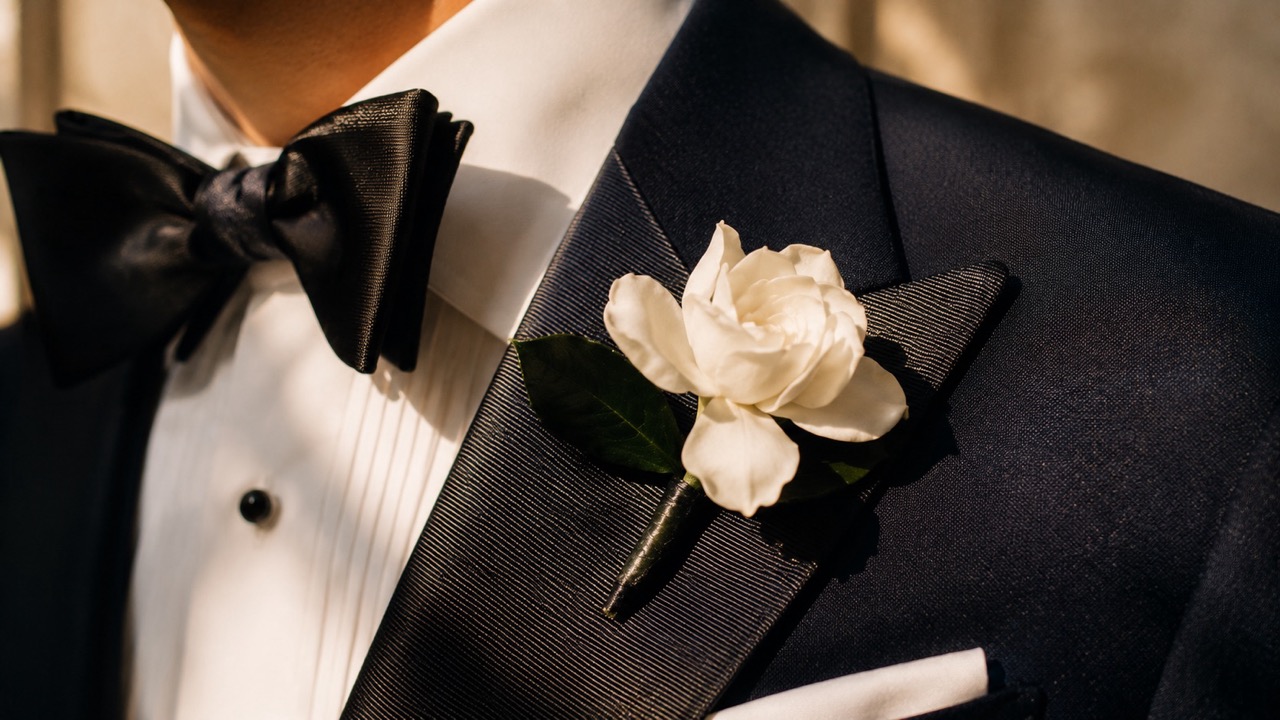
There are few moments in a man’s life that clarify his relationship with elegance as precisely as the occasion requiring a tuxedo. The dinner jacket — that masterpiece of Victorian ingenuity refined by a century of Savile Row expertise and Hollywood mythology — occupies a singular position in the masculine wardrobe: formal enough to command the evening, but liberated from the rigidity of white tie’s absolute protocol, and possessed of a visual authority that no other garment in the canon quite replicates. To wear it well is not a matter of simply acquiring the correct pieces. It is a matter of understanding what the garment means, how it was made, and the particular intelligence with which its details must be chosen and assembled.
The Historical Foundation
The dinner jacket emerged in the 1880s as a comfortable alternative to the tail coat for informal evening entertainments — the sort of private dinner or smoking room gathering where the full armour of white tie felt excessive. Edward VII, then Prince of Wales, reportedly wore an early version at Sandringham; American tobacco heir Griswold Lorillard is said to have introduced it to the New World at Tuxedo Park, New York, in 1886, from which the American name derives. For several decades it occupied an uncertain position — acceptable in some circles, considered underdressed in others — before the mid-twentieth century consolidated its status as the universal standard for black-tie occasions, a dress code that now spans opera galas, charity dinners, wedding receptions, and the more elevated registers of the private dinner party.
This history matters not as trivia but as orientation: the dinner jacket was conceived as a relaxation of formality, and the most assured wearers carry this understanding in the manner they wear it — with a certain ease, a suggestion that the clothes are an extension of the man rather than a costume assumed for the occasion. This quality of ease is learned, and it begins with the fit.
The Imperative of Fit
No principle in the architecture of the tuxedo supersedes fit. A suit of the finest cloth, cut indifferently, is simply an expensive disappointment; a less costly garment that fits the body with precision will always outperform it. The jacket should sit flat across the upper back with no collar gap; the shoulder seam should fall exactly at the shoulder’s natural end point, neither overhanging nor pulling inward; the sleeve should reveal approximately one centimetre of shirt cuff; the chest should button without pulling; the jacket length should cover the seat entirely when standing. These are not arbitrary aesthetic preferences but the grammar of correct tailoring, and deviation from them in any direction reads, to any trained eye, as wrong.
For the man investing seriously in a dinner jacket, the bespoke path — through the great Savile Row houses, or their equivalents in Naples, Milan, or New York — represents not extravagance but economy of a long-term kind: a correctly made suit of fine cloth that fits the specific body for which it was constructed will outlast and outperform three or four ready-to-wear alternatives. The made-to-measure option, offered by a growing range of high-quality tailors, provides much of this advantage at a more accessible price point, and for most men represents the intelligent middle ground between off-the-rack compromise and full bespoke investment.
Cloth and Construction
The traditional cloth for a dinner jacket is a fine wool barathea or a worsted with a subtle sheen that responds to evening light with a quiet richness. Velvet — midnight blue, deep burgundy, or black — is a magnificent choice for those of sufficient confidence, carrying a Victorian opulence that reads, on the right man in the right setting, as the highest expression of black-tie dressing. Pure silk is exceptional and exceptional is perhaps the correct word: magnificent for the warmest climates and the most formal occasions, but demanding of an assurance in wearing it that not every man possesses.
The lapel is among the dinner jacket’s most consequential details. The shawl lapel — that continuous curve from collar to button — carries the greatest historical authority and a particular fluidity of line that the peak lapel, though equally correct and somewhat more assertive, does not replicate. Both are entirely appropriate. The notch lapel, acceptable on a business suit, has no place on a dinner jacket: it is a compromise that satisfies neither formality nor elegance. The lapel facing, traditionally of grosgrain ribbon or silk satin, should match the trouser braid in character if not necessarily in precise material — consistency of detail being among the markers that distinguish the thoroughly considered ensemble from the assembled one.
The Supporting Cast
The shirt beneath the dinner jacket performs a role of quiet critical importance. A pleated or plain-fronted dress shirt in white cotton, with a stiff bib front and appropriate collar — wing or turndown, both correct, the choice a matter of personal preference and tie style — provides the brilliant white contrast that gives the tuxedo its particular graphic authority. The bow tie should be tied by hand, always: the pre-tied alternative, however convenient, carries a slight asymmetry of purpose that undermines the studied negligence at which successful black-tie dressing aims. A hand-tied bow carries the slight imperfection of the human gesture, and this imperfection is precisely correct.
The cummerbund, worn with pleats facing upward, provides the covered waistband that maintains the unbroken vertical line when the jacket is open. Waistcoat alternatives — either matching the jacket fabric or in a formal white piqué — are equally proper and add a layer of interest for those occasions when the jacket will be removed. Patent leather or highly polished black Oxford shoes complete the ensemble with an authority that no loafer, however expensive, can match.
The perfect tuxedo, ultimately, is not the most expensive or the most fashion-forward but the most correct for the specific man wearing it — a garment made or chosen with genuine understanding, worn with the ease that comes from knowing exactly why each decision was made, and carrying into the room that particular confidence which is the true foundation of all elegance.