
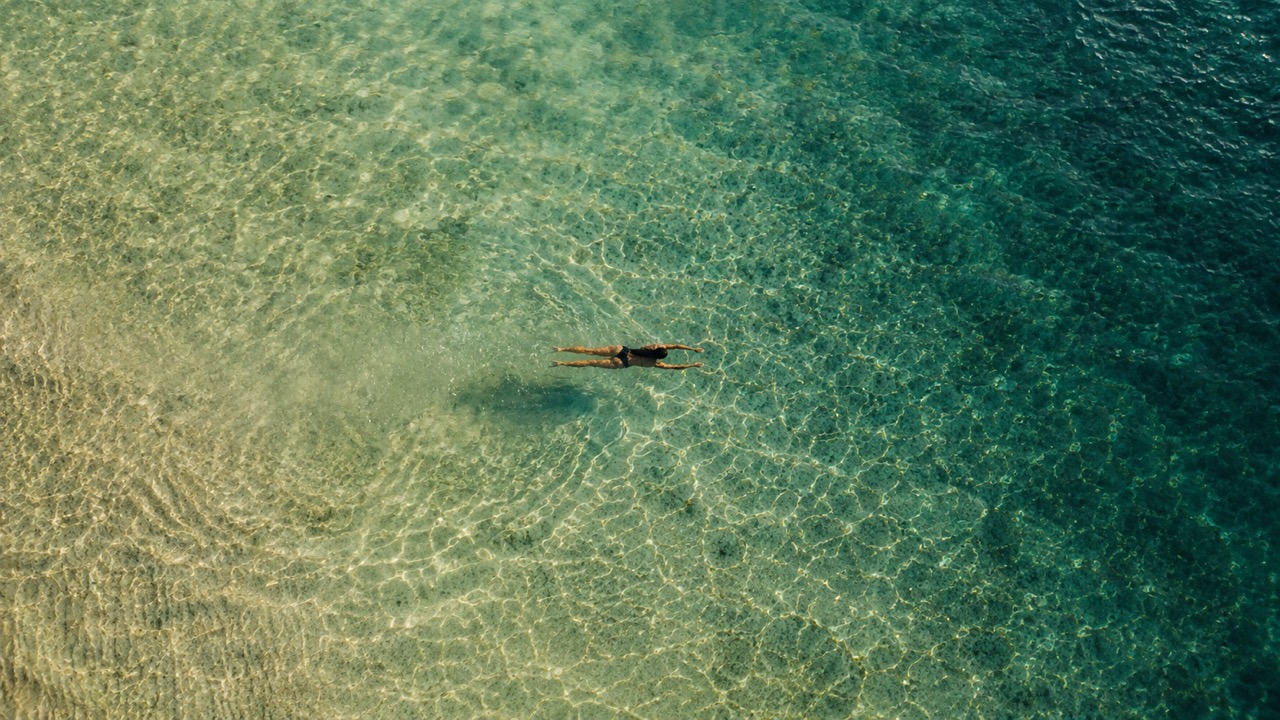
To see the earth from above is to see it abstractly — stripped of narrative, reduced to pattern, colour, and the geometry of human intervention upon landscape. A ploughed field becomes a Rothko. A river delta becomes a neural map. A city’s grid reveals the ideology that planned it. Aerial photography has always offered this defamiliarisation, but in the past decade — through the convergence of drone technology, satellite accessibility, and fine-art ambition — the view from above has become one of photography’s most vital and philosophically charged genres.
Steinmetz and the Abstract Earth
George Steinmetz has spent three decades photographing the planet from motorised paragliders and ultralight aircraft, working at altitudes between fifty and five hundred metres — too high for ground-level detail, too low for cartographic abstraction. This middle distance produces images of uncanny formal beauty: the salt evaporation ponds of San Francisco Bay as Mondrian compositions in rose and jade; the Saharan ergs as studies in repetition and shadow; the irrigated circles of Saudi agriculture as geometric proofs against the desert’s indifference. Steinmetz’s work operates at the intersection of documentary and abstraction — each image is factually precise yet aesthetically autonomous, requiring no caption to function as visual experience yet transformed by context into environmental commentary. His project represents aerial photography’s highest aspiration: to make the familiar planet genuinely strange.
The Drone Revolution
Consumer drone technology has democratised the aerial perspective with a speed that has fundamentally altered landscape photography’s economics and aesthetics. What once required chartered aircraft or dangerous ultralight flights is now achievable with equipment costing less than a professional lens. The consequences are double-edged: the volume of competent aerial imagery has exploded, flooding social media with technically proficient but conceptually vacant overhead views. Yet the best drone photographers — those who bring compositional intelligence and thematic coherence to the medium — have produced work that extends aerial photography’s formal vocabulary. The drone’s ability to hover, to shoot vertically downward, to operate in conditions and locations impossible for manned aircraft, has opened perspectives that the earlier generation could not access. The perfectly overhead view — what photographers call the “nadir” position — has become its own aesthetic category, transforming landscape into diagram with a single rotational choice.
Satellite Aesthetics
The availability of high-resolution satellite imagery — through Google Earth, Sentinel, and commercial providers like Maxar — has created an entirely new visual culture of the overhead view. Artists like Benjamin Grant, whose Daily Overview project selects and frames satellite imagery as aesthetic compositions, have demonstrated that the algorithmic gaze of orbital cameras can produce images of genuine beauty and philosophical resonance. A lithium mine in Chile, seen from space, becomes an arrangement of turquoise rectangles that recall swimming pools; seen with knowledge of its purpose, it becomes a commentary on extraction and the hidden costs of the technologies through which we view it. This oscillation between beauty and critique — between formal pleasure and ethical discomfort — is the satellite aesthetic’s particular contribution to visual culture.
Pattern, Scale, and the Human Mark
What aerial photography reveals, consistently and inescapably, is pattern — the repetitive geometries through which human civilisation organises itself upon the earth’s surface. Agriculture creates grids and circles. Roads create networks. Cities create densities. Deforestation creates edges. Climate change creates absences. The aerial view is inherently political because it reveals what ground-level experience conceals: the scale of intervention, the logic of planning, the consequences of accumulation. Edward Burtynsky’s elevated landscapes of industrial extraction — oil fields, quarries, tailings ponds — achieve their moral force precisely through altitude: only from above can one comprehend the totality of what has been done to the land. The aerial photograph is never innocent; it always contains an argument about stewardship.
The Fine-Art Print
Aerial photography has found an increasingly secure place within the fine-art market, its large-format prints commanding prices that reflect both technical achievement and aesthetic ambition. The genre’s particular appeal to collectors lies in its dual nature: these images function as both documentary evidence and abstract composition, satisfying simultaneously the desire for beauty and the desire for meaning. A Steinmetz print operates on the wall with the chromatic intensity of colour-field painting while retaining the indexical power of the photograph — it is, irreducibly, a picture of somewhere. This ontological doubleness — abstraction that never fully abstracts, documentation that transcends the documentary — gives aerial photography its distinctive position within contemporary visual culture.
The view from above has always been associated with power — the sovereign’s map, the general’s reconnaissance, the planner’s blueprint. What contemporary aerial photography offers is something more complex: not mastery over landscape but estrangement from it, a productive distance that reveals the patterns we cannot see while standing within them. In an age when our collective impact upon the earth has become the defining fact of geological time, the aerial view is no longer merely aesthetic. It is essential — the only perspective from which the full consequences of our presence can be comprehended, confronted, and perhaps, in time, addressed.