
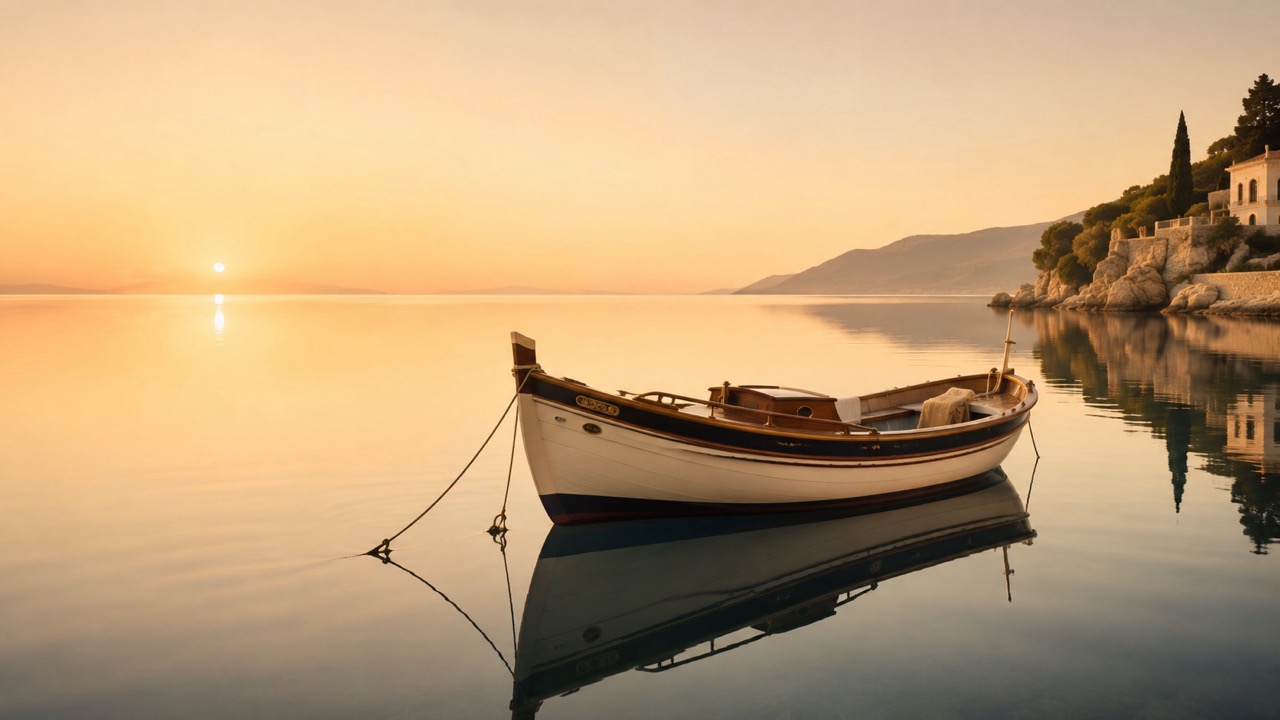
Long before the Napa Valley became synonymous with viticultural ambition, before the wine lists of the world’s finest restaurants turned their pages toward Burgundy and Bordeaux, the ancient sea-washed islands and sunlit mainland of Greece were already producing wine. Three thousand years of viniculture, at the very least — perhaps more. And yet, for generations, Greece’s extraordinary wine culture remained the province of those who had actually been there: travellers who remembered a carafe of amber Assyrtiko on a Cycladic terrace, the sea just beyond, and thought they would never taste anything so perfect again.
A Civilisation Expressed in the Glass
To understand Greek wine is to understand that no other wine-producing nation is more directly tethered to antiquity. The Greeks did not simply farm vineyards; they enshrined wine in their theology, their philosophy, their poetry. Dionysus was not merely a god of revelry — he was a civilising force, and wine was his instrument of culture. When Homer described the sea as “wine-dark,” he was not reaching for metaphor. He was describing a world in which wine permeated the very way one perceived colour, depth, and beauty.
This civilisational weight is something the finest Greek winemakers carry consciously. They are stewards not merely of terroir but of memory — custodians of indigenous grape varieties that exist nowhere else on earth, that survived the Ottoman centuries and the agricultural upheavals of modernity through the sheer stubbornness of the Greek landscape.
The Indigenous Varieties: A Connoisseur’s Lexicon
The Greek wine renaissance of the past three decades has been built, above all, on the rehabilitation of indigenous varieties — grapes that had spent centuries producing table wine for local consumption and are now commanding the attention of the world’s most discerning sommeliers. To curate a Greek wine experience worthy of the connoisseur is to begin with these varieties, each of which offers a sensory world entirely its own.
Assyrtiko, the great white variety of Santorini, is perhaps the most compelling. Grown in the volcanic caldera soil of an island that seems to hover between sea and sky, it produces wines of extraordinary mineral tension — lean, saline, with citrus notes that cut like sunlight through water. The finest examples, from producers such as Domaine Sigalas and Hatzidakis, age with the serene authority of great white Burgundy. A barrel-fermented Assyrtiko from a single estate vineyard on Santorini is one of the Mediterranean’s genuine vinous masterpieces.
From the northern reaches of Greece, the Xinomavro grape of Macedonia offers a counterpoint of thrilling complexity. Red-fruited and tannic, with a characteristic bitter finish and an aromatic profile that recalls dried roses and olive tapenade, great Xinomavro from Naoussa or Amyndeon has often been compared — by those who know both intimately — to Barolo or Burgundy. The Kir-Yianni estate and Thymiopoulos Vineyards have done much to bring this noble variety to international attention without compromising its formidable individuality.
The Terroir of Light and Stone
Greek terroir is a study in extremes. The country’s viticultural geography encompasses everything from the volcanic soils of the Cyclades to the cool altitude vineyards of Nemea and the sun-baked limestone of the Peloponnese. What unites these disparate landscapes is the quality of the light — fierce, Mediterranean, generous — and the proximity, nearly everywhere, of the sea.
The Peloponnese, ancient home of Agiorgitiko — a grape whose name means “St. George’s grape” and whose profile runs from supple rosé to profound, cellar-worthy red — offers perhaps the richest ground for exploration. Estates such as Gaia Wines and Skouras have demonstrated that this region is capable of producing wines of genuine grandeur, wines that speak of iron-rich red soils and ancient olive groves without the need for translation.
Curating the Experience
To assemble a curated Greek wine experience for a gathering of connoisseurs is an act of both scholarship and pleasure. One might begin with a chilled glass of Moschofilero — a pink-skinned grape from the high-altitude plateau of Mantinia — whose floral, almost Muscat-adjacent aromatics make it one of the world’s great aperitif wines. From there, an old-vine Assyrtiko alongside freshly shucked shellfish; then a vertical of Xinomavro with aged sheep’s milk cheese.
Presentation matters enormously. Decant your red Greeks generously — Xinomavro in particular benefits from air. Serve whites cooler than instinct suggests, then allow them to warm slowly in the glass, watching as the mineral complexity unfolds in layers. And always, if possible, accompany the experience with something that anchors it geographically: a bowl of Kalamata olives, a slab of proper feta in brine, a scattering of dried figs from the Aegean sun.
This is a wine tradition that rewards patience, curiosity, and the willingness to learn an entirely new vocabulary. Those who make that investment find themselves rewarded with some of the most distinctive, most historically resonant, and most genuinely thrilling wines available anywhere in the world. The Aegean, it turns out, is extraordinarily generous to those who seek its gifts with an open and attentive mind.