
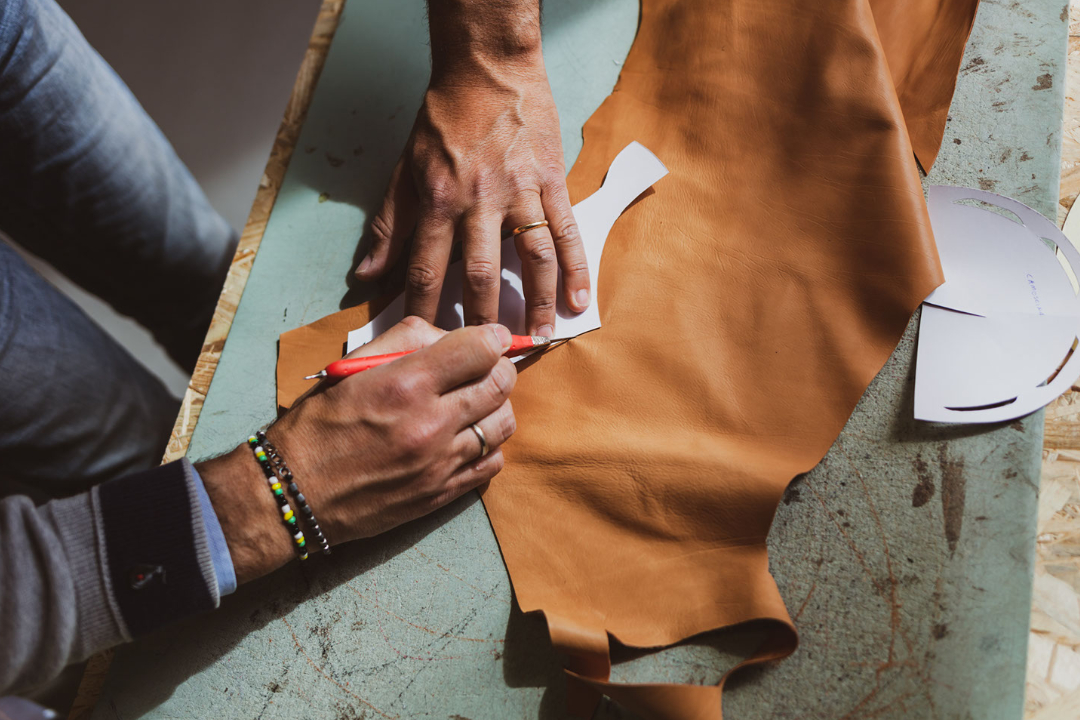
The Arno runs copper in autumn, carrying tannins from the chestnut forests upstream into the valleys where, for seven centuries, families have turned raw hides into something approaching eternity. In the tanneries of Santa Croce sull’Arno and the hills above Ponte a Egola, the greatest handbags in the world begin their lives — not in a designer’s atelier but in stone vats filled with oak bark and water, tended by hands that learned their pressure from fathers who learned from grandfathers.
The First Generation
The patriarch — call him Giovanni, though he might be any of a dozen men whose surnames appear on no label — established the conceria in the years after the war, when Tuscan agriculture could no longer sustain a family and the old vegetable-tanning traditions offered a path between the land and the factory. He knew which barks produced which colours: chestnut for warmth, quebracho for depth, mimosa for suppleness. He knew that the water from a particular spring, rich in specific minerals, produced a leather of incomparable hand. This was not science but accumulated empirical knowledge — the kind that lives in fingertips rather than textbooks.
That first generation sold to local saddlers, bookbinders, the artisans of Florence who still worked in leather as their medieval predecessors had. The hides were modest in volume, exceptional in quality, and utterly anonymous. No one outside the valley knew Giovanni’s name. But inside it, his leather was recognised by touch alone.
The Second Generation
The son — educated, ambitious, aware that the world beyond Tuscany was beginning to demand what his father produced — expanded the operation without industrialising it. He added vats, hired assistants from neighbouring families, but kept the vegetable-tanning process intact. When the first French houses came looking for Italian leather in the 1960s, drawn by the quality and the cost advantage over French tanneries, it was this generation that negotiated the relationships that persist today.
These relationships are not transactional in the way that word usually implies. A tanner does not merely supply a fashion house; he collaborates with it. When a designer imagines a particular quality — a leather that feels like paper but wears like armour, a hide that takes dye with a depth that suggests decades of patina — it is the tanner who must translate imagination into material reality. This requires not only technical skill but interpretive intelligence: the ability to understand what a designer means when they say a leather should feel “alive.”
The Third Generation
By the third generation, the conceria has become a reference point. The major houses — the ones whose names you know, whose bags command waiting lists measured in years — send their leather goods directors to this valley as a matter of course. The grandson has invested in environmental systems, water recycling, the certifications that contemporary commerce demands. But the tanning itself remains unchanged: hides submerged in vegetable liquors for weeks, turned by hand, dried in air rather than ovens, finished with oils whose formulations have not altered in decades.
This generation faces the peculiar challenge of modernity: how to meet the volume demands of global luxury while preserving the time-intensive processes that produce the quality those brands depend upon. A vegetable-tanned hide requires three to six weeks in the pits. There is no acceleration. Chrome tanning achieves similar visual results in hours — but the leather knows the difference, and so does anyone who has held both.
The Fourth Generation
The great-granddaughter — because it is increasingly the daughters who return, educated in both chemistry and commerce — inherits not merely a business but a body of knowledge that exists nowhere in written form. She knows by smell when a hide has reached the correct saturation. She knows by flexion when the fibres have absorbed sufficient oil. She knows by colour — not the surface colour but the colour revealed when the leather is cut — whether a batch will age beautifully or merely adequately.
She also knows that this knowledge, accumulated across a century, is the actual raw material of luxury goods. The designer provides the vision. The artisan provides the construction. But the leather — the foundation upon which everything else rests — comes from here. From this valley, this water, these hands.
The River and the Runway
When a customer handles a bag from one of the great houses — feeling the weight of the leather, its warmth, its particular response to pressure — they are touching something that began its journey in a Tuscan river valley, in a stone building whose walls are stained with centuries of tannin. The distance between that building and the boutique on the Avenue Montaigne is measured not in kilometres but in generations of knowledge, transmitted hand to hand, father to daughter, in a continuous chain that no factory, however sophisticated, can replicate.
The greatest handbags in the world carry no trace of their origin in the leather itself — no stamp, no mark, no acknowledgement. But the quality is there, legible to anyone who knows what to feel for: the suppleness that comes only from time, the depth that comes only from tradition, the life that comes only from a family that has spent four generations learning what leather wants to become.