
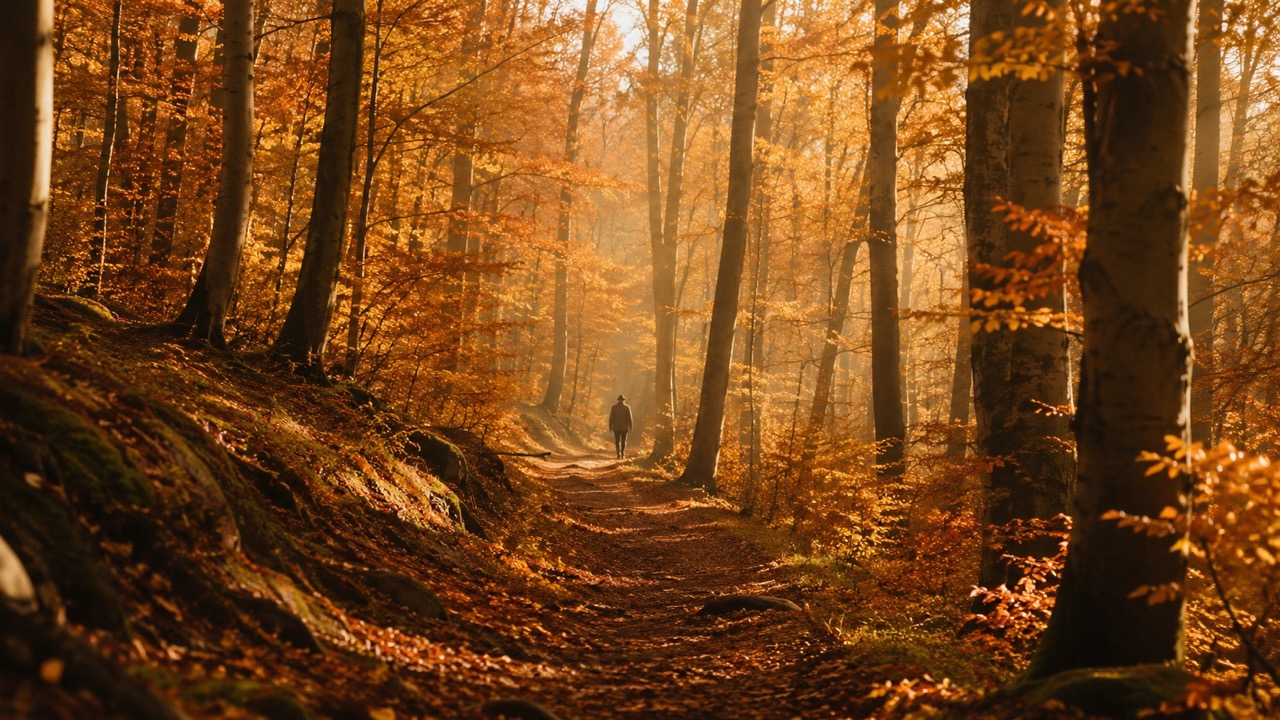
Before wellness became an industry — before the infrared saunas and the adaptogenic lattes and the retreat centres with waiting lists measured in months — human beings already knew how to heal themselves. They walked in forests and felt calmer. They immersed themselves in seawater and emerged restored. They stood under cold mountain streams and found their inflammation reduced. They knew these things not because a study had been published but because their bodies told them so, and because their grandmothers had told their mothers, who had told them. The ancient wellness practices now experiencing a renaissance are not discoveries; they are rediscoveries — ancestral knowledge that science has finally developed the instruments to validate.
Shinrin-yoku: The Forest as Pharmacy
In 1982, the Japanese Ministry of Agriculture, Forestry, and Fisheries introduced the term shinrin-yoku — forest bathing — not as a spiritual practice but as a public health initiative. The premise was simple: that time spent in a forest environment measurably reduces cortisol, lowers blood pressure, increases natural killer cell activity, and improves mood. Four decades of subsequent research has confirmed this beyond reasonable doubt. The mechanism is partly atmospheric — trees emit phytoncides, volatile organic compounds that the human immune system responds to with increased NK cell production — and partly neurological: the fractal patterns of natural environments activate the parasympathetic nervous system in ways that built environments do not.
The practice itself requires nothing but presence: walking slowly through a forest, breathing consciously, attending to sensory experience without agenda or destination. No equipment, no instructor, no membership fee. Its power lies precisely in its simplicity — and in its radical opposition to the productivity-obsessed culture that necessitates it. Japan now has sixty-two officially designated forest therapy trails, each certified by the Forest Therapy Society based on measured reductions in participants’ cortisol and blood pressure. At Akasawa Natural Recreational Forest in Nagano, where thousand-year-old hinoki cypresses exhale their antimicrobial terpenes into mountain air, the forest itself is the treatment. You need only be there.
Thalassotherapy: The Sea as Cure
The Celts knew. The Romans knew. The Bretons, whose rocky Atlantic coast has been the centre of European thalassotherapy since the nineteenth century, knew: that seawater, heated to body temperature and applied systematically, produces effects on the human organism that fresh water cannot replicate. The mineral concentration of seawater — its magnesium, potassium, calcium, and trace elements — is sufficiently close to human blood plasma that the skin absorbs it transdermally, replenishing mineral deficiencies with a directness that oral supplementation cannot match.
The Thermes Marins de Saint-Malo, established in 1963 on the Breton coast, remains the gold standard: a clinical thalassotherapy centre where prescripted protocols of seawater immersion, jet massage, algae wraps, and marine aerosol inhalation are administered under medical supervision. Across the Bay of Biscay, the Basque Country maintains its own thalassotherapy tradition — the Talaso centres of San Sebastián and Zarautz, where the Atlantic’s particular mineral profile and the region’s microclimate combine in treatments that date, in spirit if not in precise form, to the Roman occupation. These are not spas in the leisure sense; they are therapeutic institutions whose protocols are evidence-based and whose practitioners are clinically trained.
Kneipp: Water as Discipline
Sebastian Kneipp was a Bavarian priest who, in the 1840s, cured himself of tuberculosis — or believed he did — by plunging into the freezing Danube at dawn. He spent the rest of his life developing a system of hydrotherapy based on the alternation of hot and cold water: Wechselbäder (alternating baths), Güsse (affusions), the Kneipp-Becken (wading pools) that still dot Bavarian gardens and public parks. His five-pillar system — water, plants, exercise, nutrition, and inner balance — anticipated integrative medicine by more than a century.
Modern cold-water immersion research vindicates Kneipp’s central insight: that brief, controlled exposure to cold water triggers a cascade of beneficial physiological responses, including increased norepinephrine production, reduced inflammation, and improved immune function. The Kneipp-Kur (cure) facilities that survive in Bavaria — particularly the Sebastianeum in Bad Wörishofen, where Kneipp himself practised — offer structured programmes of hydrotherapy, herbal medicine, and exercise in settings that have changed remarkably little in a century and a half. The treatments are unglamorous: walking barefoot through cold streams, standing under alternating hot and cold showers, wrapping extremities in damp cloths. But the research base supporting them is now substantial, and the tradition’s survival in its original location gives it an authenticity that newer interpretations cannot claim.
Where Ancient Meets Evidence
The convergence of ancestral practice and contemporary science is wellness culture’s most compelling development. When a Japanese researcher measures the NK cell activity of forest bathers, or a French clinician documents the mineral absorption rates of thalassotherapy patients, or a German immunologist quantifies the cold-shock response of Kneipp practitioners, they are not discovering new treatments. They are providing the evidentiary framework that allows ancient knowledge to be taken seriously by institutions — hospitals, insurance companies, public health systems — that require data before they will prescribe.
For the individual, the validation is welcome but perhaps unnecessary. The body already knows what the forest provides, what the sea restores, what cold water awakens. These practices persist across cultures and centuries not because they are fashionable but because they work — because the human organism, evolved over millions of years in intimate contact with natural systems, responds to those systems with a coherence and vitality that no synthetic intervention can replicate. The ancient practitioners were not primitive; they were attentive. They listened to the body’s response to the natural world, and they built their healing traditions around what they heard. Science now confirms what they already knew: that the earth itself is the oldest and most effective pharmacy, and that the most advanced medicine is sometimes simply the courage to step outside, to immerse, to breathe, and to be still.