
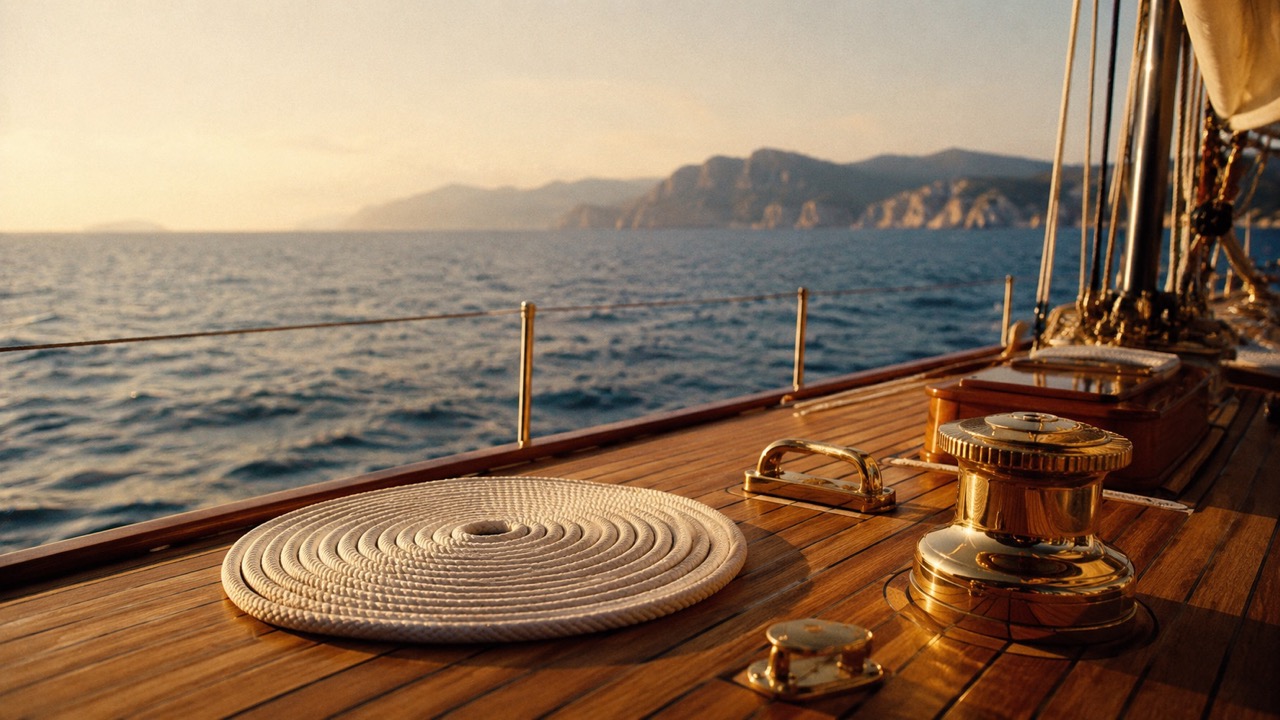
There is a speed at which the world becomes legible again — roughly four miles per hour, the pace of a barge through still water. At this velocity, the landscape does not blur past the window but unfolds in a continuous, unhurried revelation: the stone farmhouse emerging from behind poplars, the heron lifting from the reed bed, the village church spire appearing and then slowly, slowly falling behind. This is travel as it existed before the engine: intimate, deliberate, and profoundly civilised.
Burgundy: The Measure of All Things
The Canal de Bourgogne threads through the most storied wine country on earth with the quiet confidence of something that has existed since 1832. A private charter here — six guests, perhaps, aboard a vessel of polished mahogany and brass — moves through a landscape that has scarcely changed since the monks of Cîteaux first planted Pinot Noir on the limestone slopes above. The daily rhythm establishes itself within hours: coffee on deck as morning mist dissolves, a gentle cruise through locks operated by hand, mooring beside a village whose only commerce is a boulangerie and a cave coopérative.
The chef — every serious barge carries one — bicycles ahead to the morning market at Dijon or Beaune, returning with Bresse chicken, Époisses still soft from the affineur, and whatever the season dictates. Lunch is taken on deck, the barge moored beneath plane trees, the only sound the water against the hull and the distant argument of ducks. By afternoon, you might cycle along the towpath to a domaine whose wines you will never find exported, tasting in a cellar that smells of damp stone and centuries of fermentation.
The Canal du Midi: Engineering as Poetry
Further south, the Canal du Midi — Pierre-Paul Riquet’s seventeenth-century masterwork connecting the Atlantic to the Mediterranean — offers a different character entirely. Here, the plane trees that once lined the entire route (now threatened by canker stain disease, a quiet catastrophe) create a cathedral-like canopy through which dappled light falls upon the water. The locks are more frequent, the landscape drier, the architecture shifting from Burgundian limestone to Languedoc terracotta.
A barge on the Midi moves through the Minervois and into Carcassonne’s orbit, past the Cathar castles perched on impossible ridgelines, through villages where the afternoon is given over entirely to the consumption of rosé and the avoidance of exertion. The cuisine here is Mediterranean — olive oil rather than butter, cassoulet rather than coq au vin, the bold Syrahs of the Minervois rather than Burgundy’s ethereal Pinot.
England: Narrowboat Heritage Reimagined
The English canal system — built for industry, abandoned to neglect, now reborn as leisure — offers something altogether more eccentric. The narrowboat, at seven feet wide, imposes an intimacy that larger vessels cannot replicate. A new generation of luxury operators has reimagined the form: hand-painted roses and castles on the exterior, bespoke interiors of English oak and Welsh wool within. The Llangollen Canal in North Wales, crossing the Pontcysyllte Aqueduct — an iron trough suspended 126 feet above the Dee valley — offers a combination of engineering drama and pastoral beauty that no other waterway can match.
The pace is slower still than in France. English locks are frequent and manual. The towpaths lead to pubs whose flagstone floors and hand-pulled ales represent a form of hospitality that predates the country house hotel by centuries. There is a democratic quality to English canals — the millionaire’s barge moors beside the retired postman’s narrowboat, and both must wait for the same lock to fill.
Holland: History on Water
The Dutch waterways offer yet another register. Here, where water and land exist in perpetual negotiation, the barge is not leisure but heritage — the tjalk and the clipper, traditional sailing vessels converted to private use, moving through a landscape of windmills, tulip fields, and seventeenth-century towns whose canal-side houses lean toward the water as if in conversation. A cruise through Friesland in summer, the sky enormous above flat green polders, stopping at Sneek or Hindeloopen for smoked eel and young jenever, connects you to a maritime culture that understood waterways not as obstacles but as highways.
The Antithesis of the Cruise
What unites all barge travel is its opposition to the modern cruise industry’s logic of scale, spectacle, and consumption. A barge carries six or eight or twelve — never six thousand. It stops where its passengers wish, lingers where the afternoon demands, and moves on only when the morning feels right. There is no entertainment director, no buffet, no port of call where three thousand passengers disgorge simultaneously onto a medieval quay built for fishing boats.
Instead, there is the quiet satisfaction of watching the world pass at walking pace, of arriving at dinner having done nothing more strenuous than read a novel on deck, of falling asleep to the sound of water lapping against the hull. This is luxury as subtraction — the removal of speed, of choice, of stimulation — until what remains is only the essential: the landscape, the table, the unhurried passage of an afternoon that belongs entirely to you.