
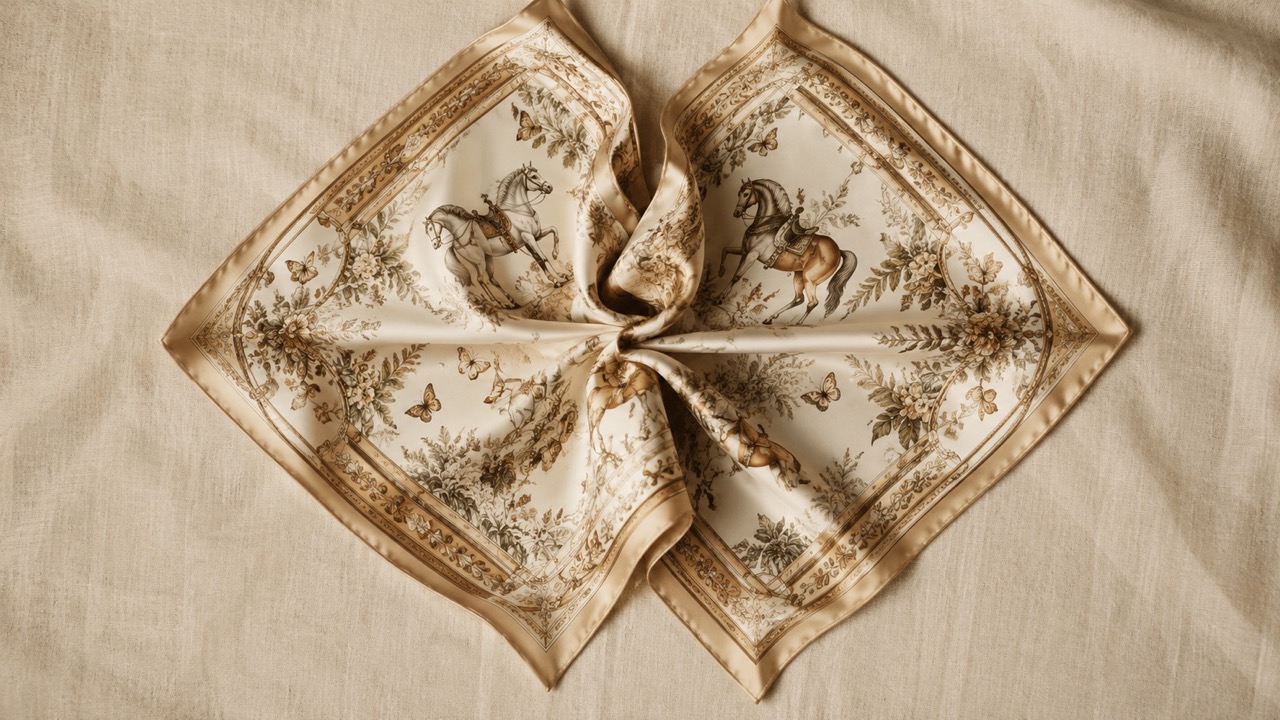
Eighteen months. That is the minimum gestation of a single Hermès silk scarf — from the moment an artist sets gouache to paper until the finished carré arrives, hand-rolled and boxed, in the vitrines of the Faubourg Saint-Honoré. In an industry that measures speed in drops and seasons, this timeline is not merely unusual. It is a statement of belief: that certain things cannot be hurried without being diminished.
The Artist’s Commission
It begins with a painting. Hermès commissions artists — some internal, many external, occasionally figures of genuine renown — to create an original work within the ninety-centimetre square. The constraint is absolute: the design must function as a repeating composition that reads from every angle, since the wearer may fold, drape, or frame the scarf in any orientation. The artist paints at scale, in gouache, working within a colour palette that may comprise up to forty-six distinct hues. Each colour must be separable, printable, reproducible with absolute fidelity on silk twill.
This alone can take months. A design of botanical complexity — a garden scene, an equestrian tableau — may require hundreds of hours of painting before the composition satisfies both artist and artistic director. The design is not merely decorative; it must tell a story, contain layers of detail that reward close examination, and maintain visual coherence whether viewed at arm’s length or from across a room.
The Engraving
Once approved, the painting enters the atelier of the engravers. Here, each of the forty-six colours is separated onto its own individual screen — a silk mesh stretched over an aluminium frame, the non-printing areas blocked with photosensitive lacquer. This is colour separation of extraordinary precision: a single misregistration of even half a millimetre will blur the entire composition. The engraving of a complex scarf can require six months of work, each screen hand-checked against the original painting for fidelity.
The screens are enormous — ninety centimetres square — and the tolerances unforgiving. Modern technology assists in the initial separation, but the final calibration remains manual, performed by artisans whose eyes have been trained over decades to detect chromatic drift invisible to most observers.
The Printing
At the Hermès print works outside Lyon — the historic heart of French silk production — the screens are mounted in sequence on flatbed printing tables that stretch the length of the atelier. Each colour is applied individually, the silk advanced screen by screen, layer by layer. Forty-six colours means forty-six passes. Between each pass, the silk must dry completely. A single print run for a complex design can take an entire day for a few dozen scarves.
The dyes are proprietary formulations, developed in-house, calibrated to produce specific colour values on Hermès’s own silk twill — a fabric woven to house specifications with a particular weight, hand, and lustre. The interaction between dye and fibre is not predictable from theory alone; it is known from decades of empirical refinement. Certain colours — a particular orange, a specific shade of bleu saphir — have taken years to perfect.
The Hand-Rolled Edge
After printing, fixing, and washing, the scarves arrive at the roulotage ateliers. Here, artisans hand-roll the edges of each carré — a process that takes approximately thirty minutes per scarf and produces the distinctive soft, rounded border that distinguishes an Hermès silk from any machine-hemmed alternative. The needle passes through the silk with a precise rhythm; the roll must be even, consistent in diameter, invisible from the front. It is work that cannot be automated without destroying the quality that justifies it.
Each roulotteuse handles only a limited number of scarves per day. Speed would compromise the evenness of the roll, the tension of the thread, the integrity of the silk at its most vulnerable edge. This is perhaps the clearest emblem of the entire process: a task that takes half an hour, performed by a specialist, on a product that has already required seventeen months of prior work.
What Patience Produces
The finished carré weighs almost nothing. It slips through a ring, folds to the size of a playing card, and contains within its ninety square centimetres the accumulated labour of painters, engravers, printers, dyers, and seamstresses — a minimum of eighteen months of collective attention. It is, in the most literal sense, condensed time.
This is what patience produces: not merely a beautiful object but an object whose beauty is inseparable from the time invested in its creation. The depth of colour, the precision of registration, the softness of the rolled edge — these qualities cannot be replicated by any process that values speed. They exist because someone decided, generations ago, that certain things are worth waiting for. The carré does not merely reward patience. It is patience made silk.