
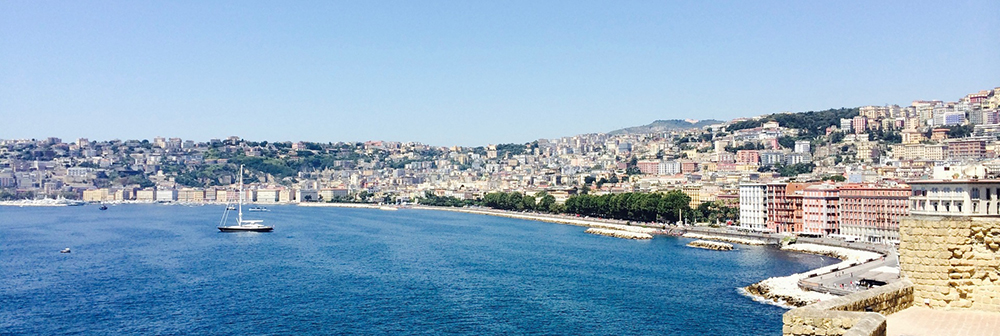
Naples does not ask for your approval. It arrives upon you — loud, layered, magnificent, disconcerting — and it is only once you surrender the expectation of orderliness that the city begins to reveal its extraordinary depths. No Italian city carries a more complex reputation, and no Italian city is more consistently underestimated by those who have not lingered long enough to understand it. For those who do linger — who allow Naples its full contradictory self — the reward is access to a region of such concentrated splendour that the chaos of the city centre becomes not an obstacle but a threshold: a price of admission worth paying with considerable enthusiasm.
The City Itself, Honestly Encountered
Begin, as one must, in the historic centre — a UNESCO World Heritage Site whose street grid follows the plan laid down by Greek colonists in the fifth century BC. The Spaccanapoli, that great crack bisecting the city, leads past churches of astonishing artistic wealth: San Gregorio Armeno with its Baroque extravagance, the Cappella Sansevero with Sammartino’s veiled Christ in marble so impossibly delicate that viewers instinctively reach to lift the stone fabric from the face. The Museo Archeologico Nazionale contains what may be the finest collection of Greco-Roman antiquities anywhere on earth — the mosaics from Pompeii alone, including the great Alexander mosaic, would justify a transatlantic crossing.
And the pizza. It would be reductive to open with it, but to omit it entirely would be dishonest. Neapolitan pizza, at its finest — from the wood-fired ovens of L’Antica Pizzeria da Michele or Sorbillo, eaten standing or at a marble-topped table, accompanied by nothing more elaborate than a glass of local Falanghina — is a lesson in the power of disciplined simplicity. The crust carries char and spring and the faint mineral character of the specific water used in the dough. This is not fast food. This is the result of generations of accumulated technique, and it nourishes differently than anything prepared without such intention.
Pompeii and Herculaneum: Time Suspended
Thirty minutes by Circumvesuviana railway lies the site that has haunted the Western imagination since its rediscovery in the eighteenth century. Pompeii is immense — the excavated area covers well over a square kilometre — and its scale means that guided private visits, especially at opening or near closing when crowds thin, reveal domestic interiors of startling intimacy. The frescoes in the Villa of the Mysteries, their deep Pompeian red still commanding after two millennia; the garden of the House of the Golden Bracelet; the bakeries with millstones still in position and bread-moulds preserved exactly as the eruption of 79 AD found them — these are encounters with human life at a remove of nearly two thousand years that manages, somehow, to feel entirely immediate.
Herculaneum, smaller and less visited, rewards the classicist even more richly. Buried under a pyroclastic surge rather than ash, the town’s organic materials — wooden furniture, foodstuffs, textiles — survived in a state of preservation impossible at Pompeii. An expert archaeologist guide, arranged through a reputable cultural agency, transforms a morning at either site from a sightseeing excursion into a genuine education in the rhythms of first-century Roman life.
The Amalfi Coast and Its Elevated Villages
The coastal road south of Naples remains one of the most dramatic drives in Europe, though in high season its drama includes the particular theatre of coaches and motorcycles negotiating hairpin bends above thousand-foot cliffs. Those who time their visits wisely — early morning departures, shoulder-season scheduling, private boat access from Positano or Amalfi — encounter something approaching the vision that made this coast famous. Ravello, high above the traffic, retains the architectural austerity of a medieval hill town and contains the Villa Cimbrone, whose terrace of busts above the Mediterranean has been called the most beautiful view in the world — a claim that, standing there at dawn with the light still pink on the water below, it is difficult to dispute.
The Islands: Capri, Ischia, Procida
Day trips to the Gulf of Naples islands by private motorboat represent some of the most purely pleasurable hours available in southern Italy. Capri’s famous Blue Grotto is spectacular when experienced outside peak hours on a small craft with a capable boatman; the island’s interior, accessible by chairlift to Anacapri, offers terraced gardens, white-washed lanes, and views that explain why Tiberius chose to govern the Roman Empire from here. Ischia, less glamorous in reputation but richer in volcanic thermal waters, offers full-day itineraries combining thermal bathing in the gardens of Poseidon with exploration of the extraordinary Aragonese Castle, a fortress-city rising sheer from the sea on a volcanic rock. Procida — smallest and least visited — received international attention when named Italy’s Capital of Culture and reveals, to those who arrive, an authenticity that the better-known islands have partly sacrificed to their own success.
Naples rewards, above all, the traveller who approaches it not as a staging post for more manageable destinations but as a destination of profound importance in its own right — a city whose imperfection is inseparable from its genius, and whose surroundings contain some of the most historically and scenically extraordinary terrain in the Mediterranean world.