
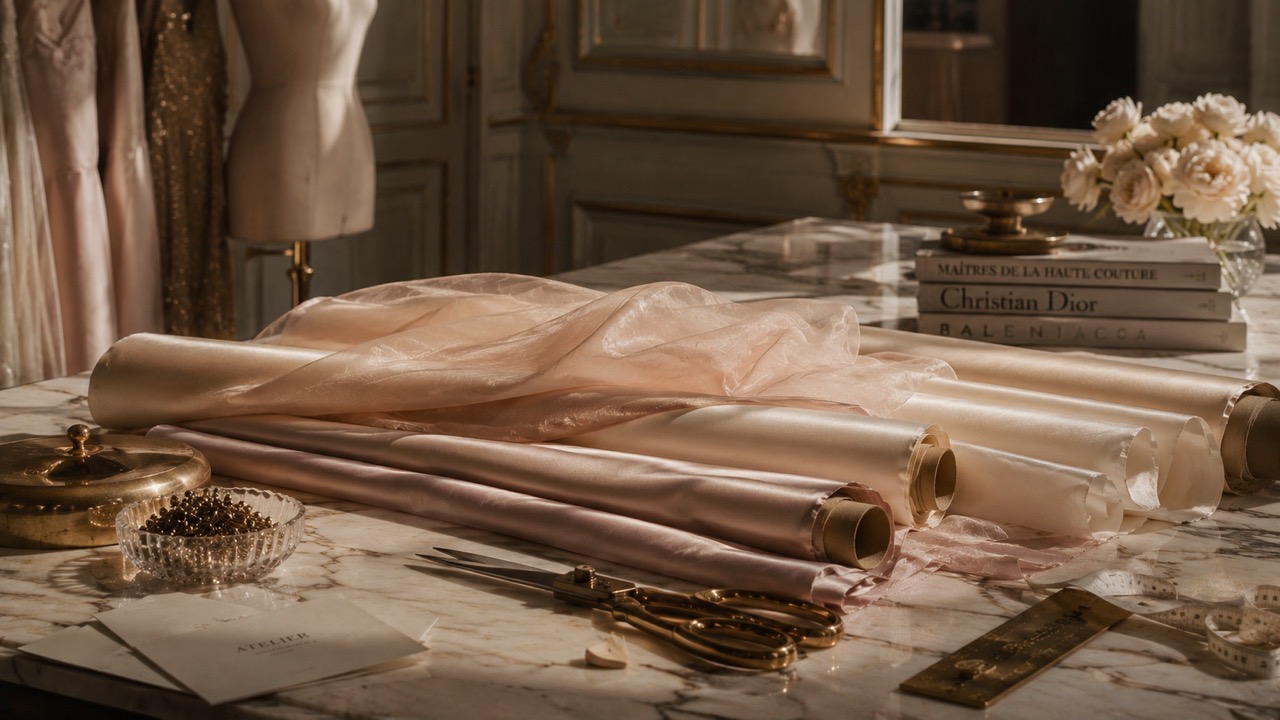
Imagine a world in which a single shade — not a logo, not a silhouette, not a name — communicates an entire universe of associations: wealth, taste, heritage, belonging. Now consider that several such worlds exist simultaneously, each governed by a colour so precisely calibrated and so ferociously protected that it functions as intellectual property as potent as any patent. This is the extraordinary territory where chromatology meets commerce, where a Pantone reference number becomes a billion-dollar asset.
Valentino Pink PP: The Audacity of Saturation
When Pierpaolo Piccioli sent his Autumn/Winter 2022 collection down the runway in a single shade of fuchsia — every look, every shoe, every bag, the walls of the venue itself — he was not merely making a colour choice. He was staking a territorial claim. Pink PP became overnight the most discussed colour in fashion, its absolute saturation creating an association so strong that encountering the shade anywhere triggered immediate recall of the house.
Piccioli understood that in an attention economy saturated with logos and monograms, a colour could achieve something more insidious: recognition that operates below the threshold of conscious branding. You do not need to see a Valentino label. You need only see that pink, at that specific intensity, and the connection is made — not intellectually but sensorially, in the part of the brain that processes colour before it processes language.
Tiffany Blue: The Original Proprietary Shade
The precedent was set in 1837, when Charles Lewis Tiffany selected a particular robin’s-egg blue for the cover of his annual catalogue. That shade has since 1998 been a registered colour trademark in the United States. No other jeweller may use it. The blue box has become so totemic that Tiffany’s own research reveals customers experience a measurable emotional response to the colour alone, independent of any product association.
The legal architecture protecting proprietary colours is complex and varies by jurisdiction. In the United States, colour trademarks require demonstrating “secondary meaning” — proving that consumers associate the colour with a specific source. This is extraordinarily difficult to establish and fiercely expensive to defend, which is precisely why only the largest and longest-established houses successfully maintain chromatic exclusivity.
Hermès Orange: Accident Elevated to Icon
The origin story of Hermès’s signature orange is deliciously prosaic: during the Second World War, the house’s preferred cream-coloured boxes became unavailable due to material shortages, and orange cardboard was the only stock the supplier could provide. The house kept it — whether through necessity or nascent genius is unclear — and orange became Hermès as indelibly as the duc carriage logo.
What the orange box demonstrates is that proprietary colour need not be designed — it can be accumulated, its associations deepening over decades until the shade becomes inseparable from the house’s identity. No legal filing made Hermès orange proprietary. Time did. Consistency did. The simple repetition of that particular warm hue, encounter after encounter, year after year, until to see it is to smell leather, to feel the weight of a silk scarf, to inhabit a particular register of French luxury.
Bottega Green and Louboutin Red
Daniel Lee’s transformation of Bottega Veneta included the adoption of a specific parakeet green — vivid, unexpected, unmistakable — that functioned as a brand signature in a house that had historically refused visible branding. The green proved that colour could substitute for logos, could function as identification for those who knew while remaining invisible to those who did not.
Christian Louboutin’s lacquered red sole represents perhaps the most commercially successful colour claim in fashion history. The sole is visible only in motion, creating a flash of recognition that operates as both signature and signal. The legal battles to protect it have been extensive and multinational, demonstrating the difficulty of claiming ownership over something as elemental as a colour applied to a surface.
The Power and the Paradox
The extraordinary power of proprietary colour lies in its pre-linguistic operation. Before you read a logo, before you recognise a silhouette, you register colour. It is the fastest channel of brand recognition, processed in milliseconds, requiring no cultural knowledge beyond repeated exposure. A child who has never entered a Tiffany boutique recognises that blue. A person who has never purchased a Valentino garment knows that pink.
Yet the paradox is inescapable: no one can own a colour in nature. What is owned is the association — the neural pathway that connects a particular wavelength of light to a particular constellation of meanings. This association must be built over years, reinforced through absolute consistency, and defended through vigorous legal action. It is a form of collective agreement — a shared understanding that this particular shade means this particular thing — elevated through repetition and capital into something that functions, for all practical purposes, as property.
That a colour can carry this weight — can signify a century of craft, can communicate belonging to a particular world, can trigger desire before conscious thought intervenes — is perhaps the most elegant demonstration of luxury’s true mechanism. It sells not objects but meanings, and colour is meaning’s purest vehicle.