
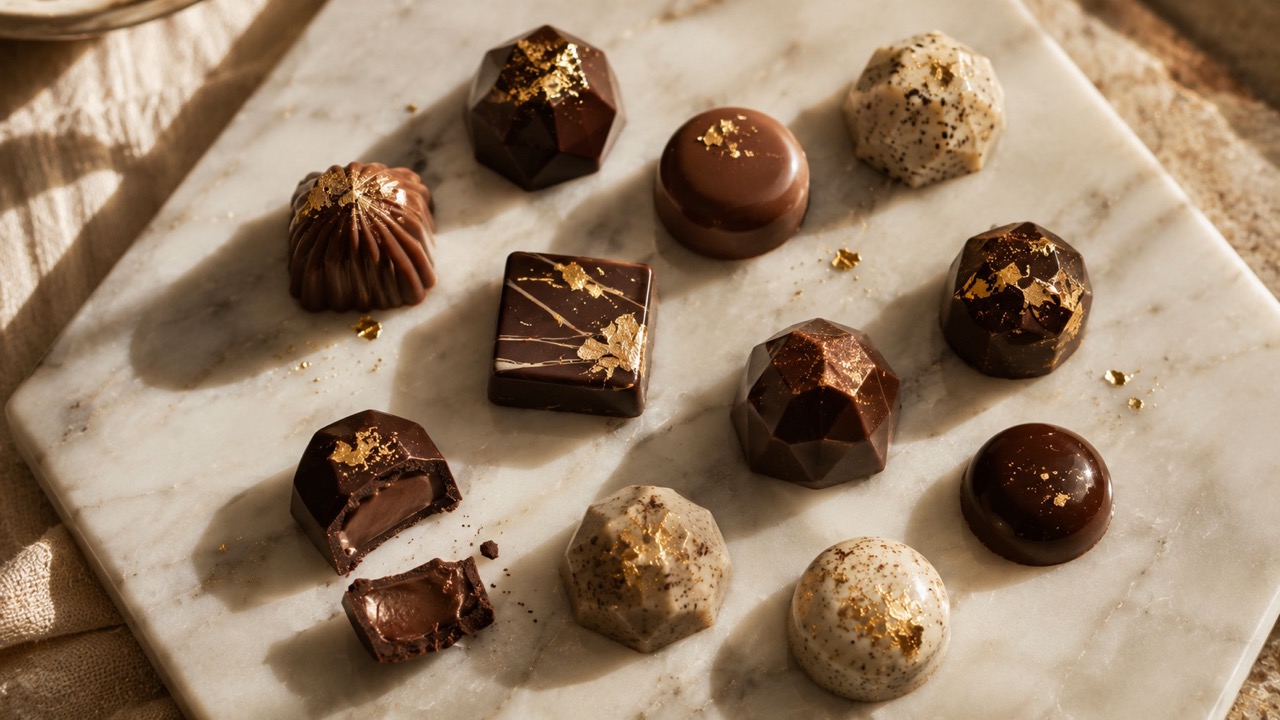
There are pleasures that civilisations have built themselves around, and chocolate is among the most ancient, the most complex, and the most persistently misunderstood of them all. To speak of chocolate casually — as a comfort, a confection, a square broken off at the end of a long day — is to miss the extraordinary depth of what a single cacao bean contains: history, geography, ceremony, chemistry, and something very close to the sublime. The serious study of chocolate is the study of human culture itself.
A Bitter Beginning: Mesoamerica and the Sacred Bean
The story begins not in a European chocolaterie but in the lowland forests of Mesoamerica, where the Olmec, Maya, and Aztec civilisations elevated Theobroma cacao — the food of the gods, as Linnaeus would later name it — into something approaching the sacred. Cacao was ground and prepared as a frothy, bitter ceremonial drink, spiced with chilli and vanilla, consumed during rituals of the highest significance. Among the Aztecs, cacao beans served as currency; to drink chocolate was to partake of wealth in its most immediate and pleasurable form. When Hernán Cortés arrived at the court of Moctezuma II in 1519, he encountered a civilisation that had spent millennia refining cacao’s possibilities. He brought its secret back to Spain, and Europe was never quite the same again.
The Great European Obsession
The journey from Aztec ceremonial drink to European luxury took less than a century. Spanish monks experimented with sweetening the bitter brew with cane sugar; by the early seventeenth century, chocolate had migrated to the French and English courts, where it became the drink of privilege. Chocolate houses proliferated in London — White’s, founded in 1693, began its long and distinguished life as one — where the aristocracy gathered not merely to drink but to be seen drinking. Chocolate was warmth, sophistication, and social currency all at once.
The industrial revolution transformed it further still. The invention of the hydraulic cocoa press by Coenraad Johannes van Houten in 1828, followed by the development of solid eating chocolate by Joseph Fry, and then the refinement of milk chocolate by Daniel Peter and Henri Nestlé in the 1870s, democratised what had been an aristocratic pleasure. By the twentieth century, chocolate had become mass-market, and with that democratisation came, inevitably, a flattening of quality. The extraordinary complexity of the cacao bean was compressed into sweetness, into the immediate gratification of sugar and fat. The bean’s origins — its terroir, its variety, its fermentation — became irrelevant to industrial production.
The Bean-to-Bar Revolution
The late twentieth and early twenty-first centuries brought a correction as consequential as any in the history of gastronomy. The bean-to-bar movement — emerging first in California, then spreading to Europe and beyond — insisted on returning to origins: that the variety of cacao, the soil in which it grew, the altitude, the fermentation and drying process, the roast, the conch — all of these determine the flavour of the final chocolate with the same authority that a grape variety and a particular hillside determine the character of a great wine.
Pioneers like Scharffen Berger in San Francisco and Valrhona in the Rhône valley began treating cacao as a serious agricultural product. Then came a new generation of makers — Dandelion Chocolate, Zotter, Pump Street, François Pralus — sourcing single-origin beans from Madagascar, Ecuador, Peru, São Tomé, and Vietnam, celebrating not uniformity but the vivid particularities of place. A chocolate made from Madagascan Sambirano beans is red-fruited, almost jammy; one made from Venezuelan Porcelana is floral and delicate; an Ecuadorian Nacional can carry extraordinary floral complexity, reminiscent of jasmine and stone fruit.
Artisans Redefining the Craft
Today, a generation of chocolatiers operates with the intellectual rigour of sommeliers and the precision of perfumers. In London, Paul A. Young brings an almost confessional passion to his ganaches; in Paris, Patrick Roger transforms chocolate into sculpture without sacrificing flavour. Japan — with its culture of monozukuri, the art of making things — has produced some of the world’s most technically refined chocolate, its artisans applying extraordinary precision to tempering, moulding, and flavour combination. In New York, Mast Brothers — whatever the controversies of their early years — helped ignite a public conversation about craft and transparency in chocolate-making that continues to animate the field.
The greatest practitioners understand that their work begins not in the kitchen but on the farm. Relationships with growers, investment in fermentation infrastructure, attention to post-harvest processing — these are the foundations upon which exceptional chocolate is built, long before the winnower or the melangeur makes its appearance.
The Art of Tasting
To taste chocolate properly is to slow down. Snap a piece: the sound should be clean and sharp, a sign of good tempering and correct cocoa butter crystallisation. Place it on your tongue and resist the urge to bite down — allow the chocolate to melt, releasing its volatile aromatics into your nasal passages as it does. Notice the evolution: the first impression, the development on the mid-palate, the finish that can linger for minutes in a truly great chocolate. A high percentage — 70%, 80%, even 90% — does not guarantee quality; what matters is the balance between acidity, bitterness, sweetness, and the complexity of flavour that the bean itself provides.
Terroir is real in chocolate. The same variety of cacao grown in different soils will taste different; the same farm’s beans will vary from harvest to harvest. This is not inconsistency but life, the honest expression of a living agricultural product. Chocolate, when it is made with integrity, tastes of somewhere, of someone’s care, of time and weather and soil. To eat it with attention is to travel — to the cloud forests of Ecuador, the volcanic slopes of Hawaii, the humid lowlands of Belize — without leaving your chair. That is a remarkable thing. That is the divine art.
We have spent five centuries learning to love chocolate properly. The bean-to-bar revolution suggests that we are only now, finally, beginning to understand what it has always been capable of.