
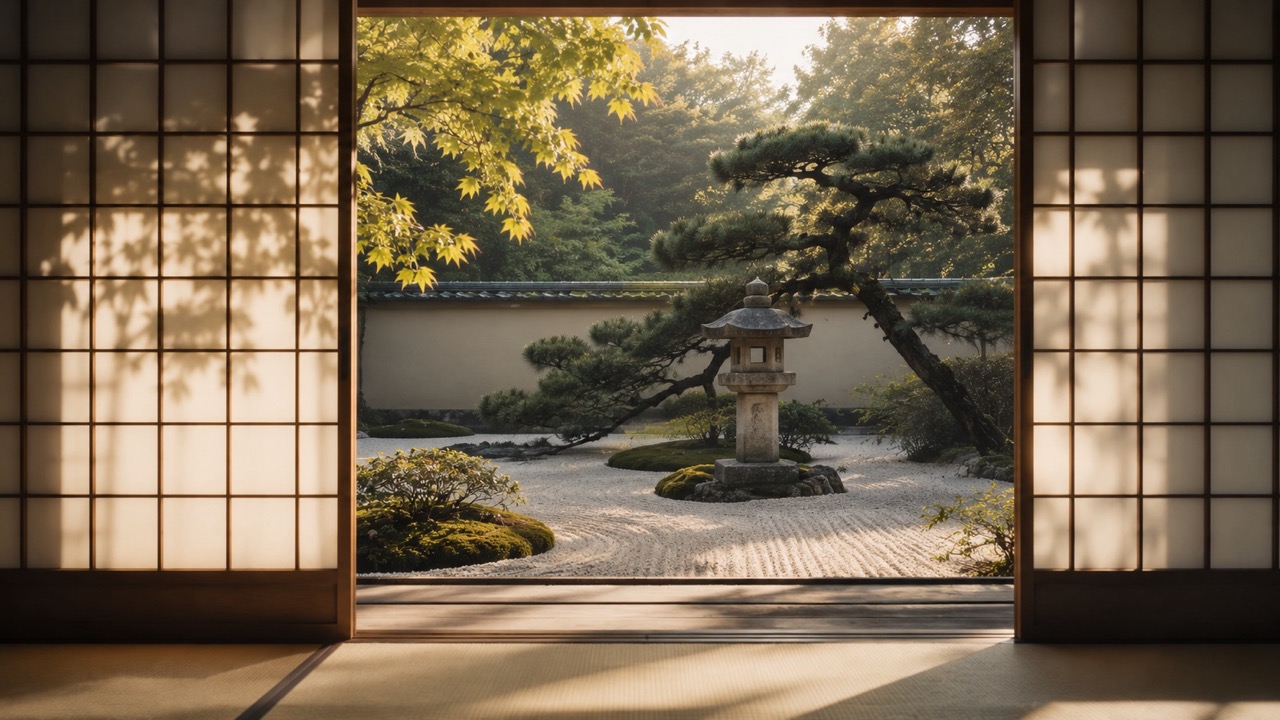
There is a quality of stillness in the most beautifully resolved Asian-inspired interiors that is not emptiness but fullness of a particular kind — the fullness of deliberate restraint, of space allowed to breathe, of objects chosen for meaning rather than accumulation. This aesthetic philosophy, drawn from centuries of East Asian thought spanning Japanese wabi-sabi to Chinese literati culture to the refined minimalism of Korean Joseon design, offers the contemporary home something increasingly rare: an environment that actively cultivates tranquility rather than merely tolerating it.
The Philosophy Before the Furniture
To approach Asian-inspired design as a shopping list of lacquer panels and paper lanterns is to misunderstand it entirely. The authentic spirit of these traditions begins not with objects but with orientation — a way of thinking about space, light, impermanence, and the relationship between interior and exterior world. In Japanese design, the concept of ma — the pregnant pause, the meaningful interval — is as important as any element placed within a room. Space is not the absence of object; it is the presence of possibility. Beginning with this understanding changes everything about how one proceeds.
The Chinese literati tradition of the scholar’s studio, the shu fang, offers a similarly rigorous model: a room furnished only with what feeds the mind and eye, arranged with apparent casualness that conceals deep intentionality. A scholar’s rock of unusual formation, an inkstone, a scroll painting, a flowering branch in a celadon vase — each element earns its place through cultural resonance and personal meaning. Nothing is merely decorative. Everything participates.
Materials and Their Meanings
The material palette of Asian-inspired design is at once humble and luxurious — a paradox that resolves itself in quality. Natural materials dominate: aged timber, river-smoothed stone, hand-woven linen in undyed tones, lacquer that has been applied in dozens of patient layers, ceramic glazes that replicate the accidental beauty of wood ash at high temperature. These are materials that improve with time and use, that carry the evidence of their making, that ask to be touched.
Bamboo — in its natural form or reconstituted into flooring and cabinetry — brings a quiet organic warmth that no engineered alternative replicates. Shoji screens, whether original Japanese paper-and-timber examples or sympathetic contemporary interpretations, manipulate light in ways that transform both the quality of a room’s illumination and the sense of its boundaries. Stone — whether the blue-grey of Chinese inkstone, the warm ochre of Japanese Oya tuff, or the pale grey-green of Korean celadon — grounds a space with geological permanence.
Colour as Discipline
The colour philosophy of traditional East Asian interiors is one of studied restraint punctuated by moments of exquisite precision. The ground — walls, floors, larger surfaces — tends toward the neutral: ink-wash white, rice-paper cream, the soft grey-green of aged celadon, the warm brown of oiled timber. Within this ground, colour appears as accent rather than statement: the vermilion of a lacquered cabinet, the deep indigo of a linen cushion, the pale celadon of a single vessel on a shelf.
The restraint is not timidity but confidence. It takes considerable aesthetic certainty to leave a wall bare when convention encourages filling it. The reward is a space that does not compete with its inhabitants — that recedes when the room is occupied and reveals itself when it is empty, which is itself a form of hospitality.
The Garden as Interior
No design tradition takes more seriously the relationship between inside and outside than the great East Asian traditions. The Japanese concept of shakkei — borrowed scenery, the deliberate incorporation of a distant landscape element into the composed view from a room — represents one of the most sophisticated approaches to interior design ever developed. One does not merely place a window; one frames a picture, and the picture changes with season, with hour, with weather.
Even in urban apartments where a borrowed landscape is not available, this principle can be honoured. A carefully chosen indoor plant — not a collection of plants but a single bonsai, a bamboo in a scholar’s pot, a moss arrangement in a shallow ceramic tray — brings the outside in with the same quiet authority. The plant is tended, observed, allowed to change with the seasons.
Acquiring with Patience
The most successful Asian-inspired interiors are not assembled but accumulated — gathered over years of attentive travel, careful dealing, and the patience to wait for the right object rather than settling for an approximate one. A visit to the antique markets of Kyoto or Shanghai, a relationship with a dealer in Chinese ceramics, a weekend spent in a Tokyo neighbourhood known for its reclaimed timber workshops — these are the sources that produce interiors of genuine authenticity.
What one is ultimately creating, in the best traditions of these philosophical design lineages, is not a look but a practice: a daily environment that encourages slower seeing, deeper breathing, and the quiet recognition that the most nourishing spaces are those that ask nothing of their inhabitants except presence. In a world that demands perpetual stimulation, that is not a small gift. It is, in fact, an extraordinary one.