
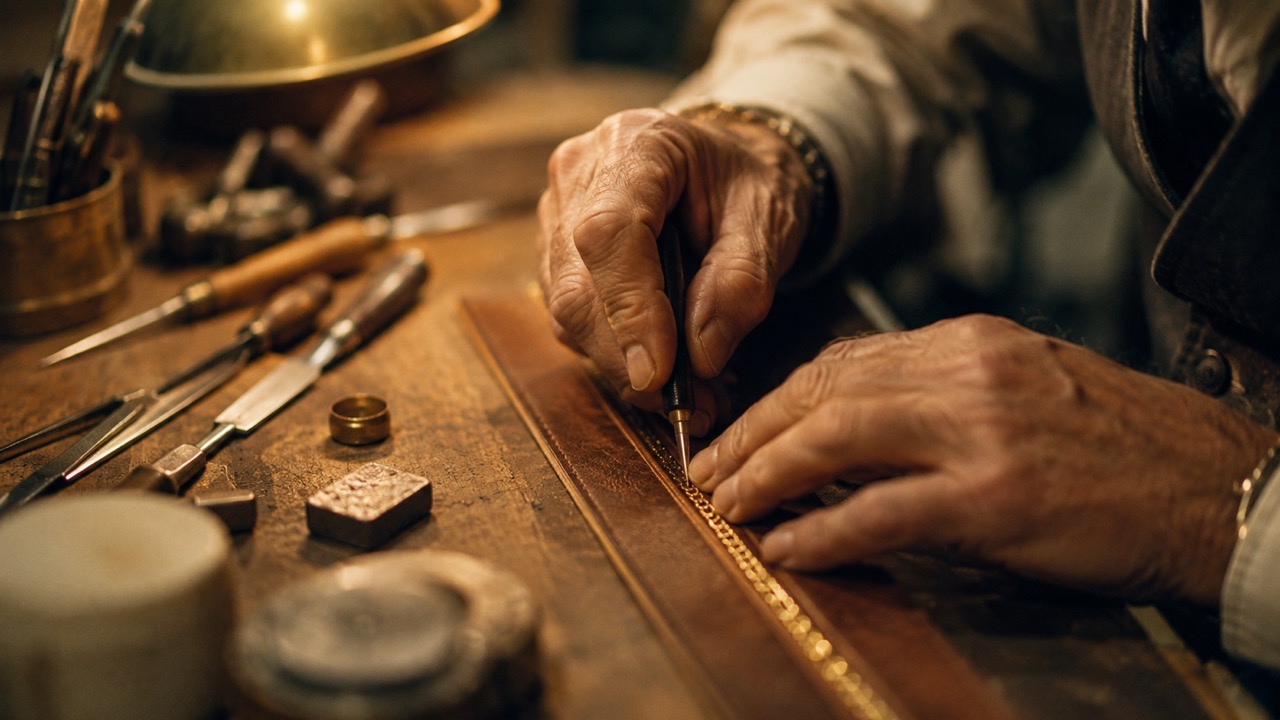
In an age of mass luxury — when the same handbag is manufactured by the thousand and the same fragrance fills every duty-free corridor on earth — there remains a parallel economy of the singular. In workshops from the Alps to Okinawa, individual craftspeople produce objects of such specificity that each piece carries the irreducible imprint of a single hand, a single intelligence, a lifetime of accumulated knowledge. To commission directly from these makers is to participate in the oldest form of luxury: the relationship between patron and artisan, unmediated by brand, marketing, or retail margin.
A Perfumer in Grasse: The Nose as Instrument
In the hills above Grasse, where the last jasmine fields yield their absolute each August, independent perfumers work outside the corporate structures of LVMH or Estée Lauder. A figure such as Jean-Claude Ellena — retired from Hermès but still composing — or the younger Amélie Bourgeois, working from a small laboratory above the old town, offers bespoke composition to private clients. The process typically involves three consultations: a first meeting to establish olfactory preferences, a second to evaluate initial compositions, a third to refine. The resulting fragrance exists in perhaps five bottles. No one else on earth wears it. The cost — between three and ten thousand euros — is less than many commercial “exclusive” fragrances, yet the object produced is genuinely unique. To visit is to enter a world where scent is discussed with the precision of a sommelier and the poetry of a novelist.
A Knife-Maker in Thiers: Steel as Autobiography
Thiers, in the Auvergne, has been France’s centre of cutlery since the fourteenth century — a town where the sound of grinding wheels against steel is as constant as birdsong. Among the remaining independent couteliers, figures like David Ponson produce folding knives of extraordinary refinement: hand-forged blades in Damascus steel, handles shaped from mammoth ivory or stabilised burl, mechanisms that open with the precision of a watch movement. A visit to Ponson’s workshop — by appointment, through a network of collectors who share his coordinates — reveals the full arc of production: the forge, the grinding, the fitting of each component to tolerances measured in hundredths of a millimetre. A commissioned piece takes three to six months. The knife, when it arrives, is less a tool than a sculpture that happens to cut — and it will outlive its owner by centuries.
A Ceramicist in Okinawa: Earth and Fire as Meditation
Okinawan pottery — yachimun — carries a tradition distinct from mainland Japanese ceramics: bolder, more colourful, influenced by Southeast Asian trade routes as much as by Chinese and Korean traditions. In the village of Yomitan, the dragon kilns of the Yachimun no Sato pottery district house a community of working potters whose pieces sell from their workshop doors. Matsuda Yoneshi, a third-generation potter working in the classical Okinawan style — bold cobalt patterns on cream stoneware, the characteristic “Persian blue” glaze — accepts visitors who understand that watching a master throw is not entertainment but education. His pieces, available only from the workshop, carry the specific gravity of a living tradition: forms that have been made in this place for four hundred years, each one nevertheless carrying the irreplaceable mark of this particular hand on this particular day.
A Glovemaker in Naples: Leather as Second Skin
Omega Guanti, on Via Chiaia in Naples, has been making gloves since 1922 — though the Neapolitan tradition extends back considerably further. Mauro Squillace, the current master, cuts and sews each pair by hand from lambskin so thin it is almost transparent, lined with cashmere or silk according to season. The fitting process is revelatory: measurements taken not merely of hand dimensions but of gesture — how the fingers move, how the thumb opposes, where the leather must give and where it must hold. A bespoke pair, ready in two weeks, fits with an intimacy that no off-the-shelf glove can approach. The shop itself — wood-panelled, barely ten metres square, gloves displayed in glass cases like jewellery — is a monument to a scale of production that has no interest in growth, expansion, or “scaling.” Ten pairs a day, made to measure, is sufficient.
A Violin-Maker in Cremona: Wood as Voice
Cremona remains, improbably, the world centre of violin-making — a city of seventy thousand inhabitants containing over a hundred active luthiers. The tradition descends directly from Stradivari and Guarneri, and the Scuola Internazionale di Liuteria continues to produce new masters each year. Among the established workshops, a maker such as Edgar Russ — an Austrian who trained in Cremona and remained — accepts commissions that require two to three years of waiting. The process begins with wood selection: Alpine spruce for the top, maple for the back and ribs, each piece chosen for its acoustic properties and aged for a decade before use. To visit a Cremonese workshop is to witness a form of making so slow, so precise, and so dependent on accumulated knowledge that it resembles less a craft than a science — albeit one whose ultimate judgment is the ear rather than the instrument.
These craftspeople share a quality that no luxury brand can replicate: the irreducibility of individual practice. Each object they produce is a document of a specific encounter between skill and material, intention and accident, tradition and individual expression. To commission from them — to wait, to visit, to participate in the slow conversation between maker and client — is to experience luxury in its original sense: not abundance but rarity, not display but relationship, not consumption but collaboration.