
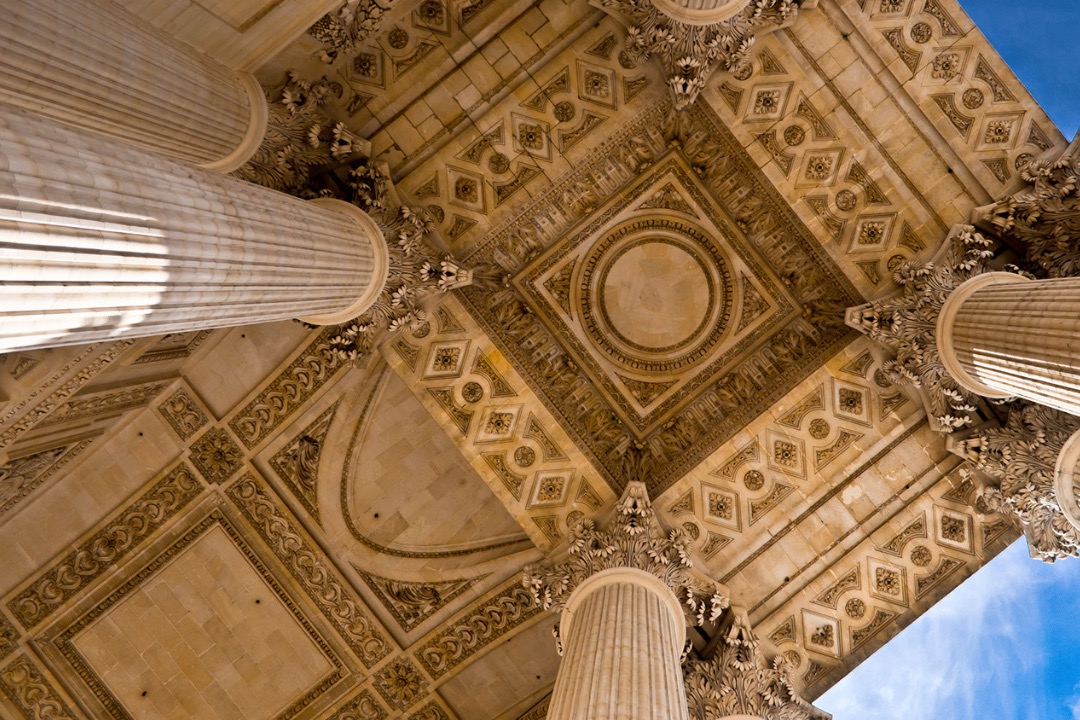
Stand in the Court of the Lions at the Alhambra in Granada and look up. The muqarnas vault overhead dissolves into a constellation of carved stucco cells, each one catching light at a slightly different angle, so that the ceiling appears to shimmer — not solid but suspended, not built but crystallised. Look closer and you see that what you took for ornament is text: Quranic verses and poetry inscribed in kufic and naskh scripts, winding through the geometric patterns, inseparable from them. The decoration is not applied to the architecture; it is the architecture. The building is its own commentary, its own interpretation, its own guide to being read.
The Alhambra: Text as Structure
The Nasrid dynasty’s palace complex is perhaps the purest surviving example of a building that narrates itself. More than ten thousand inscriptions cover its walls, columns, and ceilings — poems composed specifically for the spaces they occupy, mathematical in their metre, architectural in their imagery. The fountain in the Court of the Lions bears verses that describe the fountain itself, creating an infinite loop of reference between object and text, space and language. The building does not merely house meaning; it generates it. A visitor who reads Arabic moves through the Alhambra in a fundamentally different way than one who does not — they are not merely seeing spaces but reading them, following a narrative that the architects embedded in the structure itself.
This is architectural storytelling at its most literal — the building as book, the wall as page, the ornament as sentence. But the principle operates at more abstract levels too. Every great building tells a story; the question is whether it tells it explicitly — in inscription, symbol, and programmatic imagery — or implicitly, through the purely spatial and material experience of moving through it.
Sagrada Família: Theology in Stone
Antoni Gaudí spent the final twelve years of his life working exclusively on the Sagrada Família, and his ambition for the building was nothing less than total: a church that would be a complete catechesis in stone, a theological summa you could walk through. Every element carries symbolic weight. The eighteen towers represent the twelve apostles, four evangelists, the Virgin Mary, and Christ. The three facades narrate the Nativity, the Passion, and the Glory. The columns of the nave are trees — literally modelled on branching patterns Gaudí studied in nature — so that the interior becomes a forest, and the forest becomes an allegory of creation, and the light filtering through the stained glass becomes the presence of the divine filtering through the material world.
Gaudí understood that architecture’s unique power among the arts is its capacity to surround. A painting occupies a wall; music occupies time; but a building occupies you — your body is inside it, your movement is shaped by it, your senses are addressed simultaneously by its light, its acoustics, its temperature, its scale. A building that narrates can therefore narrate immersively, enveloping the visitor in story the way no other medium can. The Sagrada Família does not illustrate theology; it enacts it. To move from the darkness of the Passion facade into the luminous forest of the nave is to undergo, bodily, the narrative of salvation.
Ando’s Silence: Narrative Through Subtraction
Tadao Ando’s Church of the Light in Ibaraki, Osaka, tells its story through a single, devastating gesture. The rear wall of the concrete box is cut with a cruciform slot, open to the exterior, through which daylight enters the otherwise dark interior. That is the entire architectural vocabulary — concrete, darkness, one cut of light in the shape of the cross. The narrative is immediate, wordless, and complete: the divine enters the material world through an opening, and that opening is shaped like the central symbol of the faith. The building teaches you how to read it in the time it takes your eyes to adjust to the dark.
Ando’s method is the opposite of the Alhambra’s or Gaudí’s — where they accumulate meaning through density of symbol and inscription, he strips away everything until only the essential narrative gesture remains. Yet the principle is the same: the architecture does not simply contain a story; it is one. The building’s form is its content. Structure is meaning. There is no separation between what the building is and what it says.
Reading Buildings, Building Readers
The contemporary architectural world has largely abandoned narrative, preferring formal investigation or functional resolution to storytelling. This is understandable — much twentieth-century narrative architecture was didactic, propagandistic, or simply kitsch. But the examples above suggest that narrative need not be any of these things. The Alhambra’s inscriptions are poetry, not propaganda. Gaudí’s symbolism is systematic but not simplistic. Ando’s cross of light is not didactic but experiential — it teaches through sensation rather than instruction.
What these buildings share is a conviction that architecture can and should communicate — that a building has an obligation not merely to shelter or delight but to mean. They embed their meaning in their structure so thoroughly that form and content become indistinguishable. The wall is the text. The light is the narrative. The space between columns is the pause between sentences. They are buildings that make readers of their visitors — that reward attention, that deepen with study, that yield new meaning on each encounter precisely because their stories are told not in words alone but in the irreducible language of space, light, material, and time.
To enter such a building is to enter a conversation with its maker — a conversation that may have been initiated centuries ago but continues, vitally, in the present tense of your experience. The greatest architecture does not merely stand; it speaks. The only question is whether we have learned to listen.