There is a particular moment in the presence of a great abstract painting when the analytical mind, having exhausted its attempts at literal interpretation, quietly steps aside — and something else entirely moves forward to meet the work. It is not surrender but arrival. Abstract art, at its most powerful, does not communicate in the language of narrative or symbol but in the more primal vocabulary of colour, texture, scale, and rhythm — a language the body understands before the mind forms its objections. This is why abstract art heals. Not metaphorically, and not merely emotionally, but in ways that researchers are beginning to measure with growing precision.
Colour as Physiological Event
The relationship between colour and the human nervous system is far older than art itself. Long before Mark Rothko placed vast fields of deep crimson beside luminous orange on monumental canvases, colour was understood in Ayurvedic, Chinese, and indigenous healing traditions as a medium of direct therapeutic intervention. What neuroscience now adds to these ancient intuitions is specificity: measurable changes in cortisol levels, heart rate variability, and neural activity associated with sustained exposure to particular colour environments. Warm yellows activate; cool blues quieten; the particular red-orange of a Rothko Chapel canvas has been documented to produce states of psychological openness that practitioners of contemplative traditions would recognise immediately as meditative.
Helen Frankenthaler’s stained colour fields, where pigment was poured directly onto unprimed canvas and allowed to flow, create chromatic surfaces of extraordinary subtlety — hues that blend at their edges in ways that recall the transitions of natural light. Spending twenty minutes before a major Frankenthaler in a quiet gallery is an experience that several psychotherapy traditions now incorporate deliberately, understanding that the diffuse, non-narrative quality of the work allows the mind to relax its narrative grip and simply receive sensation without the imperative to make meaning.
Form and the Permission to Not Know
Abstract art offers something that representational art, for all its genius, cannot: complete freedom from the obligation to identify. When standing before a Vermeer, even the most aesthetically educated viewer is partially occupied with the work of recognition — this is a woman, this is light, this is a window. With a Kandinsky or a late Mondrian, that cognitive task dissolves entirely, and the freed attention becomes available for a different kind of engagement: sensing rather than reading, feeling rather than naming. This shift from cognitive to somatic attention is, in therapeutic terms, precisely what many contemporary wellness practices attempt to induce through breath work, movement, or meditation.
Cy Twombly, whose canvases combine gestural mark-making with text fragments and mythological reference in ways that resist complete decoding, described his paintings as explorations of a state between knowing and not-knowing. Viewers who allow themselves to inhabit that state — resisting the urge to resolve ambiguity, tolerating the discomfort of open meaning — frequently report experiences of unexpected emotional release. Grief, tenderness, joy, and nostalgia surface unbidden, as though the work provided a structure safe enough for feelings that have no other outlet.
The Studio as Sanctuary
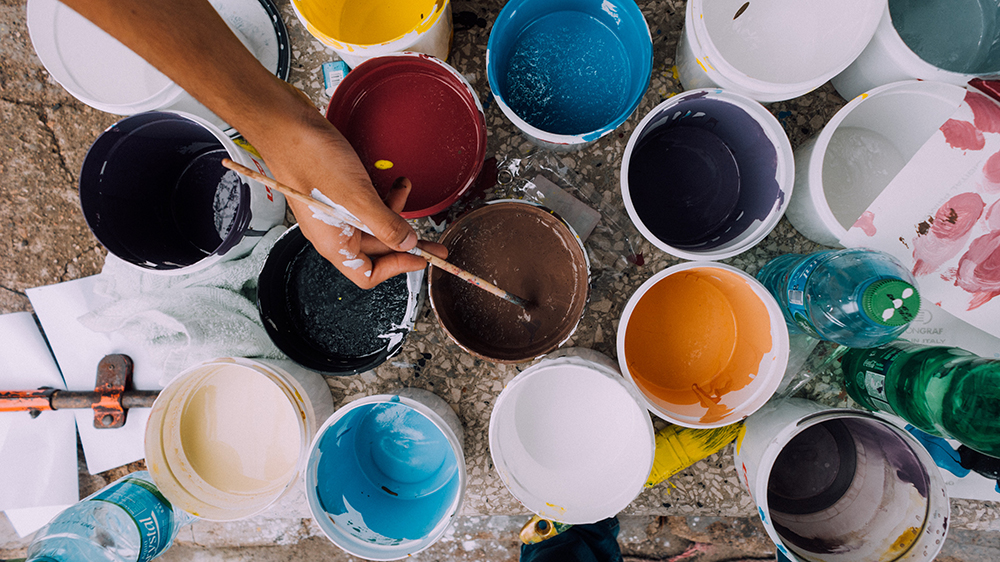
The therapeutic potential of abstract art is not confined to spectatorship. The explosion of contemporary art therapy, abstract painting workshops, and intuitive mark-making practices reflects a growing cultural understanding that the act of creating non-representational work — freed from the anxiety of whether one can draw, whether the result resembles anything, whether it is good — accesses states of flow and presence that conventional wellness approaches often cannot reach. Luxury wellness retreats in Tuscany, the Swiss Alps, and the Sonoran Desert now offer residency programmes in abstract painting alongside yoga and breathwork, recognising that the paintbrush held without expectation can dissolve self-consciousness as efficiently as any breathing technique.
The key liberation is precisely the absence of representational standard. One cannot fail at abstraction in the way one can fail to capture a likeness, and this removal of failure as a possibility creates what psychologists call a psychological safety that allows genuine expression to emerge. The smear of burnt sienna across a white surface, the drag of a palette knife loaded with cerulean — these are not artistic decisions so much as honest impulses, and their expression, however the resulting work looks, carries the relief of self-disclosure without the vulnerability of language.
Collecting as Curative Practice
For those who bring abstract works into their homes, the therapeutic relationship deepens over time in ways that collectors consistently report but find difficult to articulate. A painting that seemed merely beautiful on acquisition reveals, over years of daily coexistence, new qualities of light and surface; becomes associated with particular states of mind; functions as a kind of mirror for the shifting moods of its owner. The Abstract Expressionists spoke of wanting their paintings to be experienced the way music is experienced — not once, from a fixed distance, but repeatedly, continuously, in the changing weather of daily life. This ambition, now fully realised in the homes of serious collectors, suggests that the healing properties of abstract art are cumulative: the longer the relationship, the deeper the resource.
To live with great abstract art is to live in a space that consistently returns you to your senses — that interrupts the compulsive forward motion of contemporary life and insists, quietly but persistently, on the present moment. In this sense, a significant painting on a living room wall is not a decorative object but a daily contemplative practice: an invitation, always available, to put down the narrative of one’s own life briefly and simply be in the presence of something that asks nothing of you except that you look.