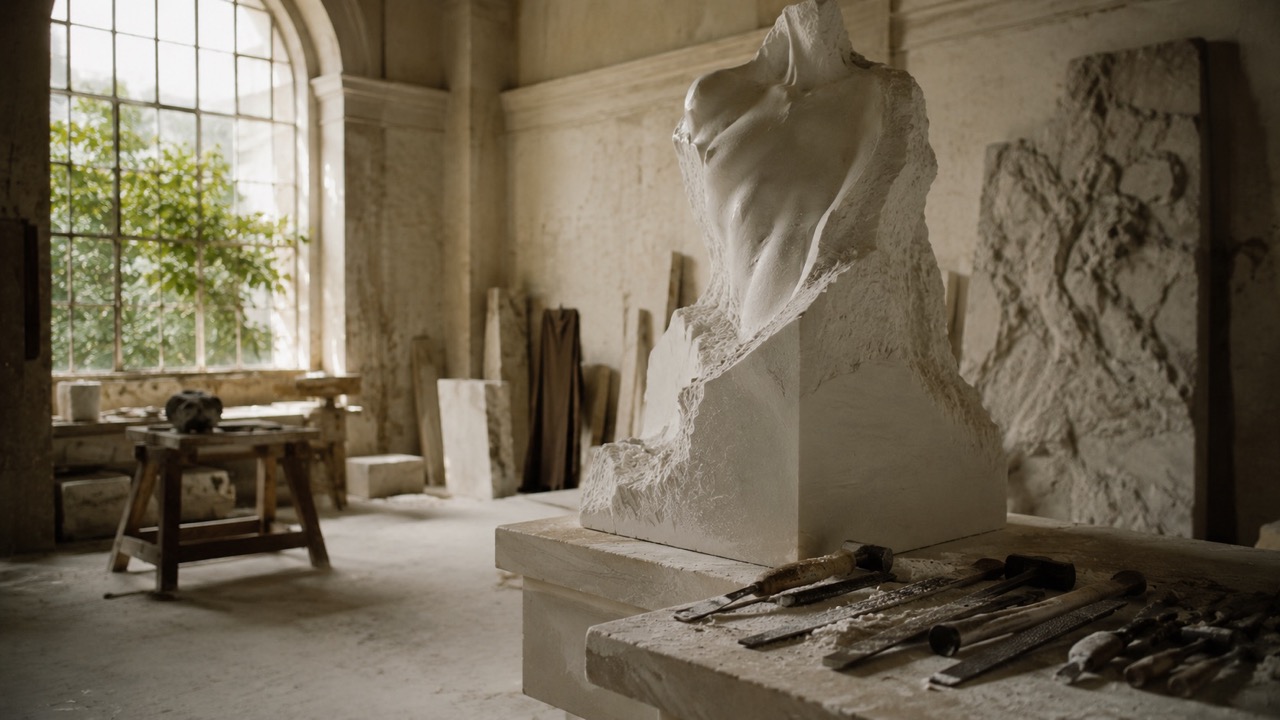
The decision arrives quietly, usually in one’s twenties, sometimes later, occasionally with the force of a conversion experience but more often as a slow accumulation of certainty: I will make things. I will make things even though the world has not asked me to, even though the compensation will be uncertain, even though the years between beginning and recognition — if recognition comes at all — will be filled with a particular quality of doubt that people in other professions never know.
The Economics of Invisibility
Marina Abramović performed for twenty years before the art world granted her the status her work demanded. Those two decades included periods of genuine poverty — heating turned off, meals skipped, the quotidian humiliations of a life organised around a practice that the market had not yet decided to value. When recognition finally arrived, it arrived completely, as it often does in the arts: a sudden consensus that what had been marginal was in fact essential. But the years of invisibility were not preparation for success. They were the work itself, and they exacted their price in ways that retrospective narratives of triumph tend to obscure.
Jean-Michel Basquiat compressed an entire career into eight years of ferocious intensity, moving from sleeping in cardboard boxes in Tompkins Square Park to selling paintings for millions, dead at twenty-seven from a heroin overdose. His trajectory is often romanticised — the outsider genius discovered and celebrated — but the speed of his rise reflected not merely talent but a market hungry for exactly what he offered at exactly that moment. The countless artists of equivalent talent who were not positioned at that precise intersection of zeitgeist and opportunity remain unnamed.
The Gallery System and Its Gatekeepers
For visual artists, the gallery system remains the primary mechanism by which work reaches collectors and institutions. Its economics are brutal: a gallery takes fifty per cent of any sale. In exchange, it provides exhibition space, critical advocacy, and access to collectors. For the artist who lacks gallery representation — which is to say, the vast majority of practising artists — the path to a sustainable practice runs through a landscape of alternatives, none entirely satisfactory: open studios, artist-run spaces, online platforms that democratise access but collapse context, academic positions that provide salary but consume creative energy.
The residency circuit offers breathing room — weeks or months at institutions from Yaddo to the Chinati Foundation, where living costs are covered and time is freed for work. But residencies are temporary by nature, and the artist’s life between them must be funded by other means: teaching, commercial work, the kindness of partners whose steady employment subsidises the uncertainty of creative practice. This last arrangement — so common as to be almost universal — is rarely discussed, though it represents one of the art world’s most significant invisible subsidies.
What “Making It” Actually Looks Like
The mythology of artistic success imagines a binary: obscurity and then fame, poverty and then wealth. The reality for most practising artists who achieve sustainability — not stardom, merely the ability to continue working without external subsidy — is far more gradual and far less glamorous. It might mean, at forty-five, earning enough from a combination of sales, teaching, and commissions to rent a studio and live without anxiety. It might mean recognition within a specialist community but complete anonymity beyond it.
For writers, the economics are even more compressed. Advances for literary fiction have declined in real terms for decades. The median income from writing for a published author in most countries hovers below the poverty line. Poetry, the art form closest to music in its direct address to human consciousness, offers almost no economic return whatsoever. Poets teach, or they have other careers, or they are supported by those who love them. The poem itself generates nothing but the poem.
The Compulsion Beyond Reason
Why, then, does anyone choose this? The honest answer is that for genuine artists, the choice does not feel like a choice. The compulsion to make — to give form to perception, to wrestle experience into material expression — precedes any rational calculation of reward. This is not romantic mystification. It is a description of a neurological reality: certain people are constituted such that the act of creation is not optional but necessary, and the cost of not creating exceeds the cost of creating without reward.
What the world owes its artists is a question that every civilisation answers differently. Patronage systems, public funding, market mechanisms, academic sinecures — each represents a different theory of how creative work should be sustained. None is adequate. All are necessary. The artist’s wager — that the work matters, that someone will eventually recognise its value, that the years of invisible labour are not wasted — is renewed each morning in studios and garrets and rented rooms across the world, by people whose stubbornness in the face of indifference constitutes either the highest form of faith or the most magnificent form of folly.
Perhaps it is both. Perhaps the inability to distinguish between the two is precisely what makes an artist.