
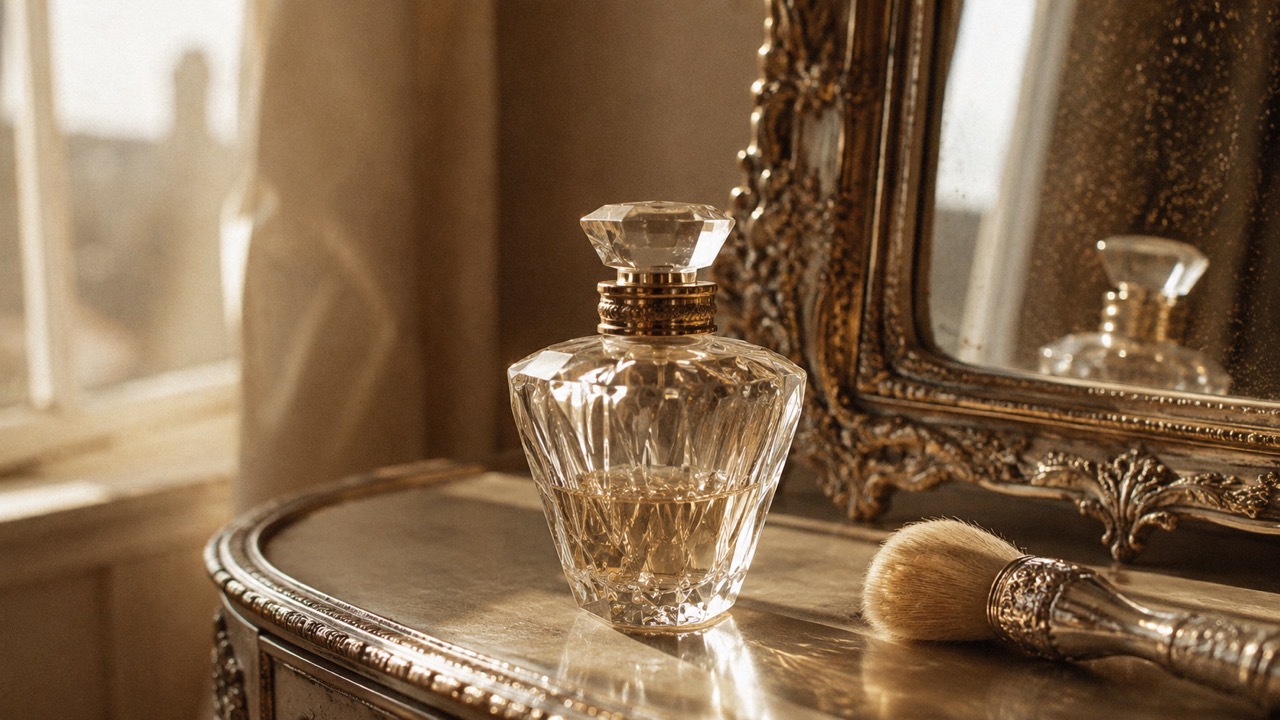
Of all the decisions one makes in the construction of a personal aesthetic, none is more intimate or more enduring than the choice of a signature scent. Clothing can be changed, jewellery exchanged, hair reimagined overnight — but fragrance, once applied, enters into a conversation with the body’s own chemistry that is entirely private, entirely unique, and entirely irreversible for the hours it persists. A signature scent is not merely something one wears; it is something one becomes, in the olfactory memory of every person who encounters it. The finding of that scent is, properly understood, an act of profound self-knowledge.
The Language of the Nose
To navigate the world of fine fragrance with genuine confidence requires a working vocabulary that most of us were never taught. The perfumer’s language — top notes, heart notes, base notes, the distinction between an eau de toilette and an extrait de parfum, the difference between a chypre and a fougère — is not arcane mystification but a practical grammar for describing olfactory experience with sufficient precision to be useful. Top notes are the first impression, the opening flourish that often bears little resemblance to what the fragrance becomes once the more volatile compounds have evaporated. It is the heart — the character that emerges after fifteen minutes on the skin — and the base — the foundation that endures for hours — that reveal whether a fragrance is truly one’s own.
The great fragrance families offer a map for orientation. Florals, from the powdery rose of a classic Parisian perfume to the green, dewy freshness of a modern white floral, span an enormous range of character. Chypres — built on the tripod of bergamot, labdanum, and oakmoss — carry an earthy sophistication that has defined feminine elegance since François Coty’s Chypre of 1917. Orientals, warm with vanilla, amber, and resinous woods, have an enveloping sensuality that the cooler aromatic and citrus families deliberately resist. Knowing which family moves one’s pulse is the beginning of a real search.
The Art of the Discovery Edit
The approach most likely to produce a genuine discovery — as opposed to a purchase driven by packaging or advertising — is the discovery set, offered by the finest fragrance houses as a curated introduction to their range. These collections of small samples, properly tested over multiple days rather than evaluated at a counter in the artificial atmosphere of department-store perfumery, allow a fragrance to reveal itself through the full arc of its development and in the particular chemistry of one’s own skin.
The rules of serious fragrance testing are few but important. Never evaluate more than three fragrances in a single session — olfactory fatigue sets in quickly, and the nose that has encountered seven fragrances cannot assess the seventh fairly. Test on skin rather than paper: the warmth and acidity of the body profoundly alter a fragrance’s development, and a strip of blotting paper tells only the most preliminary chapter of the story. Return to a fragrance on the second day, when memory and nose are both fresh, and the verdict will be more reliable than any first impression.
The Houses Worth Knowing
The landscape of fine fragrance divides broadly between the historic grand maisons and the more recent phenomenon of niche perfumery. The grand maisons — Guerlain, founded in 1828 and still producing fragrances of genuine complexity; Hermès, whose in-house perfumer Jean-Claude Ellena redefined what restraint could achieve in olfactory terms; Chanel, whose No. 5 remains the most analysed fragrance composition in history — offer the assurance of craft accumulated over generations and the particular pleasure of wearing something that carries real cultural weight.
Niche perfumery — represented by houses such as Frédéric Malle, whose Editions de Parfums present the work of named master perfumers with unusual transparency; Diptyque, whose literary and artistic references give its fragrances a specific cultural personality; and the Italian house Acqua di Parma, whose colognes carry the distilled essence of Milanese elegance — offers something different: greater originality, smaller production, and often a more direct relationship between the perfumer’s intention and the finished composition. The most rewarding wardrobes often draw from both traditions.
Skin Chemistry and the Myth of Universality
No fragrance smells the same on two skins, which is simultaneously the most frustrating and most liberating truth about perfumery. The sebum content of the skin, its pH, its natural flora — all alter the fragrance’s chemistry in ways that cannot be predicted from a bottle or a blotting strip. A rose fragrance that reads as powdery and nostalgic on one person becomes green and alive on another; a woody oriental that projects with smoky authority on one skin retreats to a quiet intimacy on a drier complexion. This variability is not a defect but a feature — it means that a signature scent, found through patient exploration, is genuinely one’s own in a way that no other aesthetic choice quite achieves.
The Signature Found
The moment of recognition — when a fragrance, tested properly over time and encountered on one’s own skin rather than another’s imagination, reveals itself as right — is not subtle. It is the olfactory equivalent of a sentence that says precisely what one has always meant. The search for that moment, conducted with curiosity and patience and genuine attention to what the nose reports rather than what the marketing suggests, is among the most rewarding journeys of aesthetic self-discovery available. The signature scent, once found, becomes part of one’s presence in the world — a silent, persistent eloquence that no words are required to express.