
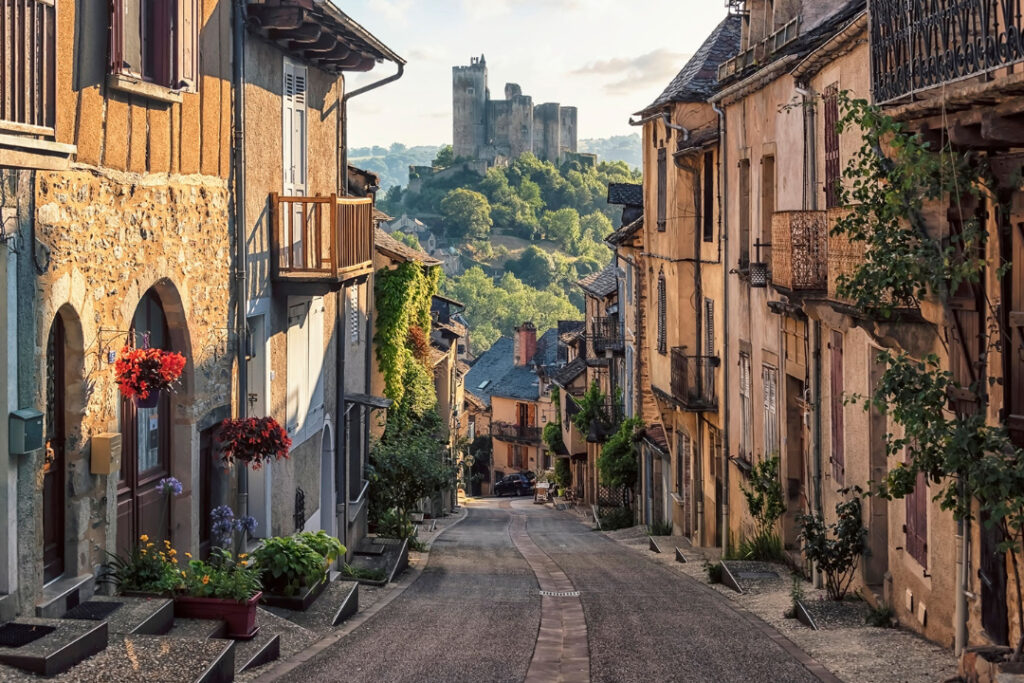
France does not merely exist as a destination. It exists as a disposition — a particular orientation toward pleasure, beauty, and the quality of daily life that other cultures have admired, envied, and attempted to replicate for centuries without quite capturing the original. The French relationship with the table, with the street, with light and stone and the arrangement of a room is not a matter of superiority but of deep cultural formation: a civilisation that decided, very long ago, that how one lives is as serious a question as what one achieves, and has been refining its answer ever since.
Paris: The City That Invented Itself
Paris is the only city in the world that functions simultaneously as a real place and as an idea of itself — and the remarkable thing is that the idea, for all its mythologisation, holds. The light on the Seine in early morning, silver and cool, with the booksellers’ stalls still shuttered and the cathedral rising from its island in a silence broken only by pigeons and the first cyclists: this is not a postcard. It is a lived experience available to anyone willing to wake before the city does. The city’s capacity to reward the early riser, the slow walker, the person without an itinerary, is essentially inexhaustible.
The great museums — the Louvre, the Musée d’Orsay, the Pompidou — need no introduction, but the city’s lesser-known collections repay equal attention. The Musée Jacquemart-André, housed in a nineteenth-century private mansion on the Boulevard Haussmann, contains one of France’s finest collections of Italian Renaissance painting in a domestic setting of extraordinary opulence. The Musée de la Vie Romantique, tucked into a cobbled lane in the ninth arrondissement, recreates the salon world of George Sand and Chopin with a delicacy that the great institutions, for all their grandeur, cannot match.
Burgundy: The Soul of French Terroir
To travel south from Paris into Burgundy is to enter the landscape that, more than any other, has defined the French understanding of place and its relationship to what it produces. The Côte d’Or — the golden slope — runs for fifty kilometres between Dijon and Beaune, its vineyards divided into appellations of medieval precision, each parcel of ground understood to produce something distinct from its neighbours. This is the birthplace of the concept of terroir, and to drive the Route des Grands Crus in autumn, when the Pinot Noir leaves have turned and the harvest is either complete or imminent, is to understand why the French regard their relationship with land not as agriculture but as culture.
Beaune itself, its medieval centre intact within Renaissance ramparts, offers the Hôtel-Dieu — the fifteenth-century charitable hospital whose polychrome tiled roofs are among the most photographed images in France — and a restaurant culture of remarkable consistency. Marc Meneau’s cooking at L’Espérance in Vézelay, the boeuf bourguignon served in a stone-flagged room in any village bistro of the region: both express the same fundamental conviction that the finest cooking begins with the finest ingredients and proceeds with the minimum of interference.
Provence: Light, Lavender, and the Art of Slow Time
Provence in July is the France of legend — lavender fields in full violet abundance, the cicadas’ continuous percussion, the particular quality of afternoon light that drove Van Gogh, Cézanne, and Matisse to a productive obsession. But Provence in October, when the tourists have retreated and the villages have returned to themselves, is the France that rewards the traveller who returns. The morning markets of Aix-en-Provence, with their stalls of local olives, fromage de chèvre, and the inevitable sachets of herbes de Provence, are at their most authentic in autumn. The Luberon’s hilltop villages — Gordes, Ménerbes, Bonnieux — are at their most beautiful when the summer’s haze has cleared and the light has the sharp, angled quality of the lower sun.
The restaurants of this region operate at a pace and with a directness that the great Parisian establishments sometimes sacrifice to ceremony. At a good table in the Luberon, lunch arrives without theatre and extends without apology into the middle of the afternoon, the rosé maintained at cellar temperature, the cheese brought at the moment of its proper ripeness. This is the Provençal table at its truest — not a performance of French cuisine but an expression of it.
The Atlantic Coast: Where France Meets the Sea
The stretch of Atlantic coastline from the Basque Country north through Les Landes to the Gironde is among France’s most underappreciated landscapes — a world of pine forest, surf beach, oyster bed, and estuary that produces some of the country’s finest seafood and its most celebrated wine. The oysters of Arcachon Bay, eaten at a wooden table on the waterfront with a glass of Entre-Deux-Mers, are a masterclass in the French principle that the finest food requires no elaboration: only freshness, quality, and the willingness to eat in the proper season.
Biarritz, the imperial resort that Napoleon III and Eugénie made fashionable in the 1850s, retains a faded grandeur that is, in the French manner, entirely unselfconscious. The grandes villas along the clifftop, the art deco casino, the long beach where surfers and promenaders coexist with complete mutual indifference: this is a France that has not tried to reinvent itself and is all the more beguiling for it.
France rewards, above all, the traveller who arrives without the pressure of completion — who understands that a country that has spent two thousand years perfecting the art of living cannot be absorbed in a fortnight, and that the most honest response to it is to choose one corner, stay long enough to stop feeling like a visitor, and allow it to reveal itself at its own unhurried pace.