
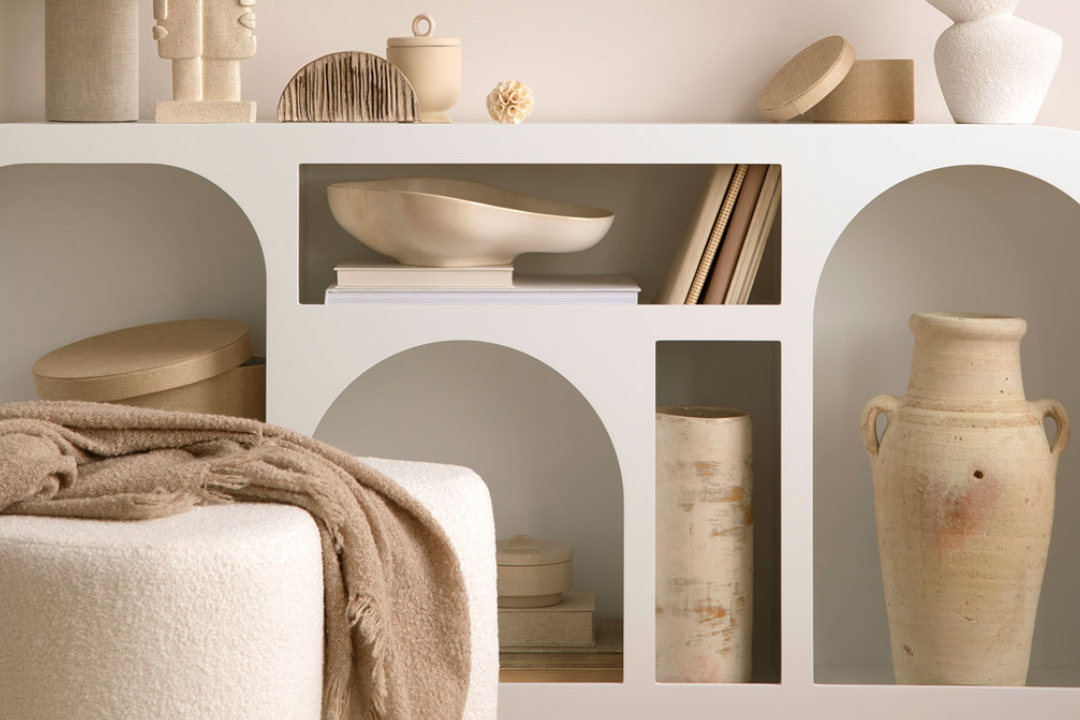
The most interesting interiors are never furnished; they are curated — assembled over years of looking, travelling, and the occasional moment of irrational conviction that a particular object, encountered in a particular place, belongs in a particular room. The Haussmannian chandelier that hangs in a Marais apartment above a Saarinen table, the Murano glass sconce that illuminates a hallway in a London townhouse alongside a collection of West African textiles, the Provençal iron lantern that presides over a farmhouse kitchen where it has witnessed sixty years of lunches — these are not decorative accessories. They are accents of heritage, and they carry within them the history of the places and traditions that produced them.
The Chandelier: Light as Architecture
A chandelier of quality does not merely illuminate a room; it organises it. The eye rises to meet it involuntarily, and everything beneath it — the table, the diners, the conversation itself — is arranged in relation to its presence. The great Haussmannian chandeliers of nineteenth-century Paris, with their cascades of cut crystal and their gilt-bronze armatures, were designed for rooms of specific proportion: the three-metre ceilings, the tall windows, the herringbone parquet that reflected their light upward. To hang one in a room of different character is not an act of imitation but of translation — the chandelier brings with it the memory of those proportions, and the tension between its original context and its new home is precisely what gives the room its interest.
Murano glass offers a different vocabulary entirely. The chandeliers of the Venetian island — hand-blown by masters whose families have worked glass for generations — trade crystal’s precision for organic fluidity: arms that curve like botanical specimens, flowers and leaves formed from molten glass in colours that exist nowhere else, a warmth of light that owes nothing to geometry and everything to the particular qualities of Murano’s silica and soda ash. A Barovier & Toso piece from the mid-twentieth century — the period many collectors regard as Murano’s modern golden age — introduces a note of Venetian exuberance that transforms the atmosphere of any room it enters.
The Sconce: Intimate Light, Vertical Interest
Where the chandelier commands the centre, the sconce defines the periphery. Placed at eye level along a corridor, flanking a mirror, or illuminating an alcove that might otherwise recede into shadow, sconces introduce vertical interest and a quality of light — close, warm, and personal — that overhead illumination cannot replicate. The finest antique sconces, whether Louis XV gilt-bronze with their rocaille curves, Georgian silver-plate with their restrained neoclassical lines, or the hammered-iron torchères of the Arts and Crafts period, were designed to hold candles, and even when electrified they retain the proportions and the intimacy of candlelight.
The contemporary interior benefits enormously from mixing periods: a pair of seventeenth-century Flemish brass sconces beside a work of contemporary art, a set of Gio Ponti–era Italian wall lights flanking a doorway in a nineteenth-century building. The principle is not eclecticism for its own sake but the cultivation of visual dialogue between objects that share a commitment to craftsmanship across different traditions and centuries.
The Lantern: Light That Travels
The lantern — whether the Provençal iron-and-glass variety that hangs in every serious farmhouse kitchen between Avignon and Aix, the Moroccan pierced-brass specimen whose perforations cast geometric shadows across whitewashed walls, or the clean-lined ship’s lantern that carries within it the memory of maritime journeys — is perhaps the most versatile of heritage lighting pieces. Unlike the chandelier, which demands a room of certain scale, the lantern adapts: hung low over a kitchen island, suspended in an entrance hall, placed on a console to cast its light sideways, or mounted on an exterior wall where it welcomes arrivals with a warmth that no modern fixture quite manages.
Textiles as Accent: The Overlooked Heritage Layer
Beyond lighting, the heritage accent that most immediately transforms a space is the textile: a Suzani from Bukhara, its silk embroidery depicting pomegranates and celestial motifs with a chromatic intensity that five centuries of Western textile production have rarely equalled; a vintage Kuba cloth from the Democratic Republic of Congo, its geometric cut-pile raffia patterns anticipating Modernist abstraction by several hundred years; a length of hand-blocked Provençal cotton from the Souleiado archive, draped over a daybed or framed as the artwork it manifestly is. These textiles carry within them the labour of specific hands, the aesthetic intelligence of specific cultures, and a relationship to colour and pattern that mass production has rendered rare.
The cultivated interior does not match its accents — it converses them. The Murano sconce beside the Malian mudcloth, the Georgian candlestick atop the Japanese tansu, the Persian garden carpet beneath the Le Corbusier chaise: these juxtapositions work not because they follow a decorating formula but because each object has been chosen for the seriousness of its making and the depth of its cultural inheritance. Heritage, in the hands of the discerning collector, is not a style. It is a principle of attention.