
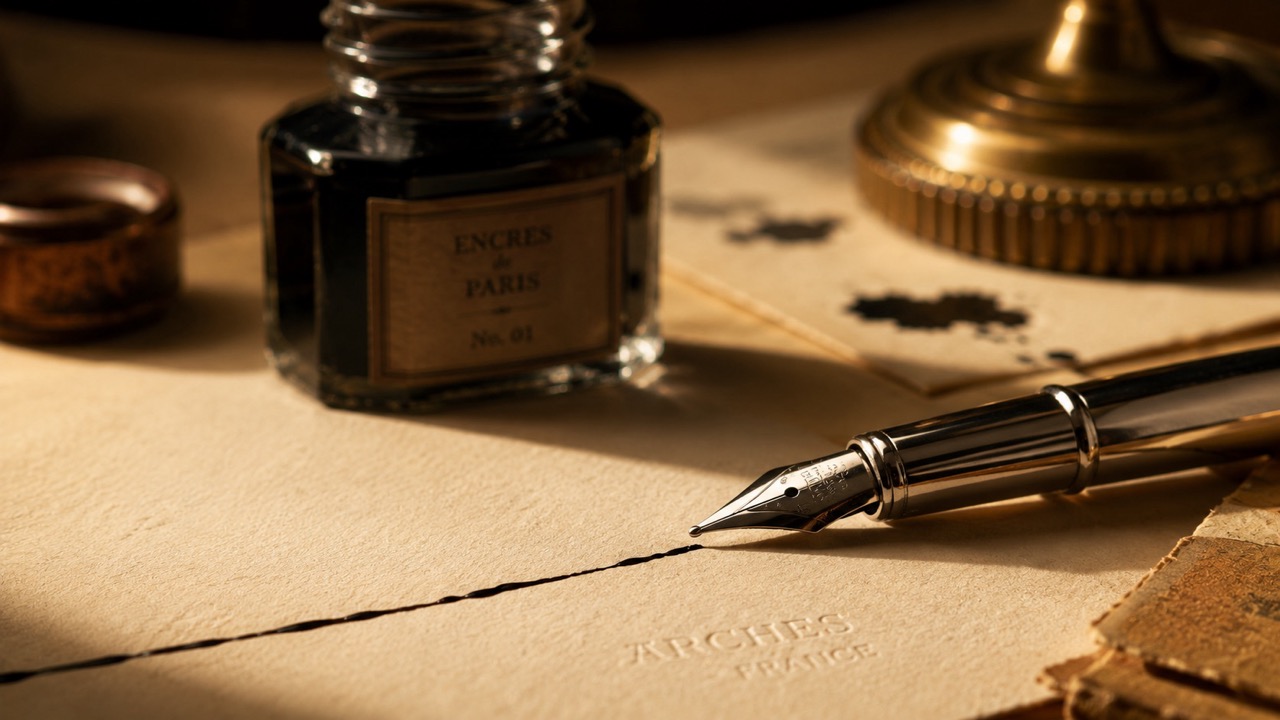
The handwritten letter is an anachronism, and that is precisely its power. In an environment of instantaneous digital communication — where a message can be composed, sent, received, and responded to in the time it takes to uncap a fountain pen — the act of writing by hand, on paper, with ink, is a deliberate refusal of efficiency in favour of something more valuable: the physical evidence of attention. A letter written by hand says what its words say; it also says, by its very existence, that the writer considered the recipient worth the investment of time, thought, and the particular form of vulnerability that handwriting, with its visible imperfections, inevitably exposes.
The Materials: Where Quality Begins
The stationery one writes on communicates before a word is read. A sheet of cotton-fibre paper from Pineider in Florence — the house that has supplied stationery to the Vatican, the Italian government, and the most discerning private clients since 1774 — possesses a weight, a texture, and a receptivity to ink that immediately signals seriousness of intent. Smythson of Bond Street, whose pale-blue paper has been a marker of English epistolary taste since the 1880s, offers a different register: lighter, crisper, with a formality that suits the British tradition of correspondence. G. Lalo in Paris produces papers of such quality and such beautiful colour — the oyster white, the pearl grey, the pale blue that the French call bleu nattier — that the empty page is itself an object of pleasure.
The pen matters correspondingly. A fountain pen — the instrument that connects the modern letter-writer to the tradition of handwritten correspondence most directly — produces a line whose character varies with the pressure of the hand, the angle of the nib, and the flow of the ink in a way that no ballpoint or rollerball can replicate. The nib, over time, wears to the angle of its owner’s hand, becoming a personalised instrument as specific as a musician’s embouchure. A Pelikan Souverän, a Montblanc Meisterstück, a Pilot Custom — each produces a writing experience of different character, and the choice of pen, like the choice of paper, is a form of self-expression that the recipient perceives even if they cannot articulate it.
The Art of the Letter: Structure and Tone
The well-written letter follows a structure that centuries of epistolary practice have refined into something close to an art form. The opening — warm, direct, establishing the occasion for writing — sets the tone. The body develops a thought, shares a piece of news, describes an experience, or expresses a sentiment with the kind of deliberation that the letter’s physical constraints encourage: when every word must be formed by the hand, the temptation to pad, to digress, to include the irrelevant diminishes naturally. The close — warmer than the opening, looking forward to the next communication or the next meeting — leaves the reader with the sensation of having been in someone’s company rather than having received their information.
The Letter as Object
The handwritten letter possesses a quality that no digital communication can match: it is an object. It can be held, folded, placed in a drawer, discovered years later and reread with an emotion that the original sending did not produce. The letters of Virginia Woolf, of Keats, of Flaubert — now published as literature in their own right — survive because they were written on paper, in ink, by a hand whose movements are still legible on the page. The email archive, by contrast, is a utility: searchable, efficient, and devoid of the physical presence that transforms communication into artefact.
The revival of interest in letter-writing — visible in the proliferation of stationery boutiques, calligraphy workshops, and correspondence societies — reflects not nostalgia but a recognition that certain forms of human connection require a medium that resists speed, demands attention, and leaves a physical trace. The handwritten letter is not a replacement for digital communication. It is its complement — the slow channel, the considered gesture, the ink-and-paper evidence that someone, somewhere, thought carefully about what they wanted to say and chose the most deliberate possible way of saying it.