
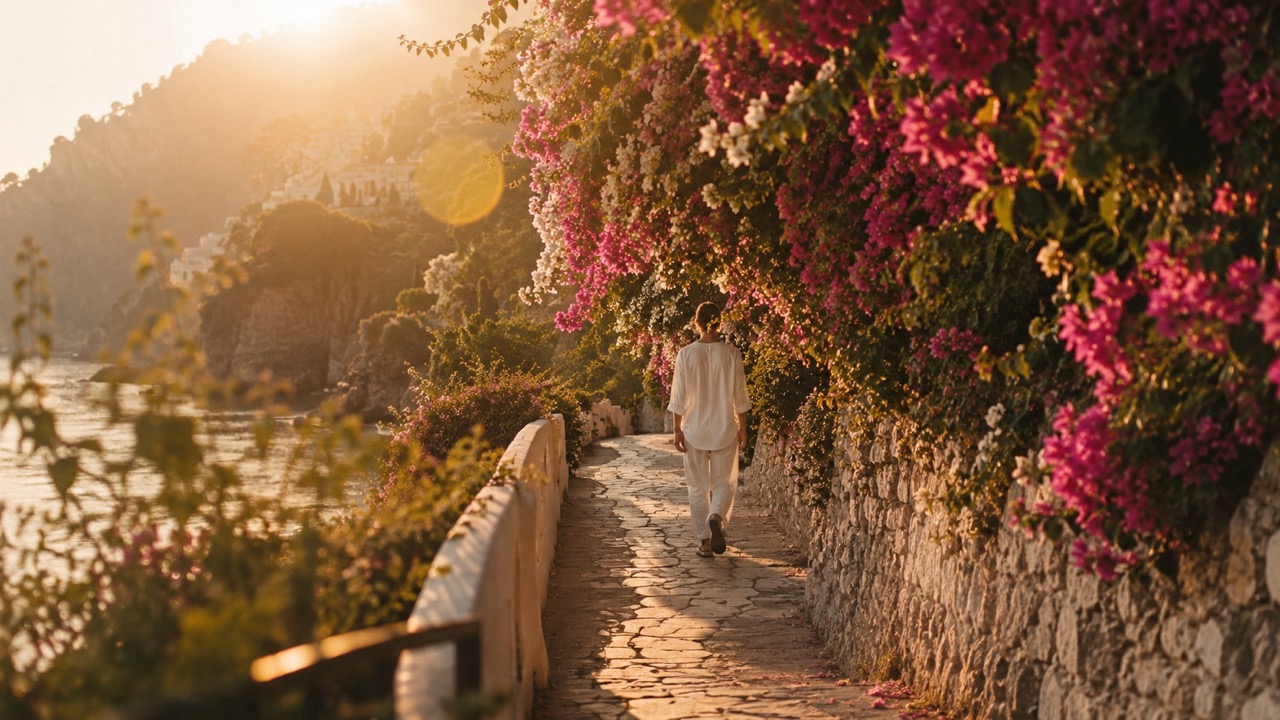
The Côte d’Azur earned its reputation honestly — the light above Antibes, the water off Cap Ferrat, the plane trees of Saint-Paul-de-Vence are as beautiful as their legend insists — but the coastline’s celebrity has, over the decades, produced a particular paradox: the most famous riviera in Europe has become, in high season, one of the most difficult places in Europe to experience the qualities that made it famous. The quiet cove, the undiscovered restaurant, the afternoon of private communion with the Mediterranean — these are available, but they require more effort, more expense, and more tolerance for traffic than they once did. The informed traveller looks elsewhere. Europe’s coastlines, it turns out, contain rivieras of comparable beauty that the world’s attention has not yet overwhelmed.
The Ligurian Coast: The Côte d’Azur’s Italian Twin
The coastline that runs from the French border to La Spezia — passing through Ventimiglia, San Remo, the Cinque Terre, and the port of Genoa — is, geologically and aesthetically, a continuation of the Côte d’Azur into Italy, with one crucial difference: it has not been subject to the same intensity of development. Portofino excepted — which has, by any measure, achieved a level of celebrity equal to Saint-Tropez — the Ligurian coast retains stretches of genuine tranquillity. Camogli, a fishing village of painted façades and pebble beaches whose beauty has not yet been compromised by its proximity to Portofino, offers a quality of coastal life that the Riviera lost a generation ago. Lerici, at the southern end, where Shelley drowned and Byron swam, combines literary association with a seafront of considerable charm and restaurants whose focaccia di Recco and pesto alla Genovese represent the Ligurian kitchen at its finest.
The Dalmatian Coast: Where Venice Meets the Adriatic
The Croatian coastline between Zadar and Dubrovnik — a thousand kilometres of islands, inlets, and walled towns whose architecture reflects four centuries of Venetian influence — is arguably the most beautiful in the Mediterranean and, outside the peak months of July and August, among the most peaceful. The island of Vis, which served as a Yugoslav military base until 1989 and was therefore closed to tourism during the decades when the rest of the Adriatic was being developed, has emerged as a destination of exceptional character: vineyards producing the indigenous Vugava grape, fishing villages of crystalline simplicity, and a quality of water that the overpopulated beaches of the northern Adriatic cannot match.
Hvar, better known but still manageable outside high season, combines a Renaissance town square of Venetian elegance with lavender fields, olive groves, and a coastline whose swimming coves are accessible by boat and largely free of crowds. The Pelješac Peninsula, north of Dubrovnik, produces the Plavac Mali wines that represent Croatia’s most serious contribution to European viticulture, and its oyster beds at Ston yield bivalves of a quality that the oyster capitals of France and Ireland would not dismiss.
The Alentejo Coast: Portugal’s Secret Shoreline
South of Lisbon, the Portuguese coastline turns wild. The Alentejo Litoral — protected as the Vicentina Natural Park, which limits development with a strictness that would be unimaginable on the Algarve — presents a landscape of dramatic cliffs, empty beaches, and a surf whose power has attracted a community of riders who value the waves precisely because they are shared with so few others. The fishing villages of Porto Covo and Vila Nova de Milfontes retain a character that the Algarve’s resort towns abandoned decades ago, and the cuisine — built on extraordinary seafood, the black pork of the Alentejo interior, and wines from the nearby Alentejo DOC that represent some of the finest value in European viticulture — rewards the traveller who comes for the table as richly as the one who comes for the beach.
The Peloponnese: Greece Beyond the Islands
The Greek mainland’s southeastern peninsula — the Peloponnese — contains a coastline of such variety and such quality that its relative obscurity, compared with the Cycladic and Ionian islands, constitutes one of the great oversights in Mediterranean travel. The Mani peninsula, whose tower villages and Byzantine churches cling to a landscape of austere, almost lunar beauty, offers a Greece that the postcards of Santorini have entirely occluded. Monemvasia, a medieval fortress town built on a rock that juts from the sea like a miniature Gibraltar, is among the most dramatic townscapes in the Mediterranean. Nafplio, the first capital of modern Greece, combines neoclassical architecture, a Venetian fortress, and a waterfront of genuine elegance with a gastronomic scene that rivals that of any Cycladic island.
The forgotten rivieras share a quality that the famous ones have lost: the sensation that the beauty of the coastline is not a commodity being sold but a fact of geography that the visitor is privileged to encounter. This quality — the feeling of discovery, of being somewhere that the world has not yet processed into a brand — is, for the discerning traveller, the most valuable thing a coastline can offer.