
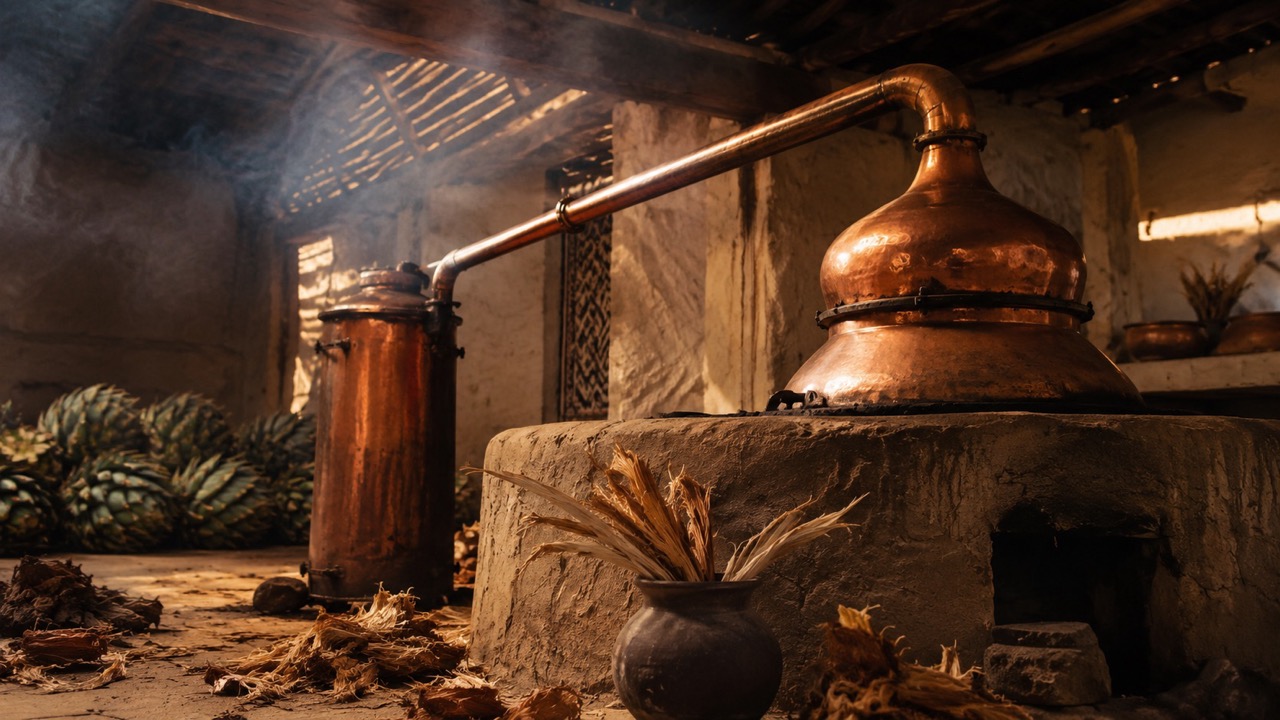
In the villages that surround Oaxaca City — Santiago Matatlán, San Baltazar Guelavila, Santa Catarina Minas — the production of mezcal has been a continuous practice for longer than anyone can precisely date. The agave is roasted in an earthen pit lined with volcanic rock, crushed by a stone tahona pulled in circles by a horse or a mule, fermented in open wooden vats colonised by wild yeasts specific to each palenque’s microclimate, and distilled in copper or clay stills whose design is a family inheritance. The resulting spirit — smoky, complex, varying dramatically from one maestro mezcalero’s hillside to the next — is among the most terroir-expressive things produced by human hands. That this ancient, artisanal spirit has, within the past fifteen years, conquered the cocktail menus of the world’s finest bars is a story about taste, authenticity, and the cyclical nature of the world’s relationship with the genuine article.
The Agave: A Plant of Extraordinary Patience
The espadín agave, the species most commonly used for mezcal production, requires seven to ten years to reach maturity — a timeline that would make any agricultural investor flinch and that gives the spirit its first layer of cultural meaning. A bottle of mezcal contains within it a decade of growth, of seasons, of the specific rainfall and soil and sunlight of the hillside where the plant was grown. The rarer agave species — Tobalá, which grows wild on rocky hillsides and requires twelve to fifteen years; Tepeztate, which can take twenty-five years to reach harvest; Madrecuixe, whose enormous rosettes produce a spirit of floral delicacy — extend this timeline into the territory of generational investment. A maestro mezcalero who plants Tepeztate is planting for his children.
The Palenque: Where Craft Meets Terroir
The palenque — the small, open-air distillery where mezcal is produced — is not a factory but a landscape feature, integrated into the terrain from which it draws its raw materials. The pit where the agave hearts are roasted is dug into the earth. The tahona that crushes them is carved from local stone. The fermentation vats are made from the wood of local trees, their surfaces colonised by yeasts that exist nowhere else. The result is a spirit that is, in the most literal sense, a product of its place — and the differences between mezcals produced by different palenques, even those using the same agave species in the same village, are as pronounced and as terroir-driven as the differences between wines from neighbouring Burgundian vineyards.
The Bar Revolution
Mezcal’s entry into the world’s cocktail bars began in Mexico City’s mezcalerías — bars dedicated to the spirit, where the ritual of tasting was conducted with the seriousness it deserved: small clay copitas, slices of orange dusted with sal de gusano, the smoky complexity of the spirit explored across multiple expressions rather than buried in a mixer. The bar culture that has since developed around mezcal in New York, London, Tokyo, and beyond has maintained something of this reverence, and the best mezcal bars — Mezcalería Oaxaca in the city of the same name, Ghost Donkey in New York, Quiquiriquí in London — treat the spirit with a curatorial intelligence that matches the connoisseurship of a wine bar.
The cocktail applications, when handled with skill, demonstrate mezcal’s extraordinary versatility: the smoky complexity that makes it a transformative substitute for whisky in an Old Fashioned, the herbal and citrus affinities that make it a natural partner for agave syrup and lime, the depth that it adds to a Negroni variation. But the greatest mezcal cocktail — if such a ranking is permissible — may be the simplest: mezcal, a squeeze of lime, a pinch of sal de gusano, and a few drops of agave syrup, served in a clay copita with the respect that any spirit of this complexity deserves.
The Question of Sustainability
Mezcal’s global success has created a tension that the industry is still resolving. The wild agave species — Tobalá, Tepeztate, Madrecuixe — grow slowly, reproduce unpredictably, and cannot be cultivated with the efficiency that industrial demand requires. The responsible producers have responded with replanting programmes, sustainable harvesting practices, and a commitment to transparency about the age and provenance of their agave that gives the informed consumer the information needed to drink responsibly in the ecological sense. The principle is simple: mezcal worth drinking comes from producers who care as much about the hillside as they care about the spirit, and the connoisseur who learns to identify those producers — by certification, by reputation, by the quality of the liquid in the glass — participates in the preservation of a tradition that deserves to survive its own popularity.