
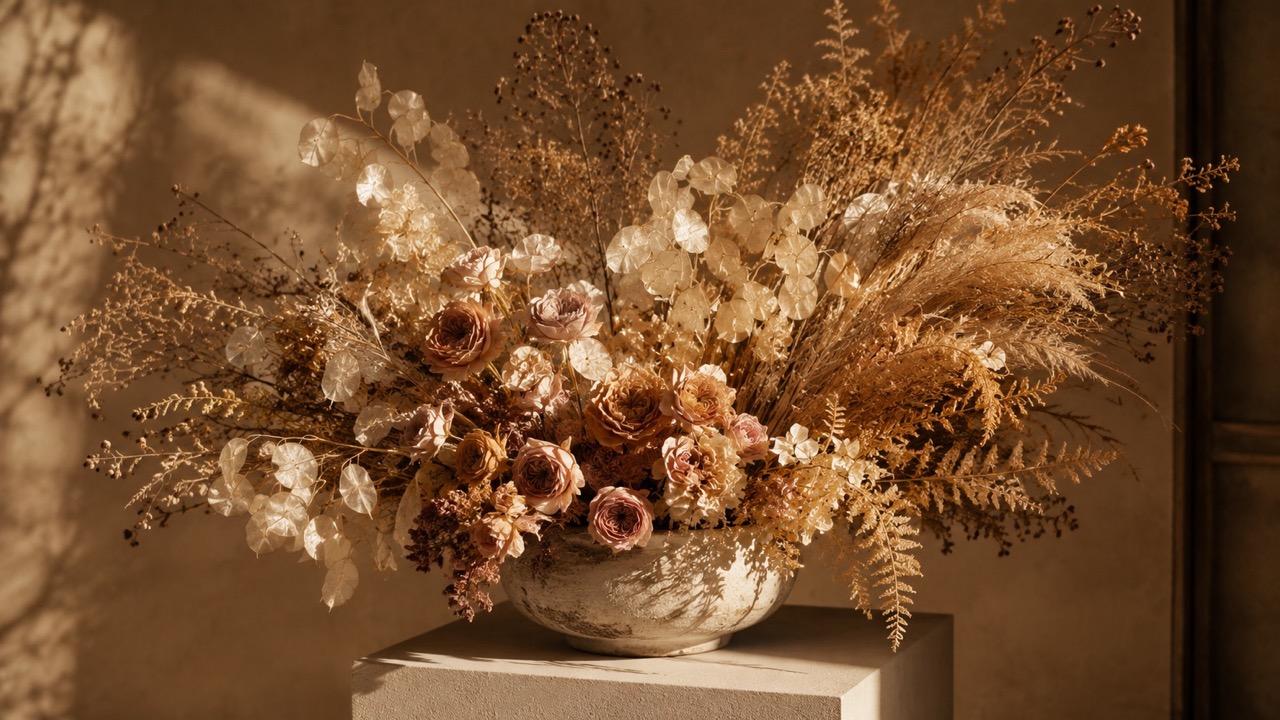
There is a point at which the arrangement of flowers in a vessel ceases to be floristry and becomes something else — art, sculpture, installation, performance — and the practitioners working at that point are redefining not merely what flowers can look like but what they can mean. The new botanical artists have abandoned the symmetry, the colour-matching, and the structured abundance of traditional floristry in favour of compositions that draw on contemporary sculpture, ikebana, land art, and the particular beauty of botanical imperfection: the bent stem, the wilting petal, the seed head past its prime, the moss-covered branch that carries within it the visible passage of time.
Azuma Makoto: Botany as Extreme Art
The Japanese floral artist Azuma Makoto has sent a bonsai tree into the stratosphere, submerged botanical arrangements beneath the ocean’s surface, and frozen flowers in blocks of ice to document their slow dissolution as the ice melts — projects that treat the flower not as a decorative element but as a medium for exploring the fundamental conditions of existence: gravity, pressure, temperature, time, decay. His Tokyo studio, Jardins des Fleurs, produces commercial work of extraordinary refinement, but his art projects — documented in photographs of hallucinatory beauty — have repositioned the flower as a contemporary art material as serious and as rich in meaning as paint, clay, or film.
Fjura: The London School of Botanical Emotion
Simone Gooch’s London studio Fjura operates at the intersection of floristry, art direction, and emotional intelligence. Her compositions — often for editorial shoots, fashion houses, and private events — reject the idea of the “flower arrangement” in favour of what she calls “living sculpture”: installations that respond to the architecture of their setting, the emotional register of the occasion, and the specific character of the botanical material available in that particular week of that particular season. Gooch works exclusively with seasonal, British-grown flowers, a constraint that produces compositions whose colour palette, texture, and character change throughout the year with a fidelity to the calendar that industrial floristry — with its globally sourced, artificially preserved, perpetually available inventory — has entirely abandoned.
Thierry Boutemy: The Florist of Couture
Boutemy, whose Belgian studio has produced floral work for Dries Van Noten, Martin Margiela, and the film industry (his arrangements appear in Sofia Coppola’s Marie Antoinette), brings a painter’s sensibility to botanical composition. His work privileges atmosphere over arrangement: masses of a single species creating a monochromatic field of texture and scent, loose cascades that suggest a garden overtaking an interior, compositions of such deliberate wildness that they appear to have grown in place rather than been placed by a hand. The effect — naturalistic, abundant, never fussy — has influenced an entire generation of floral designers and has contributed significantly to the contemporary aesthetic that favours the apparently untouched over the obviously designed.
Ikebana’s Contemporary Evolution
The Japanese art of ikebana — flower arrangement as spiritual practice, as philosophical discipline, as a form of meditation conducted with botanical materials — has undergone a contemporary evolution that has brought it into dialogue with Western contemporary art. The Sogetsu school, founded by Sofu Teshigahara in 1927 with the explicit intention of liberating ikebana from the formal constraints of the older schools, now counts practitioners whose work appears in contemporary art galleries and biennials alongside painting and sculpture. The principle that ikebana teaches — that the space around the flower is as important as the flower itself, that the negative space is not empty but active, that a single stem can carry as much meaning as a thousand blooms — has become one of the most influential aesthetic ideas of the contemporary period, visible in architecture, in interior design, in photography, and in the work of the Western botanical artists who have absorbed its lessons.
What these practitioners share — across their differences in culture, method, and aesthetic — is the conviction that the flower is not a decoration but a language, and that the act of arranging flowers with genuine artistic intent is not a minor art but a major one. The new florists have given the flower back its dignity, its complexity, and its capacity to speak about the things that matter most: beauty, time, impermanence, and the human need to hold the living world close, even — especially — in the knowledge that it will not stay.