
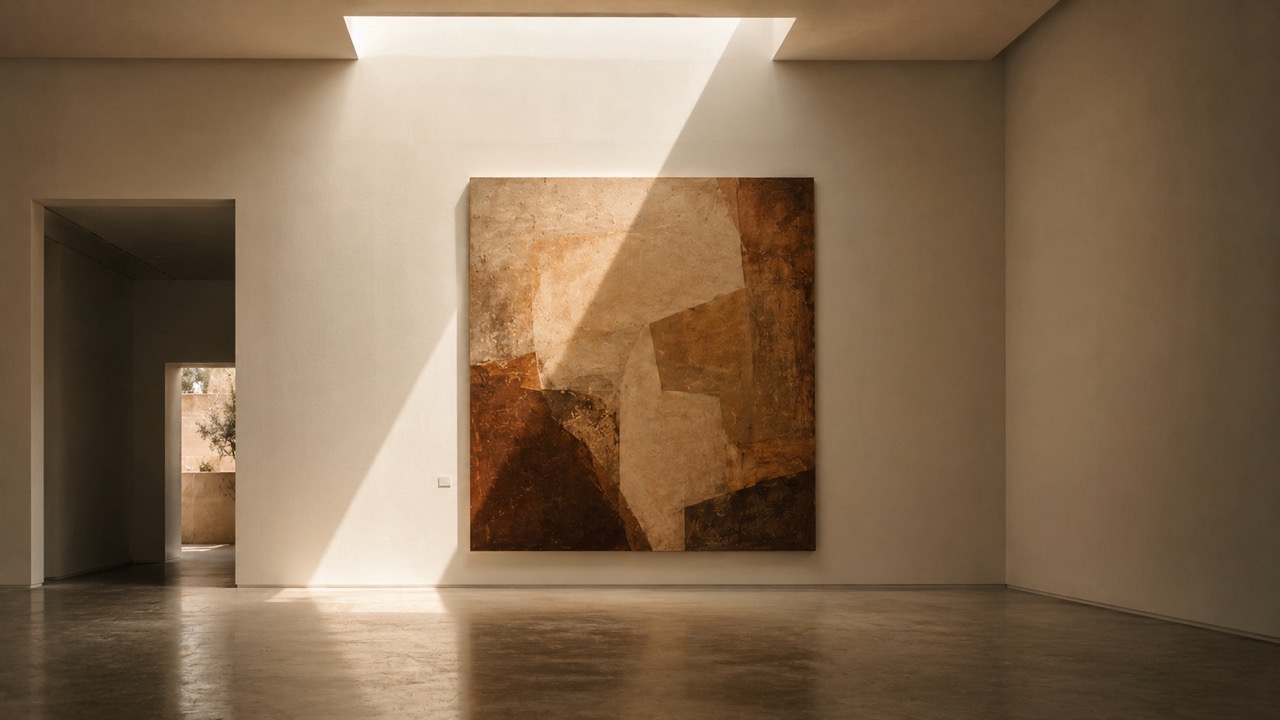
Silence, in architecture, is not the absence of sound. It is the presence of a specific spatial intention — a quality of enclosure, of proportion, of light, and of materiality that produces in the body an involuntary stillness. The breath slows. The shoulders drop. The internal monologue, that ceaseless narration that accompanies modern consciousness like a radio left on in another room, falls quiet. Buildings designed for contemplation achieve this effect not by accident but through centuries of accumulated knowledge about what spaces do to human attention — knowledge that the monastery, the library, and the sacred building have refined into an architecture of extraordinary psychological precision.
The Cistercian Inheritance
The Cistercian monks of the twelfth century built silence into stone with a rigour that anticipated minimalism by eight hundred years. The abbeys of Sénanque in Provence, Fontenay in Burgundy, and Le Thoronet in the Var — the three “sisters of Provence” that Le Corbusier visited repeatedly and described as the finest architecture in France — achieve their effect through calculated austerity: unornamented stone walls, proportions derived from musical intervals, windows placed to admit light at specific angles at specific hours, and an acoustic designed to amplify the resonance of plainchant while absorbing conversational speech. To stand in the nave of Le Thoronet is to experience a quality of attention that the building has been producing, in every visitor who enters, for nine centuries.
The Library as Secular Temple
The great libraries of the Enlightenment — the Bibliothèque Sainte-Geneviève in Paris, the Bodleian’s Radcliffe Camera in Oxford, the Real Gabinete Português de Leitura in Rio de Janeiro — understood that the room in which reading occurs is not a container for books but a participant in the act of reading. The Sainte-Geneviève, designed by Henri Labrouste in 1850, uses its iron-and-glass roof structure to create a quality of diffused, even light — neither bright enough to tire the eye nor dim enough to strain it — that is itself an argument for sustained attention. The room shapes the reading as surely as the text does.
The contemporary library has continued this tradition with resources that Labrouste could not have imagined. The Beinecke Rare Book & Manuscript Library at Yale, designed by Gordon Bunshaft in 1963, encloses its collection within walls of translucent Vermont marble that filter sunlight into an amber glow of extraordinary warmth. The Stuttgart City Library, Eun Young Yi’s luminous cube of 2011, achieves silence through geometric rigour and the colour white — floor, walls, ceiling, staircase, all in the same matte white that eliminates visual distraction and produces an environment of such spatial clarity that the mind, finding nothing to resist, simply opens.
The Japanese Meditation Room
The Japanese tradition of the meditation hall — the zendō — represents perhaps the most refined understanding of how a space can induce contemplative attention. The materials are specific: tatami matting, whose scent of dried rush grass and its slight give underfoot register below conscious awareness; shoji screens, whose translucent paper filters light into a quality that the novelist Tanizaki described as “the glow of grime” — a luminosity so soft that shadows become the dominant visual element; unfinished wood, whose grain and knots provide the only ornamentation the room requires. Tadao Ando’s Church of the Light in Ibaraki, while Christian in function, achieves its extraordinary power through means that are essentially Japanese: bare concrete walls, a single cruciform opening through which light enters with the dramatic intensity of a Caravaggio, and an austerity so complete that the visitor has nothing to contemplate but the light itself.
Peter Zumthor: The Contemporary Master of Silence
The Swiss architect Peter Zumthor has devoted his career to what he calls “the atmosphere” — the quality of a space that is perceived by the body before it is analysed by the mind. His Therme Vals, built into a mountainside in the Swiss Alps using locally quarried gneiss, produces a silence that is physical: the weight of the stone, the temperature of the water, the dim light filtering through narrow slots in the ceiling, and the acoustic — every sound muffled by water and absorbed by stone — combine to create an environment that suspends ordinary consciousness as completely as any meditation hall. His Bruder Klaus Field Chapel in Mechernich, a concrete tower formed by burning a timber scaffold and leaving the charred marks on the interior walls, achieves its contemplative effect through a single circular opening to the sky — a puncture of light in a dark, rough-walled space that makes the visitor feel simultaneously enclosed and connected to the infinite.
The architecture of silence teaches, by its example, that attention is not merely a mental state but a spatial condition — that the quality of the spaces we inhabit shapes the quality of the thought we are capable of producing within them. In an age of relentless stimulation, the buildings designed for contemplation offer not an escape but a correction: a reminder that the mind, like the body, requires environments calibrated to its deepest needs.